My Mother Gave Me 60 Days to Leave Grandma’s House—Then a Lawyer Revealed the Secret She’d Hidden for Nine Years
“You’ve got sixty days to pack your things, Bridget. After that, you’re on your own.”
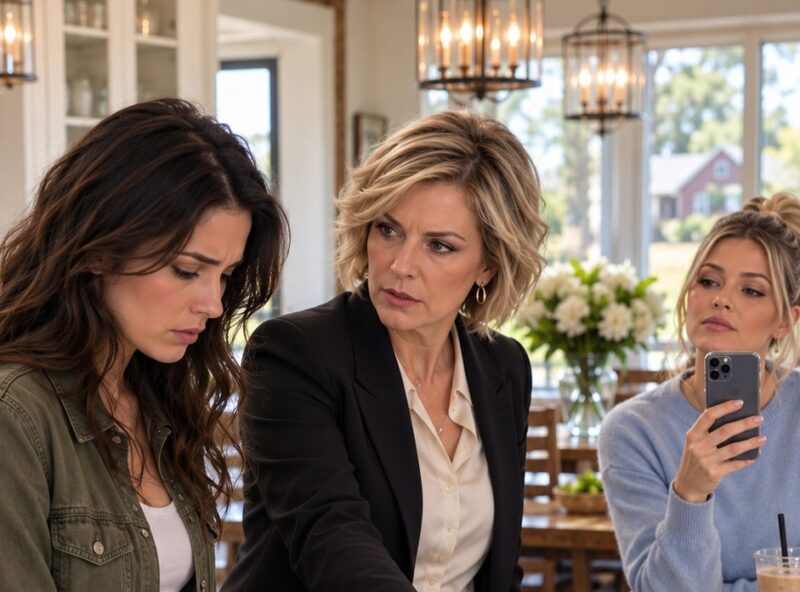
My mother dropped a real estate listing onto the kitchen table. The asking price was $385,000.
My younger sister, Presley, immediately raised her phone and started recording.
“Finally!” she laughed. “Thirty-four years old and about to find out what paying your own bills feels like!”
Mom smiled at her.
I didn’t say a word.
Instead, I walked upstairs, opened my dresser, and took out a small velvet pouch my grandmother had given me shortly before she died.
Inside was a tarnished brass key, a business card, and a sealed letter.
Forty minutes later, I was sitting across from an attorney named Arthur Finley.
After reading Grandma’s letter, he closed his office door.
“Bridget,” he said carefully, “your grandmother knew this day would come. And what I’m about to show you will change everything.”
My name is Bridget Summers. I’m thirty-four, and I spent most of my life feeling like an unwanted guest in my own family.
My mother, Yvonne, had two daughters.
Presley was her pride and joy.
I was the daughter expected to manage without help.
When Presley turned seventeen, Mom bought her a brand-new car.
For my birthday that year, I received a bus pass and a lecture about responsibility.
Presley enjoyed expensive vacations, designer clothes, and a college education paid for by our parents.
I worked two jobs to cover my tuition.
Whenever I asked why we were treated differently, Mom gave me the same answer.
“Your sister needs support. You’re strong enough to look after yourself.”
Eventually, I stopped asking.
But Grandma Evelyn never treated me that way.
She lived in a charming farmhouse outside Ashgrove, North Carolina, surrounded by vegetable gardens, enormous oak trees, and a wooden porch that creaked whenever someone climbed the steps.
She had owned the property for forty-one years.
Every summer, I stayed with her.
We baked pies, planted tomatoes, and spent evenings listening to old records.
Grandma never compared me to Presley.
She never made me feel that affection had to be earned.
“You have a place here, sweetheart,” she would say whenever I arrived.
Six years before Grandma died, Mom announced that our family would be moving into the farmhouse.
“Mother needs someone to look after her,” she insisted.
But Grandma was still perfectly capable of caring for herself.
She cooked, gardened, handled her bills, and even climbed ladders to clean the gutters when nobody was watching.
I suspected Mom wanted the property more than she wanted to help.
Grandma allowed us to move in anyway.
Then, two years ago, she passed away.
Losing her felt like losing the only person who truly understood me.
I continued living at the farmhouse, helping maintain the property and paying toward household expenses.
Mom, meanwhile, began talking about moving somewhere more fashionable.
One morning, she finally announced her plan.
She and my stepfather, Curt, were selling Grandma’s home and buying a larger house in Asheville.
Presley would be moving with them.
I wouldn’t.
“We’ve already spoken to an agent,” Mom said, sliding the listing toward me. “The house is worth $385,000. You have two months to find another place.”
I stared at the photograph.
Grandma’s porch.
Grandma’s garden.
The kitchen window where she’d always waved goodbye.
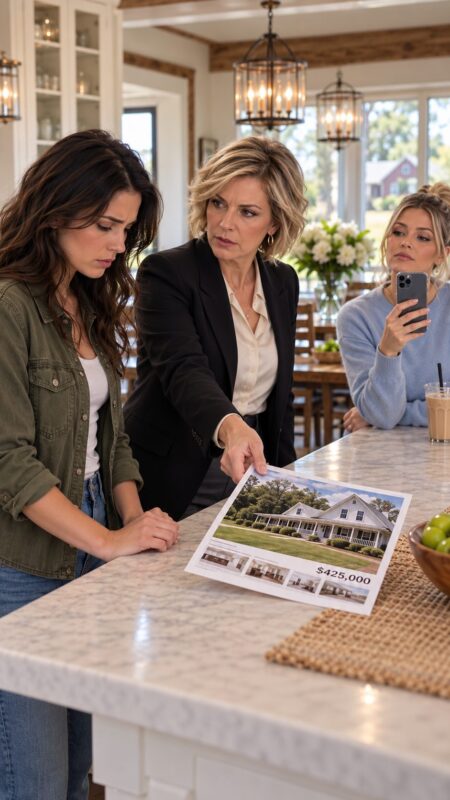
“You’re selling her home?” I whispered.
Mom rolled her eyes.
“She’s gone, Bridget. It’s just a building.”
Presley burst out laughing.
“Maybe you can rent a room somewhere. Assuming anyone wants you!”
I stood up without answering.
That was when I remembered Grandma’s pouch.
She’d given it to me during one of my final visits to her bedroom.
Her hands had been frail, but her voice was steady.
“Promise me you won’t lose this.”
“What is it, Nana?”
“Something you’ll need when the time is right.”
I had kept it untouched for two years.
Now, sitting on my bed, I finally opened it.
The letter was written in Grandma’s familiar handwriting.
My dearest Bridget,
If you’re reading this, I believe your mother has tried to take away the place you’ve always called home.
Please don’t fight with her. Don’t tell her what you’ve found.
Go straight to Arthur Finley. I’ve already spoken to him about everything.
You have been stronger than anyone should have to be, my darling. It’s time someone protected you.
All my love, Grandma.
My hands shook as I reached for my car keys.
Arthur Finley’s office was located above an old bank building downtown.
When I gave the receptionist my name, she immediately stood.
“Mr. Finley asked to be notified whenever you came.”
A moment later, an elderly man appeared.
“Bridget Summers?”
I nodded.
He smiled gently.
“You look very much like Evelyn.”
That nearly made me cry.
Inside his office, Arthur opened a thick folder filled with legal documents.
“Your grandmother came to see me nine years ago,” he began.
“Nine years?”
“Yes. She was worried about what would happen to her farmhouse after her death.”
He explained that Grandma had watched Mom’s behavior for years.
She knew Yvonne wanted control of the property.
And she feared that once she was gone, I would be the first person pushed aside.
“So Evelyn created a living trust,” Arthur continued.
He turned a document toward me.
“The farmhouse and its surrounding land were transferred into that trust. She named one person as the sole beneficiary.”
I looked down.
There, in unmistakable black letters, was my name.
Bridget Elaine Summers.
I stared at it.
“What does this mean?”
Arthur leaned forward.
“It means the property passed to you when your grandmother died.”
I couldn’t breathe.
“The farmhouse?”
“Every square foot.”
“But Mom says she’s selling it!”
“Your mother has no legal authority to sell it.”
I shook my head in disbelief.
“She’s a licensed real estate agent. How could she possibly not know?”
Arthur’s expression grew serious.
“She knew the property was protected by a trust. She simply didn’t know who would inherit it.”
He explained that Mom had attempted to challenge Grandma’s arrangements three times.
Every challenge had failed.
Grandma had taken extraordinary care to document her decisions, ensuring there could be no reasonable doubt about her intentions.
Then Arthur examined the real estate listing I’d brought.
His face hardened.
“This is a serious matter, Bridget. Your mother is advertising property she doesn’t own.”
He explained that the listing and related conduct had already been reported to the appropriate authorities.
Then he handed me another envelope.
“Your grandmother asked me to save this for today.”
Inside was a second letter.
My beautiful Bridget,
I have watched you spend your life trying to win your mother’s approval.
I’ve seen how often you put everyone else’s happiness before your own.
You deserve more than a life spent asking people to love you.
This farmhouse is yours because I want you to have a place where nobody can make you feel unwanted.
Keep the little brass key I gave you.
Even if the locks change, let it remind you that you will always belong somewhere.
And whenever the world feels cold, remember that the porch light will be waiting.
Love, Nana.
Tears fell onto the paper.
For years, I’d believed I was alone.
But Grandma had spent nearly a decade quietly preparing to protect me.
With Arthur’s assistance, I began the legal process of securing possession of the property.
Two days later, Mom received an official notice.
She called immediately.
“What kind of stunt are you pulling?” she shouted.
“I’m not pulling anything, Mom.”
“Someone is claiming I can’t sell Mother’s house!”
“That’s because Grandma left it to me.”
Silence.
Then she laughed bitterly.
“Don’t be ridiculous.”
“The trust documents are clear. I’m the beneficiary.”
Her voice rose.
“You must have tricked her! You always knew how to make her feel sorry for you!”
“No, Mom. Grandma made this decision nine years ago.”
Mom hung up.
Within hours, Presley posted a tearful video online.
She accused me of manipulating our grandmother and stealing the family home.
She claimed I’d made our parents homeless out of jealousy.
But the reaction wasn’t what she expected.
People began examining publicly available records and questioning her version of events.
Why had Mom listed a property she didn’t own?
Why had she tried to remove the person who legally inherited it?
Why had the family concealed the ownership dispute?
The listing was quickly withdrawn.
Soon afterward, Mom’s real estate license was suspended pending an investigation.
She blamed me for everything.
But she still refused to move.
“This house belonged to my mother!” she screamed when Arthur contacted her. “No piece of paper can change that!”
The matter eventually reached court.
Three weeks later, a judge confirmed that Grandma’s trust was valid and that I had the legal right to the property.
Mom and Curt were ordered to surrender possession.
On moving day, I returned to the farmhouse with Arthur and sheriff’s deputies.
A rental truck stood in the driveway.
Curt carried boxes from the garage while Presley sat inside her car, refusing to make eye contact.
Mom stood on the porch.
Her face was tight with anger.
“I hope you’re satisfied,” she said.
I looked at the house behind her.
“I never wanted any of this, Mom.”
“You’ve ruined our lives!”
“No. I just refused to lose the one thing Grandma wanted me to have.”
She stepped closer.
“Your grandmother would be disgusted by what you’ve done.”
For a moment, the old familiar pain returned.
Then I remembered the letters.
I met her eyes.
“Grandma knew exactly what she was doing.”
Mom turned away.
Minutes later, the truck disappeared down the road.
For the first time in years, the farmhouse was quiet.
Arthur placed the new keys in my palm.
“Welcome home, Bridget.”
I unlocked the door.
The wooden floors creaked beneath my shoes.
Grandma’s faded floral wallpaper still covered the hallway.
Her favorite clock hung above the fireplace.
Through the kitchen window, I could see the tomato plants she’d taught me to grow.
I stood there crying, but this time the tears weren’t from fear.
They were from relief.
A week later, another surprise arrived.
An email appeared in my inbox from my biological father.
He had left our family twenty-three years earlier.
In his message, he apologized for abandoning me and admitted he’d known how differently Mom treated Presley and me.
He said he wished he’d defended me.
I read the email several times.
Then I closed it.
I wasn’t ready to forgive him.
And for once, I didn’t feel guilty about needing time.
Over the next several weeks, Arthur informed me that investigators had discovered additional irregularities in Mom’s real estate dealings.
Eventually, her professional license was permanently revoked.
Presley lost several advertising partnerships after her accusations were challenged, and she eventually moved out of town.
I didn’t feel victorious.
I felt tired.
I hadn’t wanted revenge.
I’d only wanted the right to live without being treated like a burden.
Slowly, I began making the farmhouse my own.
I repaired the porch railing, planted fresh flowers beside the walkway, and cleaned Grandma’s old rocking chair.
One evening, I carried the chair onto the porch and sat watching the sunset.
The sky turned orange above the fields.
A cool breeze rustled the oak trees.
Then, just as darkness settled, the porch light came on.
I looked up.
Nobody had touched the switch.
Later, I discovered that Grandma had installed an automatic timer shortly before entering hospice.
Every evening, at the same hour, the light switched on.
It had continued doing so throughout the two years since her death.
Night after night.
Even when I believed nobody was waiting for me.
I reached into my pocket and pulled out the old brass key she’d given me.
It no longer opened the front door.
But that didn’t matter.
Grandma hadn’t left it to me because I needed another key.
She’d left it as a promise.
A promise that no matter how many times my family rejected me, I would always have a place where I belonged.
I held the key tightly and whispered into the evening air.
“I’m home, Nana.”
My mother had given me sixty days to disappear from her life.
But my grandmother had spent nine years ensuring I would never have to disappear from my own.
And beneath the warm glow of that porch light, I finally understood something I’d spent thirty-four years trying to learn.
A home isn’t simply the place where your family lives.
It’s the place where you never have to beg to be loved.