Nobody in the Conti mansion was brave enough to challenge Damiano Conti.
Until Lucia Vitale did.

She was three years old.
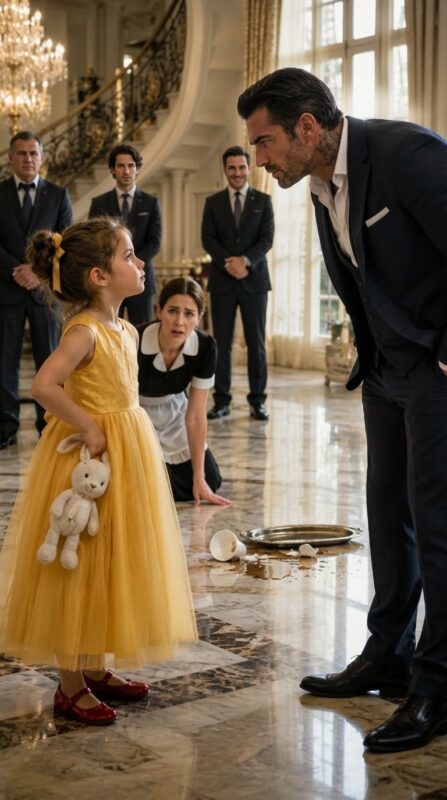
She barely reached his waist, wore bright red shoes, and carried a shabby gray rabbit with one missing ear.
Yet when she stepped directly into Damiano’s path in the middle of the marble entrance hall, the entire room seemed to stop breathing.
A few feet behind her, Lucia’s mother, Serena, was gathering pieces of a broken porcelain cup from the floor. Damiano had collided with her moments earlier, sending the cup crashing from her hands.
“Lucia,” Serena said urgently. “Please come back here.”
The child remained exactly where she was.
“It’s okay, Mommy. I have to fix something.”
Damiano looked down at her.
At thirty-eight, he had built a reputation that made grown men carefully reconsider their words before speaking to him. His employees obeyed immediately. His associates rarely questioned him.
Apparently, nobody had explained any of that to Lucia.
“You were rude to my mommy,” she said.
A tense silence followed.
Damiano raised an eyebrow.
“Excuse me?”
“You knocked her cup down, and then you got mad at her.”
Lucia held up two tiny fingers.
“That’s two mistakes.”
“Lucia!” Serena whispered.
Damiano gestured toward the hallway.
“Move aside.”
Lucia shook her head.
“Not until you say sorry.”
Several members of the household suddenly became extremely interested in the floor.
Damiano sighed.
“Fine. I apologize for the spilled coffee.”
Lucia’s nose wrinkled.
“That’s not right.”
“What isn’t?”
“You said sorry about the coffee.”
Damiano stared at her.
“So?”
“The coffee isn’t sad.”
A muffled laugh came from somewhere behind him.
Damiano ignored it.
“What would satisfy you?”
Lucia pointed toward Serena.
“You have to look at Mommy and tell her you’re sorry.”
For perhaps the first time since Serena had begun working at the estate, Damiano looked at her as something other than an employee.
He noticed her tired expression.
Her shaking fingers.
And the fear in her eyes as she watched her daughter confront the most intimidating man in the house.
Damiano turned fully toward her.
“Serena, I’m sorry.”
Lucia considered his apology carefully before giving a satisfied nod.
“Better.”
She moved out of his way.
Damiano started toward his office.
Then Lucia’s voice followed him.
“You forgot something!”
He turned.
“What now?”
“You should thank me.”
“For what?”
“For helping you learn manners.”
This time, Marco Bellini burst out laughing.
Marco had known Damiano for most of his adult life, and seeing a three-year-old defeat him in an argument was apparently too much.
“I think she just won,” Marco said.
Damiano was about to respond when something caught his attention.
The rabbit.
Lucia had tucked the worn toy beneath one arm.
Its fabric had once been gray but had faded with age. Uneven blue stitches covered its paws, and one ear had disappeared long ago.
Something about it felt strangely familiar.
For a moment, Damiano saw another child in his memory.
A summer afternoon.
A narrow Brooklyn street.
A little girl sitting on the front steps with a stuffed rabbit pressed against her chest.
Then the image vanished.
Marco was staring at the toy too.
But his reaction was different.
He recognized it.
His smile disappeared.
Hours later, Serena was explaining to Lucia why confronting Damiano had been dangerous.
“You cannot speak to Mr. Conti that way again.”
“But he needed to apologize.”
“That isn’t the point.”
Lucia tilted her head.
“Then what is the point?”
Serena had no good answer.
Neither noticed Marco standing farther down the hallway.
He pulled out his phone.
His message contained only four words.
We may have trouble.
That night, Damiano passed the kitchen and noticed Lucia asleep on a small sofa.
The battered rabbit rested beneath her chin.
He stopped.
The strange feeling returned.
He carefully studied the toy.
The stitching.
The missing ear.
And suddenly, the memory became clear.
Sofia.
His little sister.
Twenty-five years earlier, Sofia Conti had carried that rabbit everywhere.
Damiano even remembered the night their mother sat beneath a kitchen lamp repairing its torn paws with blue thread.
Then came the argument that destroyed their family.
Their father sent Sofia away.
Damiano was only thirteen.
He searched for her when he became old enough to do so, but every trail disappeared.
Eventually, he accepted the possibility that he would never see his sister again.
Behind him, Serena entered quietly.
Damiano pointed toward the rabbit.
“Where did Lucia get that?”
Serena looked confused.
“It was my mother’s.”
His heartbeat quickened.
“What was her name?”
“Sofia.”
Damiano barely breathed.
“Was her name Sofia Vitale?”
Serena’s expression changed instantly.
“How do you know my mother’s full name?”
Damiano lowered himself onto the edge of the sofa beside Lucia.
“Because before she became Sofia Vitale, she was Sofia Conti.”
Serena stared at him.
He looked toward the sleeping child.
“She was my little sister.”
Serena covered her mouth.
For years, her mother’s stories had seemed like fragments from another life.
“She told me about you,” Serena finally whispered.
Damiano looked up sharply.
“She did?”
“She said she had an older brother who tried to protect her when nobody else would.”
His expression hardened with old pain.
“I searched for her.”
“I know.”
Damiano stared at Serena.
“She knew?”
Serena nodded.
“My mother never blamed you. She said your father kept moving her and made sure neither of you could discover where the other was.”
For twenty-five years, Damiano had carried the belief that his sister had died thinking he had abandoned her.
Now, in a few sentences, that burden began to crack.
Lucia woke and rubbed her eyes.
She immediately noticed his expression.
“Why are you sad?”
Damiano managed a faint smile.
“I remembered someone I missed very much.”
Lucia looked at Bunny.
Then, without hesitation, she pushed the rabbit into his hands.
“You can borrow her.”
Damiano touched the faded blue stitches.
“I remember when these were sewn.”
Lucia’s eyes widened.
“You knew Bunny?”
“I knew the little girl who loved her first.”
Lucia turned toward Serena.
“Grandma Sofia?”
Serena nodded.
Lucia studied Damiano for several seconds.
Then understanding seemed to arrive in the simple way it sometimes does for children.
“You’re Grandma’s brother?”
“Yes.”
That was apparently enough explanation.
Lucia climbed onto the sofa and threw her arms around his neck.
Damiano went completely still.
People feared him.
People respected him.
People asked his permission before entering his office.
Nobody simply climbed into his arms.
Lucia did.
After a moment, Damiano hugged her back.
“I thought I was the last one,” he whispered.
Serena shook her head.
“You never were.”
Life inside the Conti estate changed after that night.
Several months later, visitors entering Damiano’s office often noticed something peculiar sitting among the contracts and polished accessories on his desk.
An old gray rabbit.
One ear missing.
Blue stitches around its paws.
Lucia had decided Bunny needed to spend working hours with her newly discovered uncle.
“She watches you,” Lucia explained.
Damiano had raised an eyebrow.
“Why?”
“So you remember to be nice.”
Apparently, Bunny required assistance with enforcement.
Whenever Damiano forgot his manners, tiny red shoes would soon appear outside his office.
“Uncle Damiano?”
He would look up.
“You forgot the magic word.”
The same man who could silence a room with a glance would sigh and correct himself.
“Please.”
Lucia would smile.
“Good.”
Nobody dared laugh anymore.
At least not where Damiano could hear them.
But everyone understood what had happened.
For years, Damiano had believed strength meant never needing anyone.
Then a fearless three-year-old had stepped into his path and refused to move.
She gave him back a piece of the sister he had lost.
She gave Serena the family history that had been stolen from her.
And without even realizing it, Lucia gave Damiano something he had stopped believing he deserved.
A family.
He had spent decades building a life around control, influence, and power.
Yet none of those things had healed him.
A child had done that with red shoes, an old rabbit, and the stubborn belief that everyone—even Damiano Conti—should know how to say sorry.