Sebastián Valdivia was not supposed to return to Los Laureles until the following week.
But on an October afternoon in 1907, a problem with his journey brought him home early—and allowed him to hear a conversation never meant for his ears.
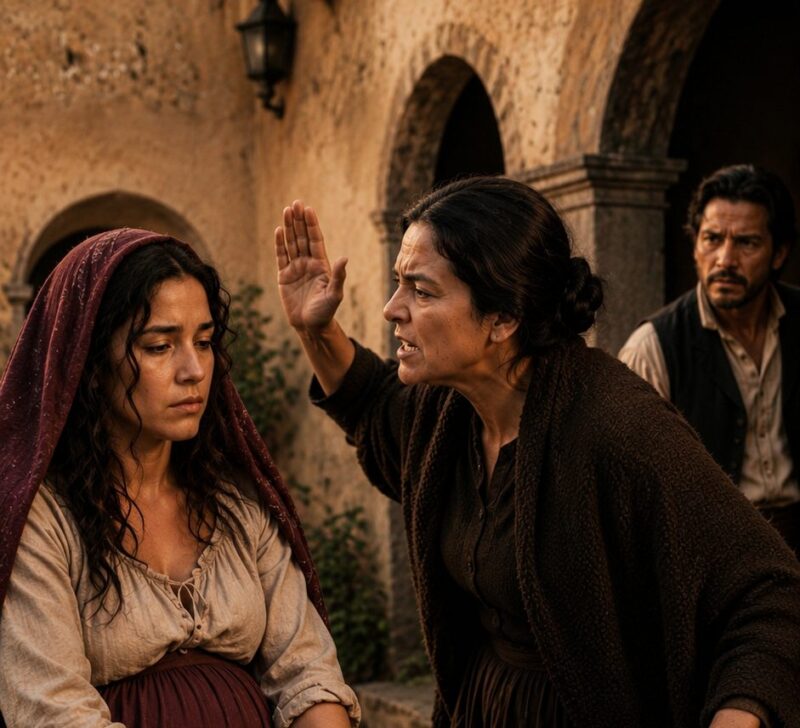
He had barely crossed the courtyard when his mother’s voice carried through an open doorway.
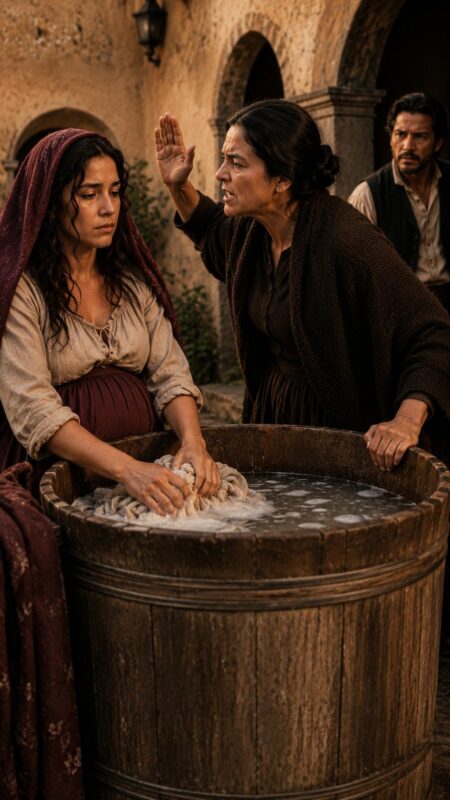
“If you give birth to that child here, don’t expect it to be accepted as a Valdivia.”
Sebastián stopped.
Inside the room stood his wife, Elena, eight months pregnant, facing Doña Matilde Valdivia.
For years, Matilde had ruled the hacienda with such authority that even longtime workers lowered their voices when she passed.
Elena did not.
“The baby is Sebastián’s,” she replied. “Whether you accept me or not, this child is your grandchild.”
Matilde gave a humorless smile.
“You married into this family with no estate, no influential relatives, and no inheritance. You brought nothing.”
Elena glanced at the blue embroidered shawl lying beside her.
“I brought the work of my own hands and something that belonged to my mother. Neither makes me inferior to you.”
Matilde followed her gaze.
The moment she saw the shawl, the color drained from her face.
Sebastián noticed.
He entered the room.
“Mother, what exactly are you trying to do?”
Matilde turned sharply.
Sebastián walked to Elena’s side.
“This is my wife’s home. Why are you threatening to throw her out?”
Matilde left without answering.
That night, Elena told Sebastián what life at Los Laureles became whenever he was away.
Matilde had stopped allowing her to eat in the formal dining room. Their wedding portrait had disappeared from the main corridor. When important visitors arrived, Elena was introduced simply as a woman employed to do embroidery.
Sebastián was enraged.
Yet his thoughts kept returning to one moment.
The shawl.
Why had his mother looked terrified of a piece of old blue cloth?
It had belonged to Elena’s mother, Soledad Villaseñor, a woman surrounded by unanswered questions.
Soledad had appeared in Dolores Hidalgo when she was nineteen, expecting a child and carrying almost nothing except the shawl. She had raised Elena without a husband and rarely discussed where she had come from.
Sebastián decided to investigate.
His first visit was to Father Basilio, an aging priest whose memory reached further into the history of Los Laureles than Sebastián’s own.
The priest listened silently before asking one question.
“Did Matilde recognize the shawl?”
“Yes.”
Father Basilio sighed.
“Then perhaps it is finally time you learned how your family acquired this hacienda.”
Sebastián stared at him.
The priest explained that Ignacio Valdivia, Sebastián’s father, had not created Los Laureles by himself.
The estate had begun as a partnership.
The other man was Leandro Villaseñor—Elena’s grandfather.
Leandro had supplied property, construction materials, livestock, and workers. In exchange, a written agreement granted him one-third of the northern territory.
When Leandro died, his only daughter inherited his rights.
Her name was Soledad.
Years later, she returned to claim what belonged to her.
She carried the original contract and brought two men who could verify its authenticity.
By then, Matilde was in control.
And then everything changed.
One witness abruptly denied his earlier statement.
The other vanished.
Several pages disappeared from the local registry.
Soon afterward, rumors began circulating that Soledad was a fraud who had manufactured documents to steal Valdivia property.
No one wanted to defend a young unmarried woman against one of the region’s most powerful families.
Soledad left Dolores Hidalgo in disgrace.
She was pregnant with Elena at the time.
Sebastián refused to rely on an old story alone.
He searched for surviving witnesses and eventually located Arcadio, a former Los Laureles laborer living outside town.
At first, Arcadio claimed he remembered nothing.
Then Sebastián showed him Elena’s blue shawl.
The old man’s resistance collapsed.
“I remember that,” he whispered.
He admitted seeing Matilde’s estate administrator remove papers Soledad had submitted as evidence.
“Why didn’t you say anything?”
Arcadio lowered his head.
“Because your family controlled my wages, my house, and the food my children ate. Speaking the truth would have cost us everything.”
Sebastián understood the fear.
But testimony still wasn’t enough.
He traveled to León, following a clue Father Basilio had given him, and found a retired clerk who had once worked with property records.
The man still possessed an officially certified copy of the partnership contract.
Nothing had been erased from it.
Leandro Villaseñor and Ignacio Valdivia had both signed it.
The boundaries of Leandro’s share were clearly described.
One-third of the northern lands belonged to the Villaseñor family.
Sebastián finally had proof.
Then, after returning to Los Laureles, he found something far more disturbing.
While searching Matilde’s private desk for additional records, he discovered a hidden letter addressed to the woman expected to assist with Elena’s delivery.
The wording was cautious, but the implication was chilling.
If childbirth placed Elena and the baby in danger, the woman was expected to consider which life would better protect “the continuation and interests of Los Laureles.”
Sebastián carried the letter directly to his mother.
“You already destroyed Elena’s mother’s life. Were you planning to control what happened to Elena too?”
Matilde’s composure cracked.
“I have spent my life protecting this estate.”
“By stealing it?”
“I preserved what your father built.”
“My father didn’t build it alone.”
Matilde said nothing.
Sebastián placed the certified agreement on her desk.
“Leandro Villaseñor built Los Laureles with him.”
Matilde realized the secret was over.
She offered a compromise: Elena could receive money, a comfortable house, and several valuable parcels if Sebastián kept the old scandal from becoming public.
He refused.
“You cannot give Elena something that already belongs to her and call it generosity.”
The truth was presented publicly days later.
Father Basilio described the original partnership. Arcadio confessed what he had witnessed. Others, encouraged by their testimony, finally spoke about events they had remained silent about for decades.
Then Sebastián produced the certified contract.
Before everyone present, he asked Matilde one final question.
“When Soledad came here asking for her inheritance, did you know she was carrying a child?”
For several seconds, Matilde stared at Elena.
Then her eyes dropped to the blue shawl around Elena’s shoulders.
“Yes.”
That answer destroyed a lie that had survived for twenty-six years.
The Villaseñor claim was restored.
Elena, however, refused to take homes from families who had unknowingly purchased pieces of the disputed property. Settlements were negotiated instead.
She used part of what she recovered to establish a school for girls from poor families.
“Money wasn’t the greatest thing they stole from my mother,” Elena said. “They stole her credibility. I wanted her name returned first.”
That same night, Elena’s labor began.
The woman expected to assist with the birth had disappeared.
Hours passed, and the situation grew increasingly difficult.
Then Matilde appeared.
“I have helped with births before,” she said quietly. “Let me do something useful.”
Sebastián stepped between her and the bedroom.
“No.”
Elena heard them.
“Sebastián.”
He turned.
She extended her hand.
“Let her come in.”
For the next six hours, Matilde worked beside the household women. She carried water, prepared linens, followed every instruction, and remained near Elena until dawn.
Then a newborn’s cry broke through the exhausted silence.
A daughter.
Later, someone asked Elena what name she had chosen.
She looked at the old blue shawl.
“Soledad.”
Matilde’s face tightened.
“I don’t deserve to hear that name in this house.”
Elena answered calmly.
“The name isn’t about what you deserve. It’s about what my mother deserved.”
Matilde never requested forgiveness.
Instead, she began revealing the names of the people who had helped suppress the Villaseñor claim. She sold her jewelry and directed the money toward Elena’s school.
None of it erased the past.
Elena never pretended that it did.
But confession replaced secrecy, and accountability replaced denial.
Eventually, the estate itself was renamed Hacienda Villaseñor Valdivia.
The order of the names mattered.
Inside the school, Soledad’s blue shawl was placed in a glass case.
Years later, Elena stood there with her daughter.
The little girl pressed closer to the display.
“Mama, why is Grandmother’s shawl kept behind glass?”
Elena studied the faded embroidery.
“Because sometimes the smallest thing is all that remains when someone tries to erase a person’s story.”
The girl looked up at her.
“And it proved Grandmother was right?”
“No,” Elena said gently. “Grandmother had always been right. The shawl helped us discover the people who were finally brave enough to admit it.”
What Doña Matilde once considered the possession of a poor, insignificant woman became a symbol of everything her power had failed to bury.
A stolen inheritance was acknowledged.
A disgraced woman’s name was restored.
And the baby Matilde once threatened to exclude from the Valdivia family grew up with two surnames:
Soledad Villaseñor Valdivia.
She carried them not as evidence of a divided family, but as proof that both sides of her history deserved to be remembered.
From then on, one principle mattered more than tradition at Los Laureles:
No family name, fortune, or estate was worth preserving at the cost of the truth.