THE $300,000 GOWN AND THE PROMISE SHE NEVER FORGOT
Before Adriana Vélez became the woman behind one of the world’s most successful bridal brands, she knew what it meant to count every dollar.
She grew up watching her mother, Teresa, sew at a battered kitchen table.
There was no elegant studio, no staff, and no sign above the door. Teresa earned what she could by shortening uniforms, repairing torn clothes, and altering curtains for neighbors.
But those jobs were only how she survived.
Wedding dresses were what she dreamed about.
At night, Teresa filled sheets of paper with designs and stored them in a worn cardboard box. One sketch stood apart from all the others.
It showed a flowing silk gown covered in embroidered flowers and scattered with tiny stones that seemed almost like drops of light.
Teresa had given it a name:
Aurora.
“Someday,” she told Adriana, “I’ll sew this one for you.”
Adriana believed her.
Life had other plans.
When Adriana was seventeen, Teresa fell gravely ill. Hospital visits, medicine, and treatment quickly consumed the family’s savings.
Adriana started working after school, cleaning offices until late at night.
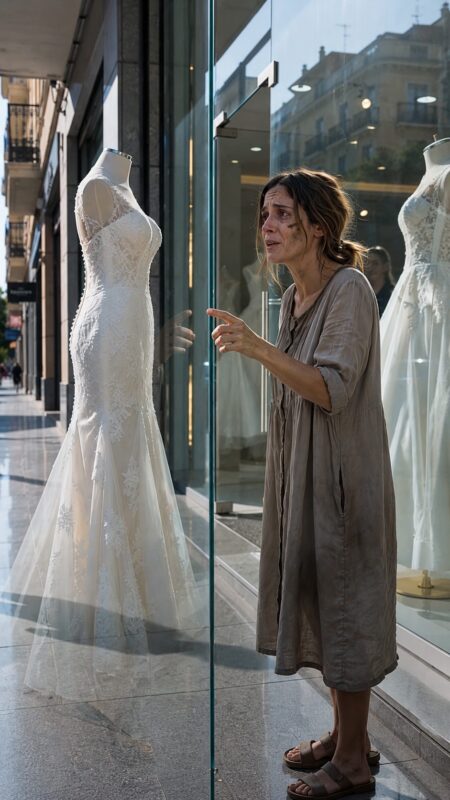
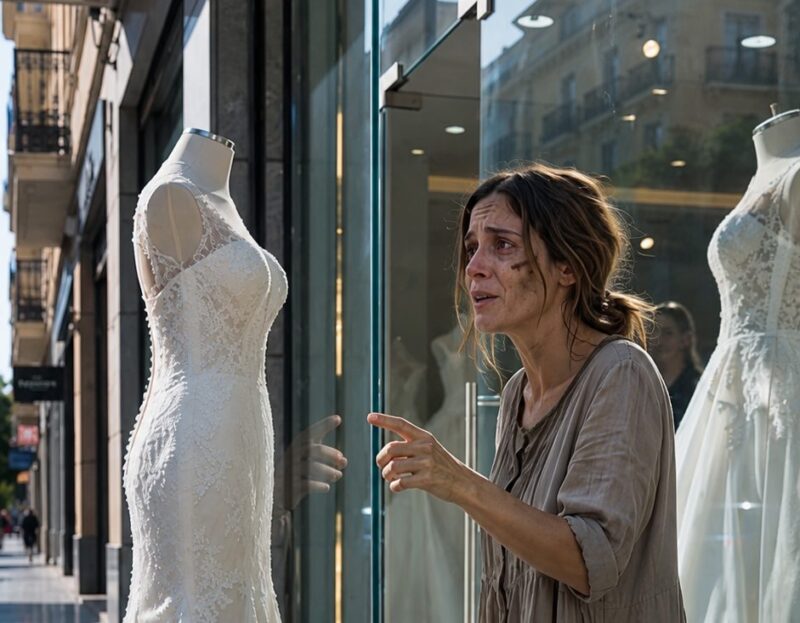
One afternoon, on her way to work, she stopped outside a luxurious bridal boutique.
A magnificent gown stood behind the glass.
Adriana thought immediately of her mother.
She entered the store hoping to take a photograph so she could show Teresa something beautiful when she visited the hospital later that evening.
She never got the chance.
A saleswoman looked Adriana up and down, lingering on her inexpensive uniform and scuffed shoes.
“What exactly are you doing here?”
Adriana explained.
The woman gave a dismissive laugh.
“This isn’t a place for people like you.”
Then she told Adriana to leave.
The humiliation stayed with her all the way to the hospital.
When Adriana finally told Teresa what had happened, she expected her mother to be angry.
Instead, Teresa reached for her hand.
“If life ever puts you in a position where people have to listen to you,” she said quietly, “promise me you’ll remember how today felt.”
Adriana looked at her.
“I promise.”
“Good. Then never make someone else feel that way.”
Teresa died a few weeks later.
Adriana kept two things from that period of her life: her promise and the battered box of sketches.
The years that followed were difficult.
She cleaned offices, served food in restaurants, babysat children, and took whatever work she could find. At night, she studied design and practiced sewing whenever she had enough energy to stay awake.
Her first opportunity came almost by accident.
A friend bought a secondhand wedding dress that didn’t fit properly and asked Adriana for help.
Adriana transformed it.
Soon, other women began bringing her inexpensive gowns to alter.
Then one friend trusted her to design an entire wedding dress.
Someone posted a photograph of the finished gown online.
Within days, strangers were asking who had made it.
Within months, Adriana had more orders than she could handle from her apartment.
She eventually rented a tiny shop.
Above the entrance, she placed a sign:
WHITE ROSE
The name honored Teresa, who had always loved white roses.
Adriana established one rule for everyone who worked there.
Never decide how much respect a customer deserves by looking at her wallet.
White Rose grew.
The tiny boutique became several stores. Several stores became dozens. Eventually, the company expanded internationally, and Adriana found herself running a bridal empire worth millions.
Its most famous creation was a gown called Aurora.
Priced at $300,000, it was made from exceptional silk and decorated with intricate embroidery and thousands of tiny stones.
But almost no one knew where the design had come from.
It was Teresa’s drawing brought to life.
As White Rose expanded, however, Adriana could no longer watch everything happening inside every branch.
One day, a letter arrived at company headquarters.
It wasn’t from an investor or a wealthy client.
It came from a woman named Marina.
Marina explained that she had saved for three years to buy her wedding gown from White Rose.
She had imagined the day countless times.
But when she entered one of the boutiques after work, dressed in ordinary clothes, the staff treated her as though she were invisible.
Some barely answered her questions.
Others exchanged looks when she asked about certain dresses.
Marina eventually walked out without trying on a single gown.
Her final sentence stopped Adriana cold.
“I went there believing every woman deserved to feel like a bride. I left wondering whether some dreams are only for people who look wealthy.”
For a moment, Adriana was seventeen again.
She could see the polished boutique.
She could hear the laughter.
And she could remember Teresa holding her hand.
Adriana ordered an immediate internal review.
The results showed almost no problems.
That made her more suspicious, not less.
She discovered that branch managers were being warned before inspectors arrived. By the time anyone from headquarters walked through the doors, every employee knew exactly how to behave.
Adriana decided there was only one way to discover the truth.
She would go herself.
But no one would know who she was.
She dressed plainly and visited White Rose stores without warning. She didn’t arrive in a company car or introduce herself as the founder.
She simply walked in as another potential customer.
Some branches made her proud.
Employees welcomed her, offered assistance, and treated her with the same courtesy they would have shown someone prepared to spend a fortune.
Then Adriana entered the branch run by Beatriz.
The atmosphere changed immediately.
Employees stared at her worn clothing.
One tried to stop her at the entrance.
Another laughed when Adriana began asking about expensive gowns.
Then Adriana pointed toward the most valuable dress in the boutique.
Aurora.
“I’d like to try that one.”
The employees laughed openly.
They saw an ordinary woman asking to wear a $300,000 gown.
What they didn’t see was the girl who had inspired its creation.
And they certainly didn’t see their employer.
Adriana finally told them her name.
Silence replaced the laughter.
Those involved were suspended while the company investigated the branch.
When an employee nervously asked whether Adriana still wanted to try on Aurora, she looked toward the gown.
“No,” she said. “Not like this.”
The investigation uncovered years of complaints.
Customers had been dismissed because of their clothes, their age, their appearance, or assumptions about how much money they had.
Worse, Beatriz had hidden many of those complaints to protect the branch’s reputation.
She was dismissed, as were employees who had repeatedly participated in the behavior.
But Adriana didn’t want revenge.
She wanted change.
The branch was reorganized from the ground up.
Staff underwent new training. Complaints were sent to an independent review system. Employees were instructed to help customers explore dresses at different price points without embarrassment or pressure.
Adriana also launched the Teresa Vélez Program, offering gowns and bridal assistance to women who otherwise could not afford them.
Weeks after the store reopened, Adriana returned.
This time, Aurora had been prepared for her.
There was no wedding.
There was no groom waiting somewhere.
Adriana wasn’t putting on the dress because she intended to marry.
She was completing a promise that had begun at a kitchen table decades earlier.
When the gown settled around her, Adriana faced the mirror.
For a few seconds, the businesswoman disappeared.
In her place stood the seventeen-year-old girl who had cleaned offices to help pay her mother’s medical bills.
Adriana opened Teresa’s cardboard box.
The edges of the original Aurora sketch were faded and worn.
She held the drawing beside the gown.
Her mother’s imagination had become real.
Adriana smiled through her tears.
“You finally made it, Mom.”
A year later, she returned to that same branch unexpectedly.
Near the entrance, Adriana noticed an older woman in a faded jacket standing outside the window, staring at Aurora.
A consultant walked toward her.
The woman quickly shook her head.
“I’m only looking. I could never afford anything in there.”
Instead of walking away, the consultant opened the door.
“Looking is free,” she said with a smile. “Come inside. You can see it properly.”
She invited the woman in and offered her a cup of tea.
From the other side of the boutique, Adriana watched without saying a word.
The employee had no idea the founder was there.
There was no inspection.
No manager was watching.
No reward was waiting.
And that was precisely why the moment mattered.
Adriana looked at Aurora and thought of the woman who had first drawn it at a kitchen table.
Teresa’s greatest creation had never been the dress.
It was the lesson her daughter had carried into every White Rose boutique:
A person’s dignity should never depend on what she wears, what she owns, or how much money you think she can spend.