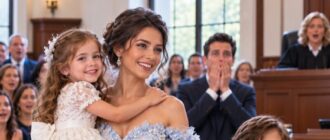
The ballroom had hosted luxury before.
Crystal chandeliers hanging like frozen light. Perfect gowns gliding across polished floors. Formal applause rising and falling in rehearsed waves. Wealthy guests exchanging practiced smiles, as if elegance itself could keep pain at a distance.
But it had never witnessed anything like this.
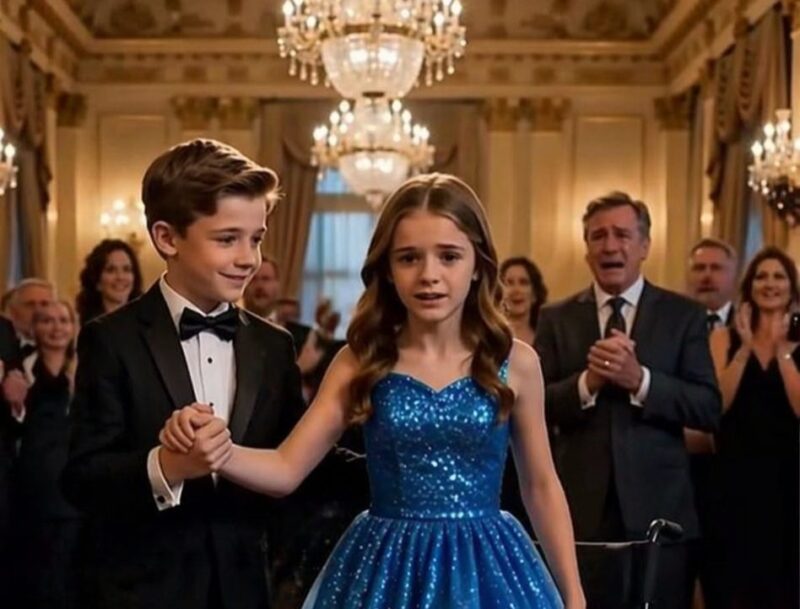
At the edge of the dance floor stood a little girl in a shimmering blue princess dress beside a black wheelchair.
Not because she was fragile.
Because she knew every gaze in the room was about to land on the one moment she had dreamed of—and feared most of all.
Across from her, a young boy in a black tuxedo stepped forward and offered his hand.
No theatrics. No hesitation. No pity in his expression.
Only trust.
“Come on.”
Silence spread through the room.
She stared at his hand.
Then at the glossy floor beneath the lights.
Then at the wheelchair beside her.
For a brief moment, it felt as if even the chandeliers had stopped swaying.
The light touched her prosthetic legs.
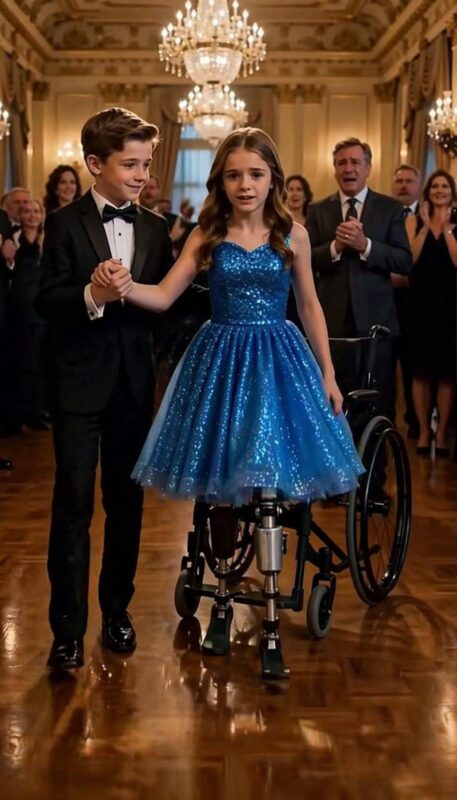
She shifted, unsteady.
A quiet gasp moved through the crowd.
But the boy didn’t move away. He didn’t doubt her for a second.
He held her steady, as if he had already decided the outcome, and all she needed to do was step into it.
She took one step.
Then another.
Her shoes against the wooden floor sounded sharper than any applause.
Some guests covered their mouths without realizing it.
Behind them, an older man in a dark suit stood frozen, tears already gathering in his eyes.
Because he understood exactly what this moment demanded from her.
The months of pain. The endless therapy. The falls no one applauded. The nights she cried where no one could reach her.
The music swelled gently through the hall.
The boy guided her into a slow turn.
Her blue dress opened under the chandelier glow like a flower unfolding for the first time.
And through trembling laughter and tears, she whispered:
“I’m dancing…”
Applause began to rise.
Then it changed.
Something shifted in her.
She released his hand.
For a single, breathless moment, she stood alone in the center of the floor.
The boy instinctively reached back toward her.
The man in the background stopped breathing entirely.
And then she turned—slowly, deliberately—and looked straight at him.
Her voice broke through the silence:
“Daddy… I did it.”
The applause faded into something distant, almost unreal.
Not because it stopped.
But because the entire room had been pulled into that one sentence.
Daddy… I did it.
The man in the dark suit covered his mouth, his shoulders shaking.
Everyone who saw him understood instantly:
This wasn’t a performance.
It was survival turned into movement.
A year earlier, everything had changed.
A winter road. Hidden black ice. A sudden crash. Metal twisting into silence.
A hospital corridor where her father first learned she was alive—and then learned she would never walk again.
After that came stillness.
Not from him.
From her.
No more requests for dresses.
No more talk of celebrations.
No more promises about dancing at his charity ball, the one she had once spoken about with shining certainty.
And her father—someone used to control, strength, certainty—discovered the one thing he could never fix.
Pain that belonged to someone else.
In rehabilitation, she fell again and again.
Each fall made him want to stop the world.
Each tear made hope feel like something too dangerous to hold.
But she kept one thing untouched.
A blue dress hanging quietly in her room.
The dress she said she would wear when she danced again.
And the boy in the tuxedo—her closest friend, the one who stayed after therapy sessions, who practiced steps beside her wheelchair, who never looked at her as anything less than whole—had made her a promise:
When you’re ready, I’ll be there with you.
Tonight, he was.
That was why the father was crying.
Not because she stood.
But because she returned.
She took the boy’s hand again and turned once more, this time lighter, freer—almost laughing at her own courage.
The ballroom erupted.
Not polite applause.
Not careful admiration.
Real sound—raw, unrestrained, human.
The kind that breaks through status, image, and expectation.
The father pushed forward through the crowd, unable to stay back any longer.
His eyes were red.
His composure was gone.
And he didn’t try to hide either.
She stopped in the center of the floor and looked at him—truly looked at him—with a strength that didn’t belong to fear anymore.
Then she spoke, softly but clearly:
“You don’t have to carry me anymore.”
And in that instant, everything became clear.
This wasn’t just a dance.
It was release.
Not loss.
Not distance.
But a child finally giving her father back the weight he had been holding alone.
And choosing to walk forward—even if only for a moment—on her own.