The Boy No One Believed — Until the Impossible Happened
Ethan Caldwell had lost faith in everything.
It didn’t fade over time—it shattered in a single moment. The night of the accident. The night the doctors told him his wife was gone. The night his three-year-old daughter screamed from the backseat until her voice broke—and something inside her never truly returned.
Two years later, he still carried an umbrella to the park, even under clear skies. Not because he expected rain—but because life had already caught him off guard once, and he wasn’t willing to be unprepared again.
That day, the rain came anyway.
Lily sat in her wheelchair beside the pond, her eyes fixed ahead but empty. Her hands rested in her lap, still and lifeless. They hadn’t moved on their own in months.
“Do you want to head back?” Ethan asked gently.
No answer.
He studied her face—the shape of his own jaw, the softness of her mother’s eyes. It was too much. He looked away.
“Excuse me, sir.”
The voice came from behind—young, calm, certain.
Ethan turned.
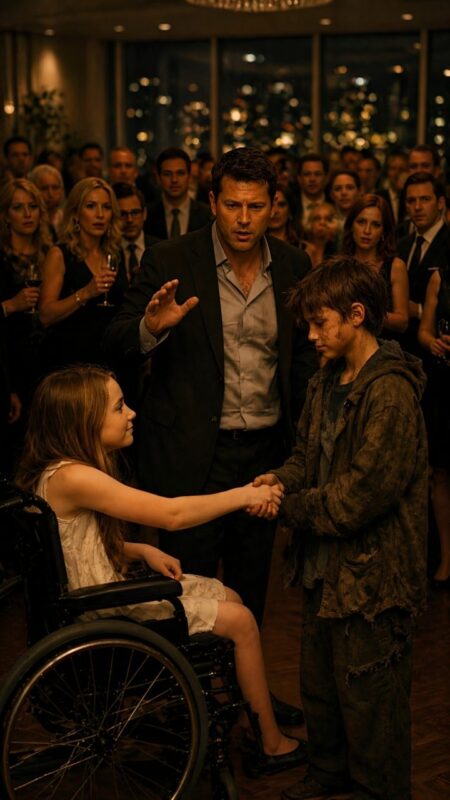
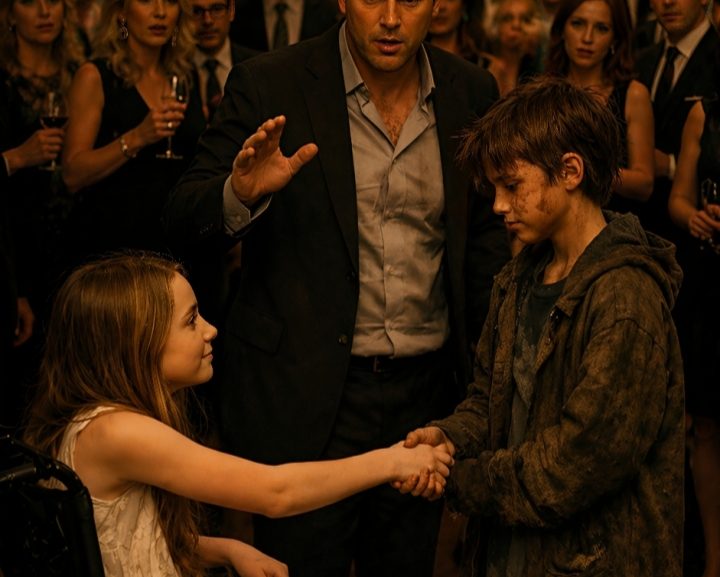
The boy standing there looked about twelve. Thin in a way that suggested hunger, not fitness. His shoes were worn through, his oversized jacket sleeves folded back. But his gaze—steady, direct—carried something far beyond his years.
“May I dance with your daughter?” the boy asked. “I can help her walk again.”
Ethan blinked, unsure he had heard correctly.
For a long moment, he said nothing. Then a familiar feeling tightened in his chest—not hope, but resistance. The kind that builds just before something shuts completely.
“Go,” Ethan said quietly.
“I understand you don’t believe me.”
“I said go.”
“I’ve done this before,” the boy replied, unwavering. “For my sister. I know how it sounds. But I’m telling you the truth.”
Ethan stepped forward. “You don’t understand what she’s been through—”
He stopped.
Lily’s hand had moved.
Only slightly—just enough to brush against his arm.
He froze and looked down.
She was staring at the boy. Really looking at him. The way she once looked at thunderstorms, fireflies… or her mother.
“What’s your name?” she asked softly.
The boy’s face softened. “Noah.”
Lily turned to her father.
“Please, Dad. Let him try.”
Ethan didn’t agree that day. He wasn’t reckless.
But he didn’t ignore it either.
He investigated—quietly, thoroughly. He hired someone to dig into the boy’s past, to confirm whether there was anything behind those bold words.
What he found was strange—but undeniable.
Noah Reyes. Twelve. No stable home. Multiple foster placements. And one unusual detail buried in the reports:
His younger sister had once stopped walking after a traumatic experience. Doctors labeled it conversion disorder—a condition where the body shuts down to shield itself from overwhelming emotional pain.
Noah had worked with her for months.
No training. No certification. Just patience, music, movement—and something instinctive that no report could fully explain.
And somehow, it worked.
She walked again.
Shortly after, they were separated. She was sent to another state. Noah was placed elsewhere.
The records ended there.
Ethan arranged for the boy to visit.
Tuesday afternoon. The penthouse. Security present.
He stayed in the kitchen, watching through the glass.
Noah stepped inside, glanced around briefly, and said nothing about the luxury surrounding him. He looked cleaner now—someone had made sure of that.
He walked straight to Lily, sat cross-legged on the floor in front of her, and placed a small speaker on the table.
“Can I play something?” he asked.
“Okay,” Lily replied.
Soft music filled the room—gentle, almost like a distant pulse.
Noah didn’t mention her legs. Didn’t ask her to move.
“What did you love doing before?” he asked.
Lily thought for a moment. “Drawing… swimming… and my mom used to sing in the car. I don’t remember the song.”
“What did it feel like?”
She hesitated. “Like… everything was safe.”
Noah nodded.
Then he began to move—not performing, just flowing. Slow, subtle motions. His shoulders swayed, his arms moved like quiet waves. The rhythm was barely noticeable, but it was there.
“Movement doesn’t start in your legs,” he said softly. He touched his chest. “It starts here.” Then he gently tapped her temple. “And here.”
Lily watched him closely.
From across the room, Ethan watched them both.
Three weeks later, his mother arrived.
Margaret Caldwell never called in advance. In her world, announcing yourself meant you weren’t certain of your place.
She stepped in halfway through the session, paused, and took in the scene—Noah seated on the floor beside the speaker, Lily still and focused, her eyelids lowered in quiet concentration.
“Ethan. We need to talk.”
In the kitchen, her voice remained calm—too calm. With Margaret, restraint always carried more force than anger.
“You’re allowing a homeless boy to carry out some kind of ritual on your daughter.”
“That’s not what—”
“I have the contact information for a neurologist at Columbia-Presbyterian. She specializes in cases like Lily’s. She’s qualified, has a full team, and is widely published—”
“Mom.”
“A child waving his arms is not going to heal her.”
“His sister recovered.”
Margaret stopped. “His sister?”
“She was paralyzed at six. Same symptoms. He worked with her for eight months.” Ethan set his cup down with care. “There’s documentation.”
She hesitated. “Ethan… false hope—”
“Is still hope.” He glanced toward the living room. “She laughed last week. Did I tell you? She actually laughed at something he said. I stood right here and couldn’t move because I hadn’t heard that sound in over a year.”
Margaret studied him, silent.
“I’m not ending this,” he said quietly. “I’m not.”
Dr. Harris, Lily’s physician, arrived on Thursday.
He was methodical, careful with every word—someone who preferred probabilities over certainty. Sitting across from Ethan at the dining table, he folded his hands.
“I reviewed the footage you sent,” he said. “The finger movement in week two.”
“And?”
“It’s genuine. Voluntary.” He paused. “I want to be clear, Ethan. I can’t officially support what this boy is doing. I don’t understand the mechanism. But…” Another pause. “Something is responding.”
Ethan leaned forward. “Is a full recovery possible?”
“I don’t use that term in situations like this,” Harris replied, holding his gaze. “But I’m not going to tell you to stop.”
Week five.
Rain returned, tapping softly against the windows while gray light spread across the floor.
Noah sat facing Lily, the speaker between them. The music was slower today. Twenty minutes earlier, he had asked her to close her eyes—and she had.
“Feel it in your chest,” he said quietly. “Not your ears. Your ribs.”
She inhaled. Exhaled.
“Your body isn’t broken,” he continued. “It’s waiting. It placed itself somewhere safe. We’re just asking it to come back.”
Her hands rested motionless on the wheelchair’s armrests.
Noah stood and moved in front of her, his arms lifting and falling in slow, fluid motions—unhurried, almost as if he were underwater.
“Don’t think about standing,” he said. “Just notice the floor under your feet. That’s all. It’s still there.”
Lily’s brow tightened.
Her right foot shifted.
Barely a fraction. Then a little more.
“I…” Her voice faltered. “I felt that.”
Ethan, standing by the wall, froze.
“Again,” Noah said softly. “Same thing. Don’t force it. Let it happen.”
Her foot moved again. Her toes curled slightly against the footrest.
“Dad.” Her voice trembled. “I felt it.”
Before he realized it, Ethan was on his knees beside her chair, his hands wrapped around hers.
“I know,” he whispered, his voice unsteady. “I saw it.”
Lily broke down—not quietly, but with the full weight of something locked away for two years finally released.
Ethan held her, his shoulders shaking.
Across the room, Noah stayed where he was. He didn’t interrupt the moment. But his eyes filled, and he didn’t hide it.
After a while, Lily lifted her head and looked at him over her father’s shoulder.
“Your sister,” she said softly. “Emma.”
Noah’s jaw tightened. “Yeah.”
“You did this for her too.”
“I tried.”
“Why did they take you away from her?”
He paused. The music had stopped. Only the rain remained.
“Because I was a kid. I didn’t have a lawyer. No one asked what I wanted,” he said plainly. “They said separating us was better. I don’t know who that helped.”
Ethan slowly pulled back and looked at him.
“How long has it been since you’ve seen her?”
“Fourteen months.”
Ethan held his gaze. Something shifted in his expression—measured, deliberate, like a decision forming.
“I want to find her,” he said. “If you’ll let me help.”
Noah studied him carefully. Trust didn’t come easily—it showed in his stillness.
“Why?” he asked.
“Because you gave my daughter something back,” Ethan replied evenly. “And someone took something from you. That’s not a balance I’m willing to accept.”
It took six weeks to find Emma.
It took six weeks to track Emma down.
Not because she had disappeared, but because the system moved at its own sluggish pace—full of paperwork, delays, and barriers no one had bothered to fix. Ethan refused to sit still. He hired a family attorney, called in every favor he had, and made late-night calls that stretched his patience thin.
Dr. Harris submitted a detailed report outlining Lily’s progress—her motor function was returning, her emotional responses were stronger, and she was beginning to move on her own again. His recommendation was firm: continue working with the person who had started her recovery.
Margaret Caldwell, to her credit, stopped arguing.
By the time Emma’s placement was confirmed in Trenton, New Jersey, Lily could flex both feet and slowly rotate her right ankle.
When Noah finally saw his sister again, Ethan drove them there himself.
Emma was eight now—quiet, observant, wearing sneakers that flashed with every step. The moment she spotted Noah, she ran straight toward him. He hadn’t even fully stepped out of the car before she reached him.
He caught her and held her close, saying nothing at all.
Ethan remained by the car, hands in his pockets, eyes lifted toward the overcast sky. It looked like rain—but he didn’t bother reaching for his umbrella.
From the backseat, Lily watched everything.
“Hey,” she said softly.
Ethan turned toward her.
“Thank you for not stopping it.”
He met her eyes, steady and certain. “Thank you for pushing me to begin.”
Three months later, Lily managed six steps.
No support bars. No walker. Just Noah standing in front of her, his hand extended, soft music playing as they moved together in a slow, steady rhythm—like water pulling back from the shore.
Six steps.
Then she lowered herself into the chair again. “That’s enough for today.”
Noah smiled—an actual, unguarded smile Ethan had never seen before. It transformed him completely.
“You’re officially my most difficult patient,” Noah said.
“You’ve only had two.”
“And you’re still the most difficult.”
Lily laughed.
Ethan stood in the doorway, arms folded, watching in silence.
He didn’t need to say anything.
Emma moved into the guest room in January.
That same week, Ethan filed for guardianship. His lawyer warned him it would take time. Ethan simply nodded—he had learned how to wait.
One night, close to midnight, he found Noah in the kitchen, sitting at the counter with a glass of water, staring out over the city lights.
“Can’t sleep?” Ethan asked.
“Just thinking.”
Ethan poured himself a drink and sat beside him.
“About what?”
Noah hesitated. “About whether I made the right choice that day. In the park. Coming up to you.”
“You did.”
“You could’ve called the police.”
“I almost did,” Ethan admitted, glancing down at his glass. “Then Lily looked at you, and I realized—if I’m wrong, I lose nothing. But if she’s right, I lose everything by walking away.”
Noah nodded slowly.
“For what it’s worth,” Ethan added, “she’s usually right.”
Noah almost smiled. Then the smile stayed.
After a moment, he looked back out at the city. “She’s going to run someday,” he said quietly. “Not soon—but someday.”
Ethan let out a slow breath.
“Yeah,” he said. “I know.”
They sat there in the dim kitchen, the glow of the city below them, and for a while, silence said everything.