The CEO Who Walked Into His Own Dealership in Disguise — And Changed Everything
“Leave. People like you don’t belong here.”
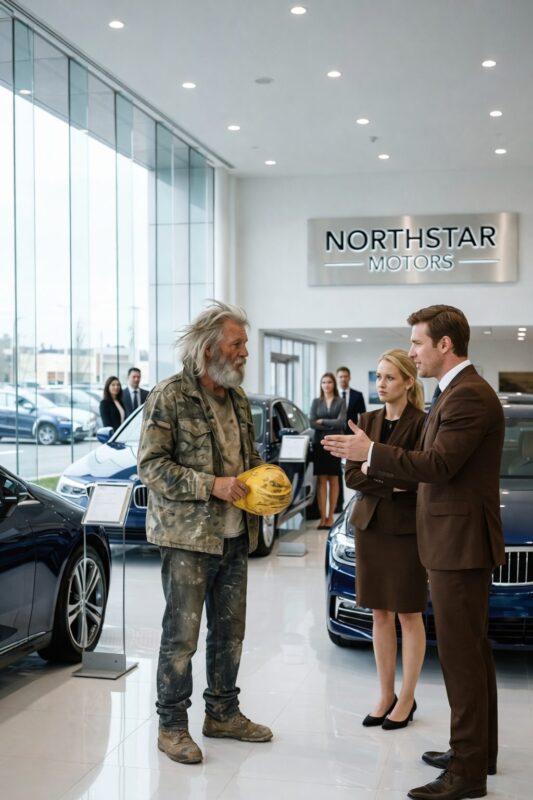
Those were the first words the dusty man in a reflective vest heard when he stepped into the Northstar Motors showroom. No one asked where he had come from. No one wondered why he looked exhausted. They saw the dirt on his boots, the worn vest, the rough hands—and they laughed.
Clyde lifted his phone, whispering to the others, “Watch this. A construction worker thinks he can afford a luxury car.”
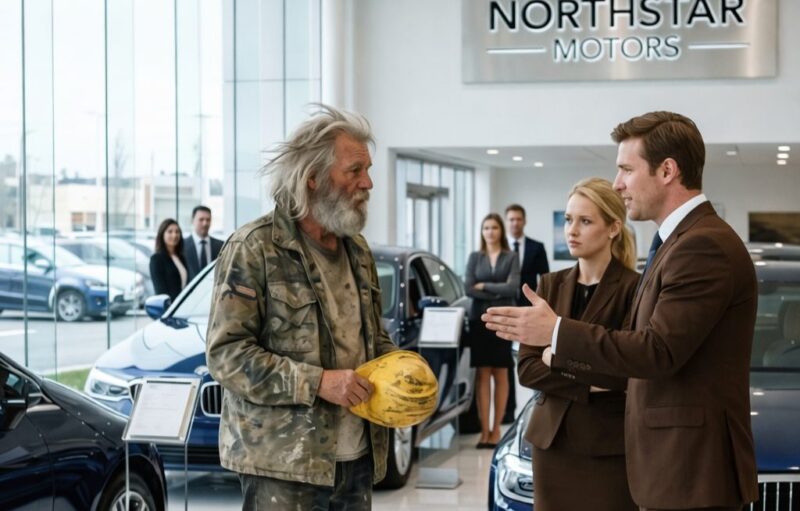
Miss Readington examined the visitor with clear irritation.
“Sir, this showroom isn’t for casual browsing.”
The man remained calm. Without arguing, he placed his hard hat on a nearby counter and slipped a hand into his pocket, pulling out an old identification card.
For the first time, the employees noticed the name printed on it:
Jackson Crowell.
What they didn’t realize was that he already knew exactly how they would treat him.
The night before, Jackson had been alone in his office, reading a stack of letters from customers.
Real letters. Handwritten.
One message read:
*“I’ve never felt so humiliated in my life—especially in a dealership that carries your name.”*
Another letter, sent by a truck driver, said:
“I stopped by after a long shift just to look at a car. They told me I wasn’t the kind of customer they wanted.”
But one sentence had stayed in his mind longer than the rest:
*“Don’t waste time on people who look poor.”*
Jackson leaned back in his chair and looked at an old photograph on his desk. In it, his father stood beside a workbench—hands rough from years of repairing engines, face proud and warm.
Northstar had started in a small garage like that.
If the company had turned into a place where people were judged by their clothes, something had gone terribly wrong.
The following morning, Jackson opened his closet and pushed aside his expensive suits.
Instead, he picked up a faded reflective vest—his father’s.
It was worn and dusty, with frayed seams.
He put it on.
In the mirror, the wealthy CEO disappeared.
In his place stood a tired construction worker.
“If respect only comes with expensive clothes,” he murmured, “then the people running that showroom have forgotten everything.”
He slipped a fake road-worker ID into one pocket and placed his real CEO badge deep into another.
Then he drove to the dealership.
When Jackson entered the showroom, the noise of the street faded behind him.
Bright lights reflected off the marble floors. Luxury cars were displayed like museum pieces.
Employees looked up.
Their eyes moved slowly from his worn boots to the dust on his vest.
Miss Readington frowned.
Jackson smiled politely.
“Ma’am, could I take a look at that blue sedan?”
She studied him carefully before answering.
“Do you have an appointment?”
“No, ma’am.”
She sighed.
“That vehicle is quite expensive. You might want to look at something in the used section.”
The message was clear: *You don’t belong here.*
Mr. Doyle approached with a small grin.
“Most buyers pay for that model outright,” he said loudly. “They usually don’t need financing.”
Clyde continued filming with his phone.
“Look at this,” he joked. “A construction worker shopping for a luxury car.”
Miss Taber crossed her arms.
“Test drives are only available for qualified customers,” she said coldly. “Do you have a bank statement? Pre-approval from a lender?”
Then she added the harshest comment of all.
“This isn’t a place where people come to dream.”
From the corner of the room, an intern named Mills had been watching quietly.
After a moment, he stepped forward.
“If you want,” he said gently to Jackson, “I can show you some of the features of that model.”
Readington snapped immediately.
“Mills, you have other responsibilities.”
But the young intern looked back at Jackson and said softly,
“I’m sorry about how they’re treating you.”
Jackson nodded appreciatively.
It was the only moment of kindness anyone had shown him.
A few seconds later, the manager arrived.
Mr. Halcom walked out of his office and approached Jackson with a stern expression.
“This is a high-end dealership,” he said firmly. “If you’re not planning to purchase a vehicle, you’re wasting our time.”
“I only asked about financing,” Jackson replied calmly.
Halcom folded his arms.
“You’re not the kind of customer we’re looking for.”
Then he leaned closer.
“If you don’t leave now, I’ll have security escort you out.”
The room fell silent.
Jackson slowly placed his hard hat on a chair.
Then he reached into his pocket.
Everyone assumed he was about to leave.
Instead, he pulled out a badge and held it up.
Jackson Crowell
Chief Executive Officer
Northstar Motors
The entire showroom froze.
Clyde slowly lowered his phone.
Readington’s face turned pale.
Halcom took a step backward.
The laughter had vanished.
Jackson spoke quietly.
“I’ve received complaints about how customers are treated here,” he said. “Today I wanted to see the truth for myself.”
Then he repeated the words they had used earlier.
“You’re in the wrong place.”
“This isn’t a place for dreams.”
“Don’t waste time on someone who looks poor.”
Each sentence echoed in the silent showroom.
Jackson looked at Readington.
“You are the first person customers meet when they walk through that door,” he said. “Today you made it clear that some people aren’t welcome.”
“Effective immediately, you are no longer employed here.”
Gasps spread through the room.
He turned to Halcom next.
“You’re the manager. This culture exists because you allowed it.”
“You’re no longer leading this dealership.”
Then he faced Clyde.
A few customers began to applaud quietly.
The mood in the room shifted.
Later, an older man who had been watching the entire scene approached Jackson.
Holding his cap nervously, he said,
“They treated me that way once. Nobody stood up for me.”
Jackson shook his hand.
“You deserved better.”
Then he pointed toward the blue sedan.
“Take a look,” he said kindly.
“Dreams shouldn’t be stopped at the door.”
That day didn’t end with a sale.
It ended with a lesson.
Respect should never depend on wealth, status, or appearance.
Because sometimes the person wearing worn boots is the one who built the road everyone else is driving on.
And the true measure of character is how we treat people who seem to have nothing to offer us.