The chandeliers in the grand ballroom sparkled like suspended constellations, spreading warm golden reflections across the polished marble floor. Soft laughter drifted through the hall, blending with murmured conversations and the delicate clinking of crystal glasses.
It was the kind of evening where wealth spoke without words. Luxury lived in every detail—the fabrics, the lighting, the effortless confidence of the guests moving through the room.
Against the distant wall stood a grand piano, its black surface shining under the lights. Though silent, it carried a quiet authority, as if it were patiently waiting for someone worthy to bring it to life.
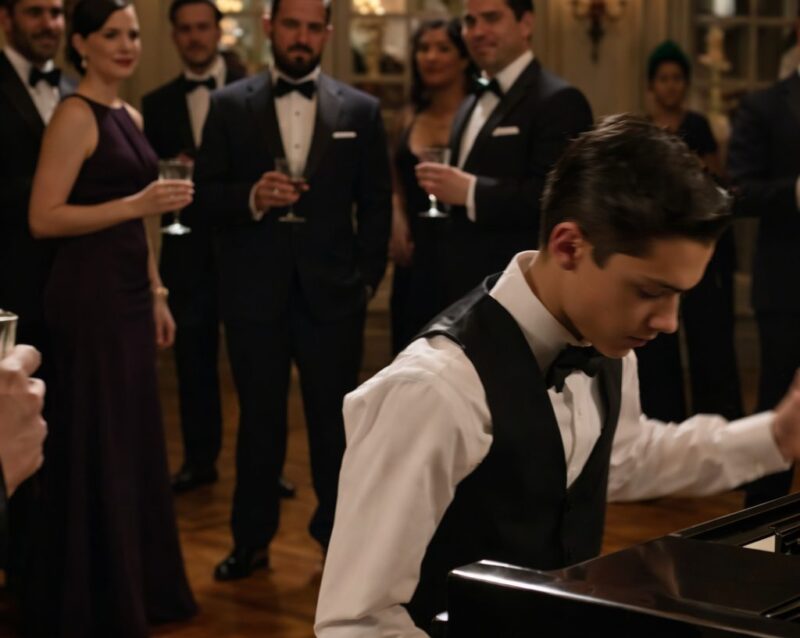
Standing nearby was a thin boy in a crisp waiter’s uniform, nearly invisible among the elegant crowd. He could not have been older than fifteen. His shoes were tidy but worn at the edges, and his young hands carefully balanced a silver tray filled with sparkling glasses.
For a long time, his eyes had been fixed on the piano.
To the guests, he was just another server—someone who passed quietly between tables and disappeared when not needed. But inside him, something stronger than the music of the party was stirring. Every soft melody floating through the room awakened memories that pulled him toward the instrument.
At last, he gathered the courage he had been building all evening.
Slowly, cautiously, he stepped closer to the piano. Not far away stood a tall man in an expensive navy suit, laughing with several guests. The watch on his wrist alone likely cost more than the boy’s family could earn in years.
The boy spoke softly, almost hesitantly.
“Excuse me… may I play the piano?”
The laughter nearby paused for a moment. The man turned, his gaze sliding from the silver tray to the boy’s uniform.
A quick smirk appeared on his face.
“You?” he said loudly enough for others to hear. “Have you ever even touched a piano?”
Several guests laughed lightly—not with cruelty, but with the easy disbelief people show when something seems impossible.
The boy felt warmth rise to his cheeks. For a moment, the old habit returned: lower your head, apologize, step away.
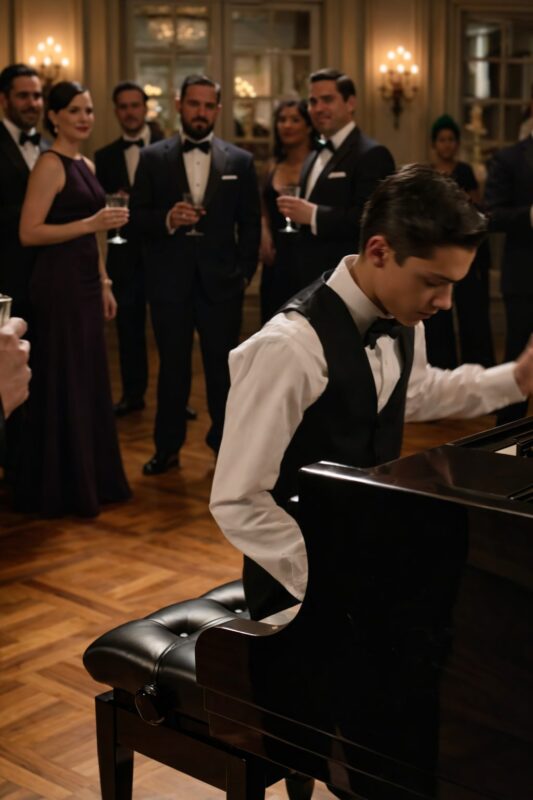
But he remained where he was.
Without arguing or explaining, he simply nodded and placed the tray carefully on a nearby table. The quiet sound of metal touching wood seemed strangely loud in the room.
Then he walked to the piano bench and sat down.
A small wave of curiosity moved through the guests. Some watched with amusement. Others were simply intrigued.
The boy lifted his hands and held them above the keys, as if greeting an old friend after a long absence.
The room seemed to pause.
As his sleeve shifted slightly, a small tattoo appeared on his wrist—a simple guitar drawn in faded ink.
The well-dressed man’s smile vanished. His eyes locked onto the symbol.
The boy pressed the first key.
A single clear note echoed through the hall.
Then another followed.
Within moments, the quiet testing of sound turned into music—rich, powerful, and deeply emotional. Conversations faded as if carried away by the melody. The music held something more than beauty: longing, memories, hope, and quiet pain. Every emotion the boy had never spoken flowed through his fingers.
People slowly turned toward the piano.
Glasses froze halfway to their lips.
Even the servers across the hall stopped moving.
The music swelled, filling the enormous room as though it had always belonged there. Each note carried a confidence far beyond the boy’s age. This was not practice.
This was belonging.
Standing nearby, the man in the navy suit felt a strange tension in his chest. A memory surfaced. Years earlier, a video had circulated quietly among musicians—a young child playing with astonishing skill on a broken roadside keyboard. The performance had been raw and unforgettable.
Beside the keyboard, someone had drawn a small guitar symbol.
The man whispered almost to himself, “Wait… are you that boy?”
The pianist did not stop playing, but something in his eyes answered.
The final note lingered softly in the air.
For a moment, silence filled the hall.
Then someone began to clap.
Another joined.
Within seconds, the entire room erupted in applause. Guests stood, some cheering, others simply staring, trying to understand what they had just witnessed.
The boy gently lowered his hands from the keys.
The man stepped closer, his voice now quiet and respectful.
“What’s your name?” he asked.
“…Daniel,” the boy replied.
The name meant nothing to the crowd, yet the music still echoed in the room.
“Where did you learn to play like that?” the man asked.
Daniel glanced briefly at the piano and then at his hands.
“My mom taught me,” he said softly. “Before she became sick.”
He paused.
“I used to play in the subway after that. Someone recorded it… but I stopped for a while.”
“Why?” the man asked.
Daniel lowered his eyes.
“Because music didn’t pay for medicine.”
The words settled heavily in the air.
For the first time that evening, the luxury surrounding them felt strangely fragile.
The man took a slow breath.
“Daniel… would you play again?” he asked gently. “Not as a waiter—but as a musician.”
Months later, the same melody filled a much larger concert hall.
A grand piano stood under bright stage lights.
Beside it sat a young performer who was no longer invisible.
When Daniel’s fingers touched the keys, no one laughed.
They listened.
Because sometimes the person no one notices is the one the world has been waiting to hear.