The little girl was supposed to remain invisible inside the enormous Alcázar estate.
Instead, she fell asleep on the owner’s chest—and accidentally became the reason a powerful family’s darkest secret finally came to light.
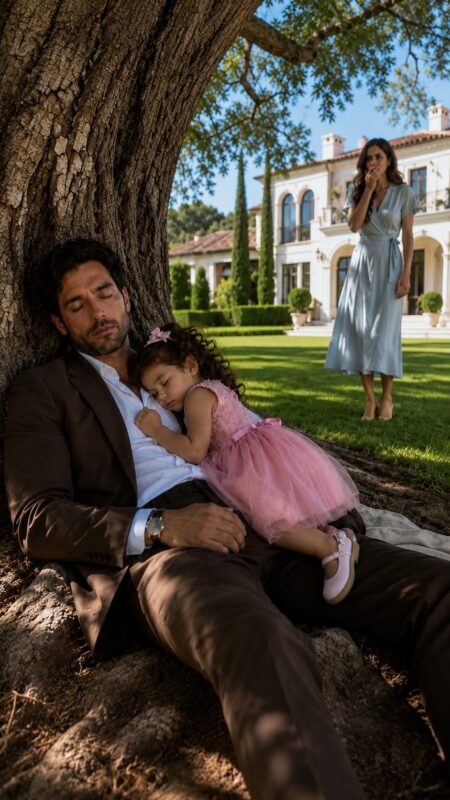
Alejandro Alcázar had money, influence, and more responsibility than he wanted. At thirty-eight, he supervised three companies and spent most of his days moving between boardrooms, conference calls, and business dinners.
There was only one place where nobody could reach him.
An ancient oak stood beyond the formal gardens of his family property outside Monterrey. Whenever Alejandro needed silence, he went there, loosened his tie, lay beneath the branches, and disappeared for an hour.
That was where Sofía found him.
The three-year-old stared at the apparently sleeping businessman for several seconds.
Then curiosity won.
She climbed onto his chest, curled against him, and promptly fell asleep.
Alejandro opened his eyes.
A tiny stranger was using him as a pillow.
Before he could decide what to do, Fernanda Ruiz came running across the lawn.
Her expression turned to horror.
“Sofía!”
She quickly explained. Fernanda worked in the house, and her childcare arrangements had fallen through that morning. Afraid of losing a day’s wages—or worse, her job—she had brought her daughter along without permission.
“I understand if you dismiss me,” she said quietly.
Alejandro glanced at Sofía, still sleeping peacefully.
“I’m not dismissing anyone.”
The incident should have ended there.
It didn’t.
A forgotten sitting room near the servants’ quarters became Sofía’s playroom. Toys appeared. Then books. Then crayons and a miniature table.
Soon, the mansion had something it had lacked for years: noise that wasn’t created by arguments, business calls, or formal parties.
Alejandro grew fond of the child.
Beatriz Alcázar grew suspicious.
Alejandro’s mother had spent decades treating reputation like another family asset. Every friendship, invitation, and marriage had political or financial value.
In her mind, Alejandro’s future already had a name.
Camila Sada.
Camila came from wealth, understood their social world, and looked perfect beside Alejandro at charity galas.
Fernanda was the opposite.
A widowed employee with a small child represented uncertainty.
Beatriz convinced herself that Fernanda’s presence was calculated.
One evening, Fernanda was stopped at the entrance by two security officers.
“You’ve been dismissed,” one informed her.
She barely had time to react before Beatriz ordered her handbag searched.
The guard reached inside.
When his hand emerged, diamonds glittered between his fingers.
The bracelet had belonged to Alejandro’s grandmother.
Fernanda froze.
“I’ve never touched that.”
Beatriz demanded the police.
Alejandro demanded the cameras.
The bracelet had been stored in a private safe. Very few people knew its combination, and Fernanda wasn’t one of them.
Security footage should have settled everything.
Instead, Alejandro discovered something stranger.
Eight minutes had vanished from the recording.
Fernanda looked around the room and understood what everyone else was thinking.
She didn’t wait for Alejandro to defend her.
She removed her staff identification card and placed it on the table.
“I won’t work somewhere I can be turned into a criminal whenever your family finds me inconvenient.”
She took Sofía and left.
By sunrise, the accusation was everywhere.
Photos showed Sofía sleeping peacefully against Alejandro beneath the oak tree.
But the headlines told another story.
They described Fernanda as an ambitious employee pursuing her wealthy employer. Some reports even connected her alleged relationship with the missing bracelet.
Alejandro immediately wondered who had supplied private photographs taken inside his estate.
Camila arrived that afternoon.
She offered an answer to the scandal before Alejandro had asked for one.
“Marry me.”
Alejandro stared at her.
“Excuse me?”
“Not tomorrow. Just announce the engagement. Once people see us together, Fernanda disappears from the story.”
That sentence bothered him.
Fernanda disappears.
Someone clearly wanted exactly that.
Alejandro ordered a forensic recovery of the estate’s surveillance system.
The missing eight minutes returned.
He watched Beatriz’s assistant enter the staff room carrying the bracelet.
She opened Fernanda’s handbag.
Dropped the jewelry inside.
Closed the bag.
Walked away.
Then technicians recovered fragments of audio from another recording.
Beatriz’s voice was unmistakable.
So was Camila’s.
One woman had engineered the theft accusation.
The other had arranged the photographs and gossip.
Alejandro confronted them, but before he could decide what came next, Fernanda received something far more frightening.
An envelope had been pushed beneath her apartment door.
Inside was a warning.
Leave Monterrey.
Beneath it lay an old internal safety report from an Alcázar-owned factory.
The name Javier Ruiz appeared throughout the document.
Fernanda’s late husband.
When Alejandro arrived at her apartment, she didn’t invite him inside.
Instead, she told him the story from the doorway.
Years earlier, Javier had worked maintenance at one of the family’s manufacturing plants. He discovered signs of a serious gas leak and repeatedly urged supervisors to shut down the affected section.
Management refused.
Every hour without production meant lost revenue.
Then the factory exploded.
Javier died.
The company called it an unforeseeable accident.
Later, the official story changed.
Javier himself was blamed for failing to follow safety procedures.
Fernanda lost her husband, her financial security, and any chance of compensation.
Alejandro had known almost nothing about the disaster.
At the time, he had been living abroad.
His mother had been overseeing company operations.
The report in Fernanda’s hands changed everything.
Executives had received Javier’s warnings before the explosion.
They knew the danger existed.
Production continued anyway.
And after people died, Beatriz had participated in making the evidence disappear.
Alejandro convened the board immediately.
His mother arrived dressed for victory.
Camila came with her.
Both believed Alejandro was finally going to announce the engagement that would restore the Alcázar family’s image.
The lights dimmed.
A security video appeared instead.
Nobody spoke as Beatriz’s assistant placed the diamond bracelet inside Fernanda’s bag.
Then came the audio.
The room heard enough to understand exactly what had happened.
Beatriz remained composed.
Until Alejandro placed Javier Ruiz’s safety report in front of her.
Her face changed.
“You don’t understand what was at stake,” she said.
“Then explain it.”
“A shutdown could have endangered the entire company. Thousands of people depended on those jobs.”
“And Javier?”
Beatriz said nothing.
Alejandro leaned forward.
“Did his life appear anywhere in your calculations?”
“It was a terrible accident.”
“No,” Alejandro replied. “You were warned. You chose not to act. That’s not the same thing.”
That afternoon, the evidence was delivered to the authorities.
Several executives were suspended. An outside investigation was authorized. Alejandro voluntarily stepped away from daily leadership until investigators could determine what responsibility the company—and his own family—carried.
But one final discovery remained.
Among his father’s belongings, Alejandro found correspondence proving that the older man had eventually learned what Beatriz had done.
He had considered exposing everything.
He never did.
Fear, loyalty, shame, or cowardice had kept him silent.
Shortly before his death, however, he had written his son a letter.
Alejandro read the final line repeatedly.
“Don’t let my silence become your inheritance.”
He didn’t.
The company acknowledged that critical safety warnings had been ignored and evidence had later been concealed. Compensation was offered to affected families, and an independently managed program was created to examine other questionable workplace incidents from previous years.
Fernanda accepted the money owed to Javier’s family.
Nothing more.
When Alejandro suggested she could return to the estate under better conditions, she refused.
“I don’t want another Alcázar deciding what my future should look like.”
He understood.
Fernanda eventually began working with an organization supporting employees harmed by unsafe workplaces.
Alejandro did not contact her again.
Months passed.
Then, on a quiet afternoon, he returned to the oak tree.
For once, he wasn’t hiding.
He simply wanted somewhere peaceful to sit.
A familiar voice interrupted the silence.
“You’re sleeping again.”
Alejandro opened his eyes.
Sofía stood beside him.
Behind her was Fernanda.
He smiled.
“I’m resting.”
Sofía climbed onto him before he could say anything else.
Apparently, seven months had changed many things but not her favorite seat.
Fernanda remained standing.
She carried a small wooden plaque.
Workers who had received assistance through the new compensation program had made it.
She handed it to Alejandro.
A sentence had been carved into the wood:
“Care begins where silence ends.”
Alejandro ran his fingers across the letters.
“I don’t deserve a thank-you.”
“Good,” Fernanda replied. “Because that isn’t why I’m here.”
He looked at her.
“Sofía kept asking about you.”
The child was already comfortable against his chest.
Fernanda continued.
“And I wanted to see whether all those public promises meant anything after the cameras disappeared.”
Alejandro almost smiled.
“What’s the verdict?”
She studied him for a long moment.
“Ask me again in a few years.”
It was not forgiveness.
It wasn’t a promise either.
But it was honest.
And honesty was enough to begin with.
Their lives crossed more often afterward, cautiously and without expectations.
Alejandro gradually learned something his wealth had never taught him.
Money could compensate for losses.
Influence could open doors.
Authority could force people to obey.
None of those things could create trust.
Trust had to be earned by what happened after the apology.
Fernanda never allowed Alejandro to confuse responsibility with generosity. When he tried to fix everything himself, she reminded him to listen first.
And Sofía remained completely unaware that any of this was complicated.
To her, Alejandro was simply the man beneath the oak tree who made a comfortable pillow.
Yet that child’s innocent decision to climb onto his chest had started everything.
A photograph led to a false accusation.
The accusation revealed a conspiracy.
The conspiracy uncovered an old report.
And the report finally exposed a tragedy that wealth had buried beneath years of silence.
For most of his life, Alejandro had been taught that protecting the Alcázar family meant defending its reputation.
Eventually, he understood the opposite.
A name has no honor simply because people are afraid to stain it.
Honor begins when someone is willing to expose the stain, accept the consequences, repair what can still be repaired, and understand that those who were harmed owe them neither gratitude nor forgiveness.
That was the inheritance Alejandro finally chose.