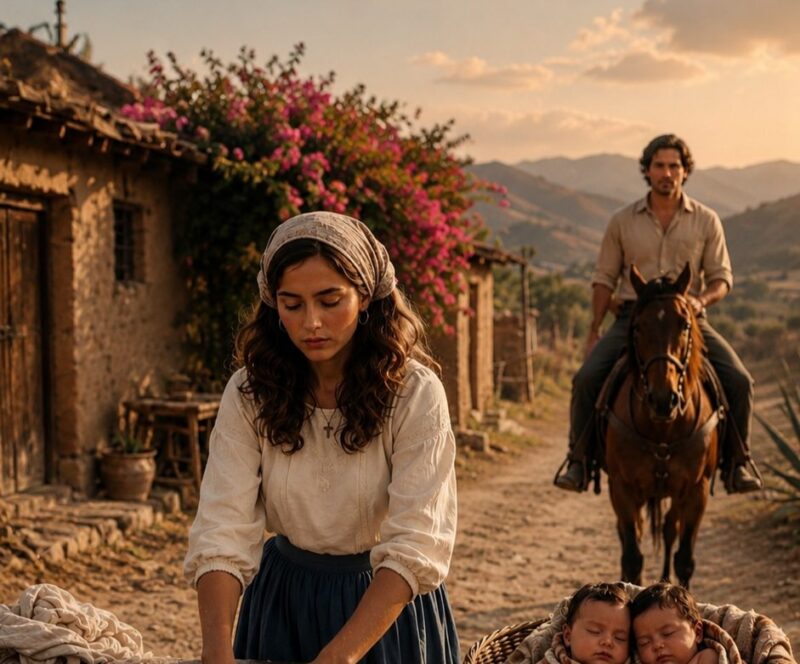
The morning Gabriel Landeros first appeared, Magdalena Villaseñor was standing ankle-deep in cold mud behind her house, wringing water from a shirt with hands she could barely feel.
A horse was coming up the narrow road.
She stopped working.
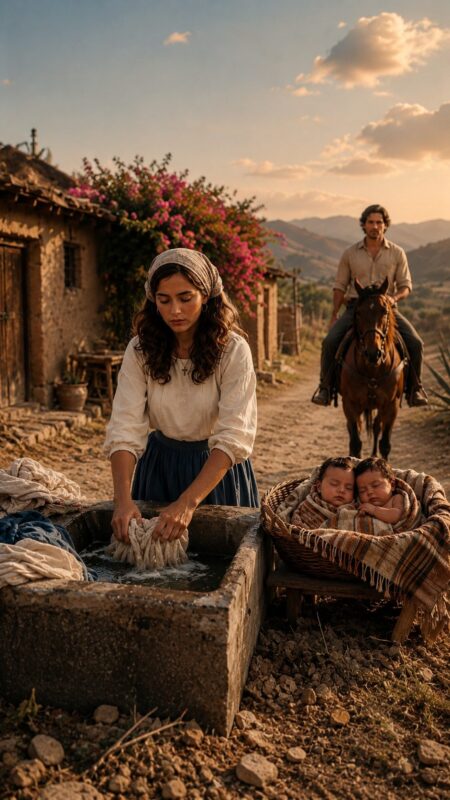
Under the broad branches of an old ash tree, her six-month-old twins, Tomás and Lucía, slept side by side on a woven blanket.
Magdalena glanced at them before turning back toward the approaching rider.
Five months had passed since she had buried her husband, Julián. In that short time, she had discovered that widowhood attracted visitors.
Creditors came looking for money.
Neighbors came carrying sympathy.
And certain men arrived offering assistance that sounded generous until they explained what they expected in return.
So when the stranger stopped his horse outside the fence, Magdalena did not welcome him.
She waited.
The man dismounted but remained on the other side of the gate.
“Gabriel Landeros,” he introduced himself. “I’ve been riding since sunrise. Could I trouble you for some water?”
The name was familiar.
La Estrella, his ranch, lay beyond the western hills. Magdalena had also heard the sad story attached to its owner. Gabriel’s wife, Teresa, had died giving birth, and the baby girl she delivered had not survived either.
Magdalena filled a clay cup and passed it through the fence.
Gabriel drank slowly.
“Thank you.”
He returned the cup and turned toward his horse.
Before mounting, however, he looked at the sky and then at Magdalena’s house.
Several clay tiles had slipped from the roof.
Rain clouds were gathering over the mountains.
Gabriel said nothing.
He simply rode away.
Magdalena assumed she would never see him again.
She was wrong.
Before midday, the same horse appeared on the road.
This time, Gabriel had brought roofing tiles, rope, and tools.
Magdalena met him at the gate.
“What are you doing?”
“Fixing your roof.”
“I didn’t ask you to.”
“No.”
“Then I cannot accept it.”
Gabriel rested the tools on the ground.
“You gave me water when you had no reason to trust me.”
“That was a cup of water.”
“And this is a few hours of work.”
Magdalena crossed her arms.
“I don’t accept debts I cannot repay.”
“Good,” Gabriel replied. “Neither do I.”
He pointed toward the roof.
“You gave me something I needed. Let me give you something you need. After that, the account between us is settled.”
Magdalena looked at the darkening sky.
Then she opened the gate.
That night, a hard rain swept across the valley.
The wind rattled the shutters, and water rushed through the yard.
But inside Magdalena’s house, the floor remained dry.
So did the blankets covering her children.
It was a small thing.
To Magdalena, it felt enormous.
Gabriel did not suddenly become a permanent visitor after that.
Sometimes several days passed without any sign of him.
Then he would appear with a practical reason for stopping.
A fence post had collapsed.
Winter nights were growing colder, so he brought extra firewood.
Once, he arrived carrying two roughly carved wooden animals for the twins.
“For when they stop trying to eat everything they touch,” he said.
Magdalena almost laughed.
Almost.
What mattered most was what Gabriel never did.
He never opened her door without permission.
He never treated her children as a way to win her affection.
He never reminded her of the favors he had done.
And he never suggested that a widow needed a man to manage her life.
By the time Magdalena realized she trusted him, the change had already happened.
Then Don Severo Barragán came to her property.
Unlike Gabriel, Severo did not wait outside the gate.
He arrived as though the land already belonged to him.
Two riders accompanied him.
Severo climbed down from his horse and pulled a folded document from inside his coat.
“Your husband left an unpaid obligation.”
Magdalena stared at him.
“What obligation?”
“Nine hundred pesos.”
For a moment, she thought she had misunderstood.
“Julián never borrowed nine hundred pesos.”
Severo unfolded the document.
The paper claimed otherwise.
According to it, Julián had borrowed the money shortly before his death and offered Magdalena’s property as security.
There was even a signature at the bottom.
Magdalena looked at it once.
Then again.
She knew every curve of Julián’s handwriting. She had watched him write his name hundreds of times.
“That isn’t his signature.”
Severo’s face remained calm.
“It is on a legal document.”
“It is still false.”
“You should be careful about making accusations.”
“And you should be careful about forging a dead man’s name.”
For the first time, Severo’s polite expression disappeared.
“You have thirty days.”
“For what?”
“To repay the money.”
“And if I don’t?”
“The property becomes mine.”
Only then did Magdalena understand.
This was never about nine hundred pesos.
Behind her house, water flowed from a natural spring even during the driest months of summer.
In a valley where drought could destroy an entire harvest, water meant survival.
It also meant power.
Severo wanted the spring.
Before leaving, he offered Magdalena what he called a generous compromise.
His nephew Anselmo needed a wife.
If Magdalena married him, Severo would forget the debt.
Everyone in the region knew what kind of man Anselmo was.
His temper was infamous.
Magdalena answered with a single word.
“No.”
Severo stepped closer.
“You have two babies and very little money. Pride is expensive for a widow.”
Magdalena did not lower her eyes.
“So is underestimating one.”
Severo rode away.
When Gabriel learned about the document, he came immediately.
“I’ll give you the money.”
“No.”
“Magdalena, nine hundred pesos is nothing compared with losing your home.”
“You don’t understand.”
“Then explain it.”
She looked directly at him.
“If you pay Severo, I remain on this land because you bought my freedom from him.”
Gabriel started to respond, but she continued.
“I will not trade one man’s control for another man’s protection.”
Silence passed between them.
Then Gabriel nodded.
“You’re right.”
The answer surprised her.
Most men she knew would have argued.
Gabriel did not.
He sat down on the wooden fence.
“So we find another way.”
“What way?”
“We prove Julián never borrowed the money.”
They began with the official records.
A notary searched through registered loans, property agreements, and outstanding debts.
Julián’s name appeared nowhere.
There was no nine-hundred-peso loan.
There was no registered agreement placing Magdalena’s land as collateral.
The document was fraudulent.
But that discovery opened the door to something much larger.
The notary remembered another widow who had lost property under suspicious circumstances.
Then another name surfaced.
And another.
Women whose husbands had died unexpectedly had been presented with debts they knew nothing about.
Some had paid.
Others had surrendered land.
One woman, Clara Ceballos, had refused to destroy the document used to take her family’s farm.
She brought it to Magdalena.
They placed Clara’s document beside the one Severo had given her.
The names were different.
The amounts were different.
But the handwriting was not.
Someone had manufactured both signatures.
Magdalena finally understood that she was not simply fighting for her own home.
She was challenging a system Severo had used for years.
And Severo understood it too.
His foreman, Eusebio, appeared at Magdalena’s house shortly before sunset one evening.
He remained on his horse.
“You need to stop asking questions.”
Magdalena stood in the doorway.
“No.”
Eusebio glanced toward the room where the twins were sleeping.
“You have children to think about.”
Her expression changed immediately.
“Look at me.”
Eusebio hesitated.
“Look at me,” she repeated.
He did.
“If you ever use my children to threaten me again, make certain you are prepared for what follows.”
Something uncertain passed across his face.
Not anger.
Fear.
But Magdalena sensed that the fear was not of her.
It was of Severo.
Eusebio rode away without another word.
Several days later, men arrived to seize the property.
Magdalena heard the horses before she saw them.
She carried Tomás and Lucía inside, closed the door behind them, and walked to the gate.
Her legs felt weak.
She was afraid.
Courage, she had learned, did not mean feeling nothing.
Sometimes courage was simply refusing to step aside while every instinct told you to run.
“This property belongs to me,” she told the riders.
“We have orders.”
“Then your orders are illegal.”
One man moved toward the gate.
Another sound rose from the road.
More horses.
Gabriel appeared first.
But he had not come alone.
The notary rode beside him.
Behind them came the parish priest, Clara Ceballos, farmers, laborers, widows, and families who had spent years believing they were powerless against Severo Barragán.
For once, Magdalena was not standing alone.
Documents were produced.
Names were read aloud.
Families began telling their stories.
And then Eusebio arrived.
Everyone expected him to defend his employer.
Instead, he dismounted and placed a battered leather notebook in the notary’s hands.
“I kept records,” he said.
Severo went pale.
Inside the notebook was the history of his empire.
Bribes.
Fabricated debts.
Forged signatures.
Threats.
Properties taken from families who had no means to fight back.
But Eusebio had one more truth to reveal.
One involving Julián.
Months before his death, Julián had discovered what Severo was doing.
He had threatened to expose him.
During the storm that later claimed Julián’s life, several of Severo’s men had driven cattle toward the flooded ravine where Julián was working. They had intended to frighten him and send a warning.
But one animal became trapped near the crossing.
Julián went after it.
The flood took him.
Magdalena listened without moving.
For months, she had blamed the storm.
Now she knew the storm had only completed what another man’s greed had begun.
Severo was eventually arrested.
Once his records were examined, the false debts collapsed one after another.
Families who had been cheated began reclaiming their property.
Clara recovered her farm.
Other widows recovered land they had believed was gone forever.
And Magdalena’s home remained exactly where it belonged.
In her name.
So did the spring.
After everything ended, Gabriel made no proposal.
He made no declaration.
He simply continued showing up.
When planting season arrived, he worked beside Magdalena in the field.
When the twins outgrew their sleeping baskets, he built them proper cradles.
When Tomás took his first steps, Gabriel crouched several feet away and encouraged him forward.
When Lucía began speaking, Gabriel insisted that her first clear word was his name.
Magdalena insisted it was “horse.”
Neither could prove it.
Nearly a year passed.
One afternoon, Magdalena asked Gabriel to accompany her to the cemetery.
She brought flowers for Julián.
Gabriel carried flowers for Teresa and the daughter he had barely been given time to know.
They stood before those graves without pretending the past could be erased.
Later, while walking home, Gabriel stopped beneath a mesquite tree.
“I need you to understand something.”
Magdalena waited.
“I will never ask you to forget Julián.”
Her eyes remained on him.
“I don’t want his place,” Gabriel continued. “I want whatever place might someday belong to me.”
Magdalena was quiet for a long moment.
Then she held out her hand.
Gabriel took it.
“If there is ever a marriage,” she said, “Tomás and Lucía keep their father’s name.”
“Yes.”
“The land stays in my name.”
“Yes.”
“The spring remains available to families who need water during drought.”
“Yes.”
She narrowed her eyes.
“You agree very quickly.”
Gabriel smiled.
“You haven’t said anything I would want to change.”
Magdalena looked down at their joined hands.
“One more condition.”
“I suspected there would be.”
“I will never marry because I need someone to save me.”
Gabriel’s smile faded into something gentler.
“I know you don’t.”
She looked up.
“But I could marry someone who knows the difference between protecting a woman and possessing her.”
Gabriel squeezed her hand.
“That sounds fair.”
Their wedding was small.
There were no elaborate decorations, expensive gifts, or powerful guests.
There were neighbors.
There was music.
There was food.
There were two children running where everyone could see them.
And there was Magdalena, standing beside a man she had chosen freely.
In the years that followed, the spring became more than a source of water.
During droughts, Magdalena opened it to families throughout the valley.
No farmer was turned away because he lacked money.
No widow was forced to surrender land in exchange for access.
Tomás eventually devoted his life to defending farmers and small landowners from exploitation.
Lucía became fascinated by documents, contracts, and property records. She learned exactly how a few lines of ink could destroy a family when no one understood what they were signing.
She made certain other women understood.
As for Magdalena, she never considered Gabriel the man who had saved her.
He had repaired a roof.
He had offered his help.
He had stood beside her when danger came.
But the person who refused Severo’s bargain, challenged the forged debt, defended the gate, and kept the land had always been Magdalena herself.
Perhaps that was why she loved Gabriel.
He had never tried to become the hero of her story.
He had simply respected her enough to let her remain her own.
And in the end, Magdalena learned that the deepest kind of love does not arrive demanding to be needed.
It arrives with respect.
It waits at the gate.
And when invited inside, it walks beside you.