The Night That Changed Everything
The storm did not arrive gently. It tore across the sky with violent force—rain hammering the ground, thunder echoing without pause, lightning splitting the darkness into brief flashes of harsh white light. On a forgotten highway in rural Tennessee stood a small roadside diner, clinging stubbornly to the edge of the road like a relic from another time. Its old neon sign flickered weakly, displaying only one surviving word: FOOD.
Water gathered in shallow pools across the cracked parking lot. Now and then headlights passed by before fading again into the storm.
Inside, the diner smelled of burnt coffee, old frying oil, and lemon cleaner. The vinyl booths had been softened by decades of customers. A tired ceiling fan squeaked slowly above. A radio played an old country song that sounded almost as weary as the building itself.
Behind the counter stood **Natalie Price**, twenty-four years old and worn down by life. She kept polishing the same glass, though it was already perfectly clean. Keeping her hands busy kept her thoughts quiet.
Half a year earlier, Natalie had been studying medicine. Her life had been filled with plans, textbooks, and the warm laughter of her mother. Then illness arrived suddenly. Hospital bills consumed their savings. Her education came to an abrupt stop. Natalie took double shifts to afford medication and spent long nights beside hospital machines—until one morning the machines went silent.
After grief came debt, documents, and an eviction notice.
Now she lived in a tiny room behind the diner’s kitchen and worked every shift she could find. Smiling for customers had become part of the job. So had hiding pain.
That night, as she counted the cash register, a powerful gust forced the front door open. Rain blew inside.
Natalie walked toward the entrance—and suddenly stopped.
Under a weak streetlamp outside sat an elderly man in a wheelchair. His thin jacket was soaked through. His hands trembled uncontrollably. No car stood nearby. No one accompanied him.
Without thinking, Natalie ran into the rain.
“Sir,” she said, kneeling beside him. “Can you hear me?”
The man slowly lifted his head. His lips were pale and blue. When he tried to speak, no clear words came out.
Natalie grabbed the wheelchair handles and pushed with all her strength. The wheels struggled over broken pavement as rain soaked her hair and clothes. Thunder roared overhead. Still, she pushed until she managed to get him inside.
She wrapped the diner’s only blanket tightly around his shoulders.
“You’re safe now,” she said softly.
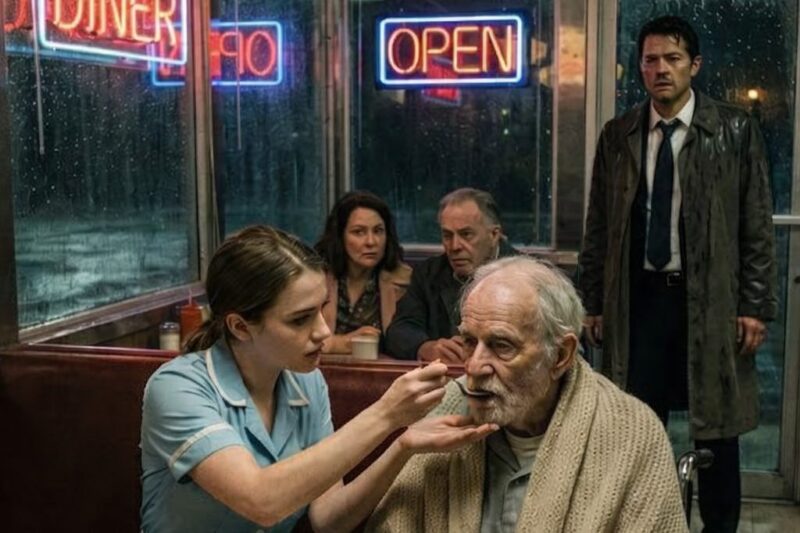
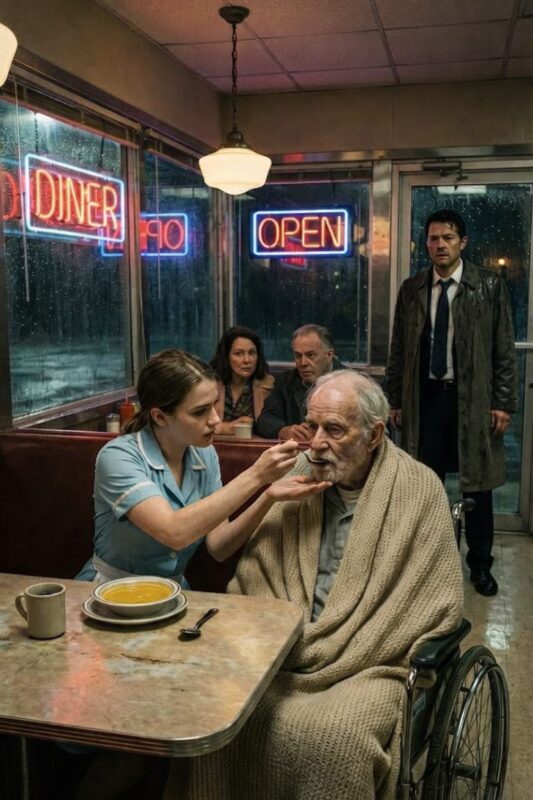
The kitchen had already closed, but Natalie turned the burner back on and warmed a bowl of leftover soup. She brought it to a corner booth and carefully fed him spoon by spoon.
“Just a little more,” she encouraged gently.
Slowly, his breathing steadied.
What Natalie didn’t notice was the black sedan pulling into the parking lot.
A tall man stepped out, rain dripping from his coat. His name was **Brandon Pierce**—the owner of hospitals, technology companies, and care facilities across the country. Business magazines called him brilliant. Critics called him ruthless.
But tonight he was simply a worried son.
An hour earlier he had received a call that shattered his calm.
“Mr. Pierce… your father has gone missing from the care residence.”
Brandon had spent enormous amounts of money ensuring his father, **Arthur Pierce**, received the best medical supervision available. He believed wealth could guarantee safety.
Yet now his father had vanished into a violent storm.
A highway patrol officer had mentioned seeing an elderly man in a wheelchair near the diner. Brandon drove there without hesitation.
When he pushed open the diner door, he stopped in silence.
His father sat peacefully in a worn booth, wrapped in a thin blanket. Across from him, a tired young waitress patiently fed him soup.
Arthur looked calmer than he had in months.
Brandon approached slowly.
“Natalie,” he said quietly, reading her name tag.
She turned in surprise. “Are you family?”
“He’s my father.”
Arthur stirred when he heard the familiar voice.
“Brandon…” he whispered.
The billionaire dropped beside the wheelchair and took his father’s shaking hand.
“I’m here,” he said softly.
Natalie spoke quickly, worried she had done something wrong.
“I found him outside in the rain. He was freezing.”
Brandon looked at her carefully—the damp uniform, worn shoes, and deep exhaustion she tried to hide.
“You saved his life,” he said.
The night ended quietly. Brandon took his father back to the hospital while Natalie locked the diner and walked through the rain to the bus stop.
She believed that was the end of the story.
She was wrong.
Two days later Brandon discovered the truth: a caregiver had forgotten to secure a door, and a security guard had fallen asleep. A facility costing millions had failed in its most basic duty.
Executives were dismissed. Lawsuits followed. Systems were rebuilt.
But Brandon made one more decision.
A week later he returned to the diner. Morning sunlight now filled the windows.
Natalie stood behind the counter pouring coffee when he approached and placed a folder before her.
Inside were official documents.
“I paid your medical debts,” Brandon said. “Your rent is covered. You’re reenrolled in nursing school, and there will be a job waiting for you at one of our clinics when you graduate—if you want it.”
Natalie stared at him in disbelief.
“But you don’t even know me,” she whispered.
Brandon smiled slightly.
“I know that you chose compassion when nobody was watching. That tells me enough.”
Years later Natalie became a nurse known for extraordinary patience and kindness. Patients requested her by name.
Arthur Pierce lived long enough to attend her graduation. He sat in the audience applauding with trembling hands.
Sometimes, on rainy evenings, Natalie still drove past the diner where everything had begun.
That night she believed she had rescued a stranger.
In truth, she had changed several lives—including her own.
Because even in a world ruled by money and influence, the simplest act of kindness still carries the greatest power.