The storm had turned Manhattan’s streets into rivers when an elderly man appeared outside the Beaumont Hotel.
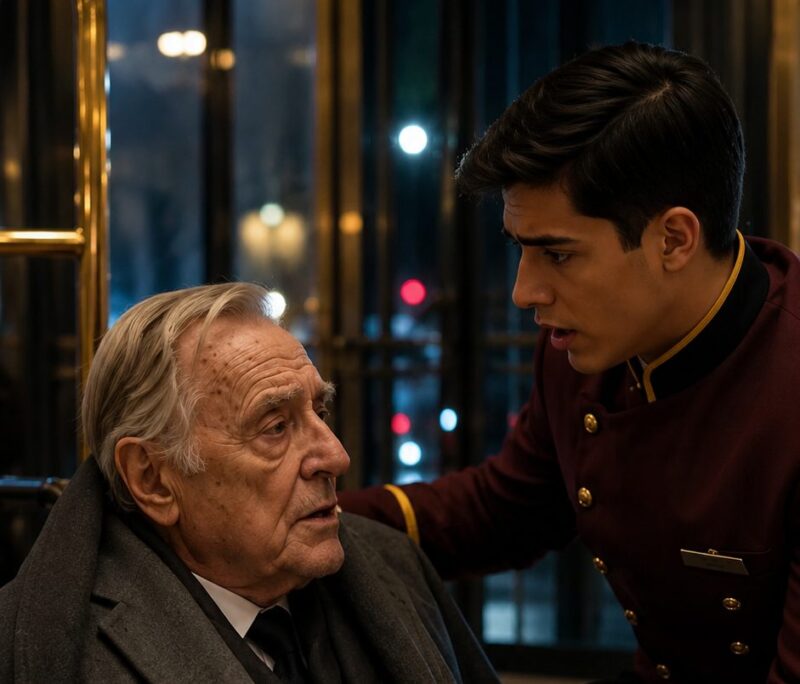
At sixty-eight, Edward Sullivan looked like any tired traveler caught in bad weather. His charcoal coat was soaked at the shoulders, and one wheel of his worn leather suitcase squeaked as he pulled it toward the revolving doors.
People hurried past without noticing him.
Inside, Lucas Bennett was counting the minutes until the end of his shift.
The twenty-year-old bellhop had already been working for nearly ten hours. Between classes, rent, and tuition, he accepted almost every extra shift the hotel offered.
Lucas was returning a luggage cart when he heard something crash outside.
Edward had lost his balance.
His suitcase struck the pavement and opened, sending documents fluttering across the wet sidewalk. Then the older man crumpled beside the entrance.
People gathered behind the glass.
Some stared.
Others raised their phones.
Lucas ran toward the doors.
His manager, Robert Crane, stopped him.
“Where do you think you’re going?”
“He fell. I’m going to help him.”
“Stay at your station. Security will deal with it.”
Lucas glanced around.
“There isn’t a security officer here.”
“Then wait.”
Outside, Edward remained on the pavement.
Lucas made his decision.
“No.”
He stepped around Robert and rushed into the storm.
Rain soaked through his uniform almost immediately.
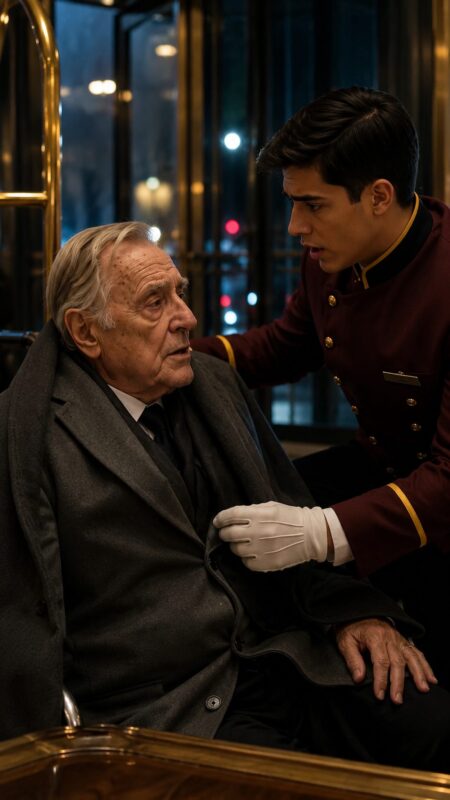
Lucas knelt beside Edward, made sure he was conscious and breathing normally, and helped him sit upright. Seeing the older man shivering, Lucas removed his burgundy uniform jacket and wrapped it around his shoulders.
“Stay still. Help is coming.”
Edward studied the young man’s face.
“You’ll get in trouble for this.”
Lucas gave a small shrug.
“Then I’ll get in trouble.”
He called for medical assistance and stayed with Edward until the paramedics arrived.
When Lucas finally walked back inside, dripping water onto the polished marble floor, Robert was waiting.
Several employees had gathered nearby.
Robert didn’t lower his voice.
“Turn in your badge. You’re done.”
Lucas stared at him.
“You’re firing me?”
“You abandoned your position after receiving a direct order.”
“A man had collapsed outside.”
“And you were told to remain at your post.”
Lucas swallowed.
That paycheck paid his rent. Those shifts helped cover his tuition. Losing the job could derail everything he had been working toward.
But there was one thing he knew with certainty.
He would do it again.
Lucas nodded slowly.
“Fine.”
He turned toward the staff elevator.
Then the revolving doors moved.
Edward Sullivan walked back into the Beaumont.
Lucas’s burgundy jacket was still around his shoulders.
The lobby became quiet.
Edward pulled a phone from his pocket and made a call.
“Contact every available member of the Beaumont board,” he said. “Tell them to come to the hotel tonight.”
Robert frowned.
“Sir, you can’t—”
Edward raised his eyes.
“And tell them Edward Sullivan is already here.”
Robert stopped speaking.
For several seconds, nobody moved.
Then recognition appeared on the manager’s face.
“Mr. Sullivan?”
Edward removed his wet glasses.
“Yes.”
“I—I didn’t know you were coming.”
“That was precisely why I came.”
Lucas looked between them, confused.
Edward Sullivan was the principal owner of the Beaumont.
For months, troubling reports had been reaching him.
Employees complained about unexplained wage deductions. Experienced workers disappeared after questioning management decisions. Overtime payments were missing. Funds allocated for safety improvements couldn’t be properly accounted for.
Whenever Edward requested explanations, the paperwork appeared flawless.
So he decided to inspect the hotel without announcing himself.
No chauffeur.
No executive assistant.
No expensive suit.
Just an old coat and a battered suitcase.
He wanted to know how people behaved when they believed nobody important was watching.
Robert had shown him.
Edward faced the manager.
“You saw a man collapse outside your hotel.”
“I followed procedure.”
“No,” Edward replied. “You protected appearances.”
Robert stiffened.
“I was maintaining order in the lobby.”
“And Lucas maintained something more important.”
Edward pointed toward him.
“Basic human decency.”
By evening, the Beaumont’s conference rooms were filled with board members, auditors, attorneys, and senior executives.
The review continued through the night.
The numbers told an ugly story.
Workers had been fined for violations that had never occurred. Overtime records had been altered. Money assigned to employee health and emergency preparedness had been redirected elsewhere.
Employees who questioned those practices had been dismissed.
Robert Crane was suspended before midnight.
Lucas knew none of this yet.
He was in the staff room placing his belongings into a cardboard box when Edward entered.
Lucas stood.
“Mr. Sullivan.”
“Put that box down.”
Lucas hesitated.
“I’ve already been fired.”
“Not anymore.”
“I disobeyed my manager.”
Edward looked at him for a moment.
“You were given a choice between obeying an order and helping another person.”
He removed Lucas’s burgundy jacket and handed it back.
“You chose the person.”
Lucas took the jacket.
Edward continued.
“A hotel can replace a damaged carpet. It can replace a broken window or a ruined uniform. What it cannot afford to lose is its humanity.”
The investigation widened over the following weeks.
Financial records were examined, former employees were interviewed, and evidence of fraudulent accounting was eventually referred to the authorities.
When Robert was escorted from the building, he spotted Lucas nearby.
“You destroyed my life,” Robert snapped.
Edward happened to be standing beside him.
“No,” he said quietly. “Lucas simply gave you an opportunity to reveal how you were living it.”
Robert said nothing more.
Edward, meanwhile, had begun examining Lucas’s employment record.
What he discovered surprised him.
Lucas frequently gave part of his tips to older employees who were struggling financially. He volunteered for difficult shifts. Guests had repeatedly mentioned his kindness in feedback forms.
And almost every evening, during his breaks, Lucas could be found reading books about hospitality and business management.
Edward summoned him to his office.
“What are you studying?”
“Hotel management.”
“Why?”
Lucas smiled awkwardly.
“I’d like to run one someday.”
Edward leaned back in his chair.
“Then perhaps we should start preparing you.”
He offered Lucas financial support for college and a position in a newly created department responsible for guest safety and employee welfare.
Lucas accepted.
The Beaumont began changing.
Unpaid wages were restored. Management practices were reviewed. Employees received better training, and a medical room was created for emergencies.
But Edward insisted on one new policy above all others.
If a person was in immediate need of assistance, every Beaumont employee had the authority to stop working and help.
No manager’s permission was necessary.
Years passed.
Lucas completed his degree while continuing to work at the hotel. Edward gradually became his mentor, teaching him about budgets, negotiations, hiring, leadership—and mistakes.
Especially mistakes.
One afternoon, they stood on the mezzanine overlooking the lobby.
“I thought building a beautiful hotel was enough,” Edward said.
Lucas looked at him.
“It wasn’t?”
Edward shook his head.
“A building doesn’t create hospitality. People do. I forgot that.”
“You remembered.”
Edward smiled.
“Because a twenty-year-old bellhop ignored an order.”
Five years after their first meeting, the Beaumont’s board gathered for an announcement.
Lucas Bennett was appointed general manager.
He was twenty-five.
At the ceremony, Lucas carried an old burgundy jacket over one arm.
Most employees recognized it.
“I nearly lost my job because of this jacket,” he told them.
A few people laughed.
Lucas smiled.
“That night, I believed I was choosing between my career and helping a stranger. I eventually understood that I was choosing what kind of person—and what kind of leader—I wanted to become.”
He glanced toward Edward.
“A great hotel isn’t defined by marble floors, expensive rooms, or crystal chandeliers. It’s defined by how people are treated when nobody thinks they’re important.”
Years later, another violent storm swept across Manhattan.
Near midnight, an elderly traveler entered the Beaumont.
His foot slipped beside the revolving doors.
Before he could fall, three employees reached him.
One supported his arm.
Another brought a chair.
The third called for assistance.
No one asked a supervisor.
No one checked the man’s clothes to determine whether he belonged in a luxury hotel.
They simply helped.
From across the lobby, Lucas watched.
He smiled.
Edward Sullivan had passed away several months earlier.
By then, Lucas was no longer the nervous bellhop who worried about losing his tuition money.
He was responsible for the hotel Edward had spent his life building.
In Lucas’s office hung a photograph taken years earlier on a rain-soaked Manhattan evening.
In it, Edward stood outside the Beaumont wearing a burgundy bellhop jacket that was far too small for him.
Beneath the photograph was a sentence Edward had written by hand:
“Power tells people who can give orders. Character tells us whose example is worth following.”
Robert Crane had believed leadership meant being obeyed.
Lucas learned that leadership meant knowing when compassion mattered more than authority.
One man clung to his position and lost it.
The other risked his position to help someone he believed could offer him nothing.
That decision gave Lucas far more than a successful career.
It gave him a mentor, a purpose, and a legacy worth continuing.
And long after Edward was gone, one principle remained at the heart of the Beaumont:
Never decide someone’s value by their clothes, their wealth, their title, or what they can do for you.
See the person first.