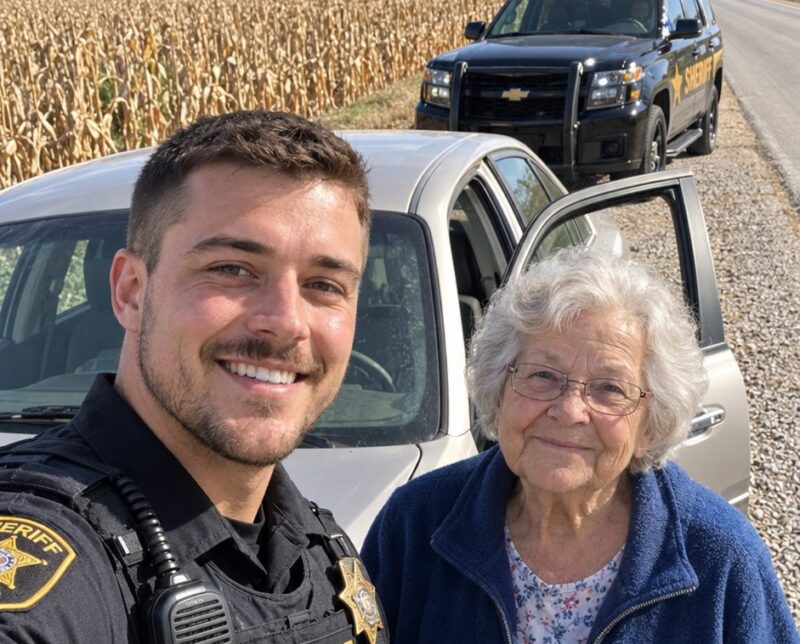
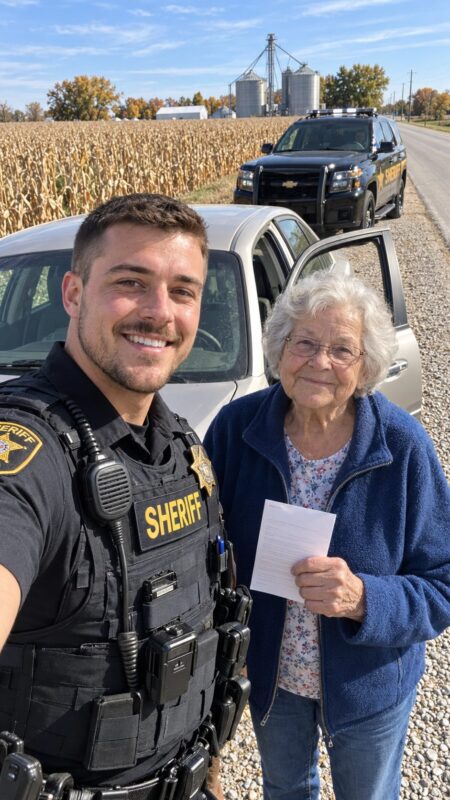
The young deputy made my 71-year-old mother stand on the side of a scorching highway for forty minutes. The temperature had climbed to 91 degrees, yet he refused to let her return to her car. He accused her of using a counterfeit driver’s license and threatened to impound her Buick.
Mom didn’t shout. She didn’t demand a supervisor or threaten to sue.
Instead, she quietly asked him one question.
“Officer, would you mind telling dispatch my name?”
He gave a mocking laugh.
“Sure. Shirley Hagen.”
What happened next was something neither of us could have imagined.
The dispatcher suddenly asked him to repeat the name. Within moments, firefighters, state troopers, and the county sheriff were speaking over the radio.
Then a familiar male voice cut through the conversation.
“Is Shirley Hagen all right?”
The deputy stiffened.
“Dad?”
His father’s next words left him speechless.
“Son, that woman is the reason you still have a father.”
That Sunday had begun like any other.
Mom and I were on our way to a church luncheon in her aging blue Buick. She wore a cheerful floral dress, and the sweet smell of freshly baked lemon bars filled the car.
She was telling me about a new recipe she wanted to try when flashing police lights appeared behind us.
Mom immediately pulled over.
A deputy who looked to be in his mid-twenties approached the driver’s window.
“License and registration.”
His name tag read KYLE BRANDT.
Mom reached into her handbag and produced her registration along with a temporary driver’s license.
Her original license had been damaged several days earlier, and the county office had issued a temporary document while her replacement was being processed.
Kyle studied the paper with obvious suspicion.
“What’s this supposed to be?”
“My temporary license,” Mom answered. “The county office issued it last week.”
He held it up to the sunlight.
“This doesn’t look official.”
“I understand your concern, Officer, but it’s valid. You’re welcome to verify it.”
Instead of checking the document and allowing her to wait inside, he ordered her out of the car.
“Step outside, ma’am.”
I leaned forward.
“Officer, my mother is seventy-one. It’s extremely hot. Can she please remain seated?”
He gave me a warning look.
“You stay where you are.”
Mom touched my shoulder.
“Don’t worry, sweetheart. We’ll have this sorted out soon.”
She stepped onto the gravel shoulder.
The sun was brutal.
Heat rose from the pavement, and there wasn’t a patch of shade anywhere nearby.
Kyle returned to his patrol vehicle, closed the door, and switched on the air conditioning.
Mom waited beside the Buick.
Five minutes passed.
Then fifteen.
By the time thirty minutes had gone by, her cheeks were flushed, and she was beginning to look unsteady.
“Mom, get back inside,” I called.
She shook her head.
“Let’s not make things worse.”
I watched helplessly as another ten minutes dragged by.
Finally, Kyle emerged from his patrol car.
“Well,” he announced, “I still can’t verify this license. I’m considering having your vehicle towed.”
I couldn’t stay silent.
“You made an elderly woman stand in this heat for forty minutes, and now you’re threatening to take her car?”
He turned toward me.
“Keep arguing, and I’ll issue you a citation, too.”
Before I could respond, Mom raised her hand.
“Officer, may I ask you for a small favor?”
Kyle sighed impatiently.
“What now?”
“Please say my full name over your radio.”
He frowned.
“Why?”
“Just humor an old woman.”
He shook his head and lifted his microphone.
“Dispatch, this is Unit Twelve. I’ve got a woman here claiming her temporary license is legitimate. Name’s Shirley Hagen. She seems to believe someone might know who she is.”
He released the button with a sarcastic smile.
“There. Happy?”
Mom nodded.
“Thank you.”
Then the radio crackled.
“Unit Twelve, confirm that name.”
Kyle looked surprised.
“Shirley Hagen.”
“Spell the surname.”
“H-A-G-E-N.”
There was a brief silence.
Then the dispatcher spoke again.
“Stand by, Unit Twelve.”
Another voice suddenly joined the conversation.
“Did somebody say Shirley Hagen? This is Captain Miller with County Fire and Rescue.”
Kyle stared at the microphone.
“That’s correct.”
“Ask her if she remembers the old Miller Bridge rescue. Tell her Captain Miller hasn’t forgotten.”
Before Kyle could reply, a state trooper broke in.
“State Patrol Seven here. Shirley Hagen from Kessler County dispatch?”
“Apparently,” Kyle muttered.
“Tell her the troopers who worked the Christmas Eve blizzard still talk about her.”
Mom looked away, visibly uncomfortable with the attention.
Then a commanding voice filled the radio.
“Deputy Brandt, Sheriff Hanley speaking.”
Kyle immediately straightened.
“Yes, Sheriff.”
“Is Shirley Hagen standing beside her vehicle?”
“Yes, sir.”
“How long has she been outside?”
Kyle hesitated.
“Approximately forty minutes.”
“In this temperature?”
“Yes, sir.”
The sheriff’s voice became sharp.
“Move her somewhere cool immediately. Give her water. I’m heading to your location.”
Kyle swallowed.
“Understood.”
He was reaching for the door when another voice interrupted.
“Tom, what’s going on? Somebody said Shirley Hagen’s name.”
Kyle froze.
He recognized that voice instantly.
“Dad?”
“Kyle? Are you the deputy who stopped her?”
“Yes, but—”
“Tell me she’s okay.”
“She’s fine, Dad.”
“Why is the sheriff saying she’s been standing outside for forty minutes?”
Kyle couldn’t answer.
His father continued.
“Son, do you have any idea who that woman is?”
Kyle glanced toward Mom.
“No.”
The reply came slowly.
“She saved my life seventeen years ago.”
My mother had worked as an emergency dispatcher for thirty-four years.
While most of Kessler County slept, she sat beneath fluorescent lights, answering calls from people experiencing the worst moments of their lives.
She talked frightened children through emergencies.
She helped rescue crews locate stranded motorists.
She coordinated ambulances, firefighters, and police officers during storms and accidents.
And she had an extraordinary ability to keep panicked callers calm.
But Mom never considered herself a hero.
Whenever someone praised her work, she’d wave a hand dismissively.
“I was just doing my job.”
Walter Brandt’s emergency was one she rarely discussed.
Seventeen years earlier, Walter had been repairing a tractor on his family’s isolated farm when the machine overturned, pinning him beneath it.
He was alone.
His mobile phone barely worked, but he managed to reach emergency dispatch.
Mom answered.
“Kessler County emergency services. What’s your location?”
Walter couldn’t give her an exact address.
He was frightened, confused, and growing weaker.
Mom immediately coordinated the search while keeping him on the line.
For fifty-one minutes, she spoke to him.
At first, she asked practical questions about landmarks and nearby roads.
Then, when she sensed his fear overwhelming him, she changed the subject.
“Walter, tell me about your family.”
He mentioned his wife and his little boy.
“What’s your son’s name?”
“Kyle.”
“How old is Kyle?”
“Nine.”
“What does he like to do?”
“Fishing. Baseball. Anything outdoors.”
Mom smiled into the telephone.
“Sounds like quite a boy.”
Walter began telling stories.
He talked about their first fishing trip, the time Kyle fell into a muddy creek, and the bicycle he’d promised to buy him.
Whenever his voice faded, Mom gently brought him back into the conversation.
“Walter, I want to hear more about Kyle.”
And he kept talking.
By the time rescuers located him, he had been on the phone with Mom for nearly an hour.
He survived.
Years later, he told friends that her calm voice had helped him hold on until help arrived.
Mom never mentioned the incident to me.
To her, Walter was one of hundreds of people she’d helped.
But to Walter, she was unforgettable.
Now, listening over the radio, his son was learning that the woman he’d humiliated had given their family a second chance.
“Kyle,” Walter said quietly, “I got to watch you grow up because Shirley stayed with me on that call. I was there for your graduation. I taught you to drive. I watched you become a deputy.”
His voice trembled.
“And today, you treated her like she didn’t deserve a little kindness.”
Kyle stared at the ground.
For the first time, he had nothing to say.
Sheriff Hanley arrived a few minutes later.
He immediately escorted Mom into his air-conditioned SUV, handed her water, and asked whether she needed medical attention.
She assured him she was feeling better.
Then he turned to Kyle.
“Explain why a seventy-one-year-old woman was left standing beside a highway for forty minutes.”
Kyle shifted uncomfortably.
“I was attempting to verify her temporary license, sir.”
“And why couldn’t she wait inside her vehicle?”
Kyle remained silent.
The sheriff shook his head.
“Your authority doesn’t excuse a lack of judgment. Every person you stop deserves courtesy and consideration.”
He paused.
“I’m assigning you to the overnight emergency communications shift for the next thirty days. You’ll work under supervision, and you’ll learn what it means to help people when they’re frightened and vulnerable.”
Kyle nodded.
“Yes, Sheriff.”
Then Hanley turned toward Mom.
“Shirley, I want you to know you have every right to submit a formal complaint. This incident will be documented and reviewed regardless of what you decide.”
Mom thanked him.
“I appreciate that, Tom. I just hope something good comes out of this.”
She looked directly at Kyle.
“Young man, can I give you a little advice?”
He nodded.
“Of course, ma’am.”
“Every stranger has a life you know nothing about. Some are carrying grief. Some are frightened. Some have spent years helping others without ever being thanked.”
Kyle lowered his eyes.
Mom continued.
“You don’t have to know their story to treat them with respect.”
His voice was barely audible.
“I’m very sorry, Mrs. Hagen.”
She gave him a gentle nod.
“Then remember how you feel right now, and make sure you treat the next person better.”
I assumed that would be the last time we saw Deputy Kyle Brandt.
I was wrong.
Three weeks later, our doorbell rang.
When I opened the door, Kyle stood on the porch holding a bouquet of yellow flowers.
He was dressed in ordinary clothes.
“Is Mrs. Hagen home?” he asked.
Mom appeared behind me.
“Hello, Deputy.”
“Actually, ma’am, I’m off duty today. And I was hoping we could talk.”
She invited him inside.
We sat around the kitchen table while Mom poured iced tea.
Kyle seemed nervous.
“I’ve spent the last three weeks working overnight dispatch,” he began.
Mom listened quietly.
“I thought it would be boring. Answering phones, passing along information, filling out reports.”
He shook his head.
“I had no idea.”
He told us about the calls he’d heard.
A mother desperately searching for her missing child.
An elderly man who had fallen and couldn’t explain where he was.
A teenager frightened by an emergency at home.
Call after call, he’d watched experienced dispatchers respond with patience and compassion.
“One night, a woman kept asking the same question,” he said. “I started getting irritated. Then I realized she wasn’t ignoring my answers. She was terrified.”
He looked at Mom.
“I remembered what you said about everyone having a story.”
Mom smiled faintly.
“And what did you do?”
“I slowed down. I listened. I let her talk until she could explain what she needed.”
He paused.
“That was the first time I understood the difference between controlling a situation and actually helping someone.”
Mom reached across the table and gently squeezed his hand.
“That’s an important lesson.”
Kyle placed the flowers in front of her.
“My dad wanted me to tell you something, too.”
“What is it?”
“He says he still remembers your voice.”
Mom’s expression softened.
“He was a very brave man that night.”
Kyle shook his head.
“He says you were the brave one.”
For a moment, nobody spoke.
Then Mom smiled.
“Well, I’m glad he’s doing well.”
That evening, after Kyle left, I sat with Mom on the back porch.
The sun was setting, and the air had finally cooled.
“I never realized how many people remembered you,” I admitted.
Mom laughed softly.
“Most of them probably don’t.”
“But some do. And you changed their lives.”
She looked toward the garden.
“I just tried to be there when people needed someone.”
Her answer stirred a memory I’d carried since childhood.
Growing up, I’d hated her overnight shifts.
She missed school concerts, holiday dinners, and more football games than I could count.
I used to search the bleachers, hoping to see her waving from the crowd.
Often, she wasn’t there.
For years, I believed her work mattered more to her than I did.
“Mom,” I said quietly, “do you remember my final football game in high school?”
She looked surprised.
“Of course.”
“You weren’t there.”
“I know, sweetheart.”
I stared at my hands.
“I used to be angry about that.”
She was silent for a moment.
Then she said something I never expected.
“Do you remember the little silver radio I kept in the kitchen?”
I nodded.
“I took it to work with me. Whenever things were quiet, I’d turn it on and listen to the games.”
I looked up.
“You listened?”
“As often as I could.”
Then she began describing that final game.
The touchdown I scored before halftime.
The missed field goal in the fourth quarter.
The final play that secured our victory.
She even remembered the short interview I gave afterward.
“You sounded so proud,” she said.
I couldn’t speak.
All those years, I’d imagined Mom sitting at work, completely unaware of the moments that meant so much to me.
But she’d been listening whenever she could, cheering quietly between emergency calls.
She hadn’t stopped being my mother when she put on her headset.
She had simply been trying to care for her family while caring for others.
I reached for her hand.
“I’m sorry I never understood.”
Mom squeezed my fingers.
“You were a child. You wanted your mother there. I understood that.”
We sat together until the porch light came on.
A few days later, Mom’s permanent driver’s license arrived in the mail.
The traffic stop became a story our family occasionally discussed, but Mom never spoke about Kyle with bitterness.
She hoped he would become a better deputy.
And from what we later heard, he did.
His colleagues noticed he had become more patient during traffic stops. He took more time to explain things to confused drivers, and he treated elderly residents with greater consideration.
Walter Brandt even stopped by one afternoon to thank Mom personally.
He brought an old photograph of himself and Kyle on a fishing trip.
“Taken a year after the accident,” he explained.
Mom studied the picture with a smile.
“That’s a lovely memory.”
Walter nodded.
“One I might never have had without you.”
She tried to brush off the compliment, as always.
But this time, I wouldn’t let her.
“Mom, just say thank you.”
She laughed.
“All right. Thank you.”
It was such a small moment.
Yet somehow, it meant everything.
After that summer, I made a promise to myself.
No matter how busy life became, I would call Mom every Sunday.
Not because she was getting older.
Not because she needed someone to check on her.
But because I finally understood something I’d overlooked for years.
For thirty-four years, she’d answered calls from strangers who needed reassurance, guidance, or simply a calm voice during a frightening moment.
She had been there for people she would never meet again.
And she had done it without expecting recognition.
Now I wanted her to experience the same simple kindness she had offered so freely.
Every Sunday afternoon, I dial her number.
Sometimes we talk for an hour.
Sometimes we chat for only a few minutes.
We discuss her flowers, the neighbors, old memories, and whatever else comes to mind.
And every time, she answers with the familiar warmth I’ve known my entire life.
“Hello, sweetheart.”
I smile.
“Hi, Mom. Just calling to see how your week’s been.”
She usually laughs.
“Oh, nothing exciting. Tell me about yours.”
But I know better now.
Behind that ordinary voice is a lifetime of extraordinary moments.
Lives saved.
Families reunited.
Strangers comforted.
A little boy who grew up because his father made it home.
And a son who finally recognized how much his mother had given.
That day on the highway taught me something I’ll never forget: You don’t need to know a person’s accomplishments to show them respect. Kindness should never depend on someone’s status, reputation, or connections.
And sometimes, the greatest gift you can give someone who has spent a lifetime listening to others is a simple phone call that says:
“You matter to me, and I haven’t forgotten you.”