They Left Their Children on an Icy Sidewalk… Believing It Was Their Only Chance to Survive
For years, I believed there was no excuse for parents who walked away from their children.
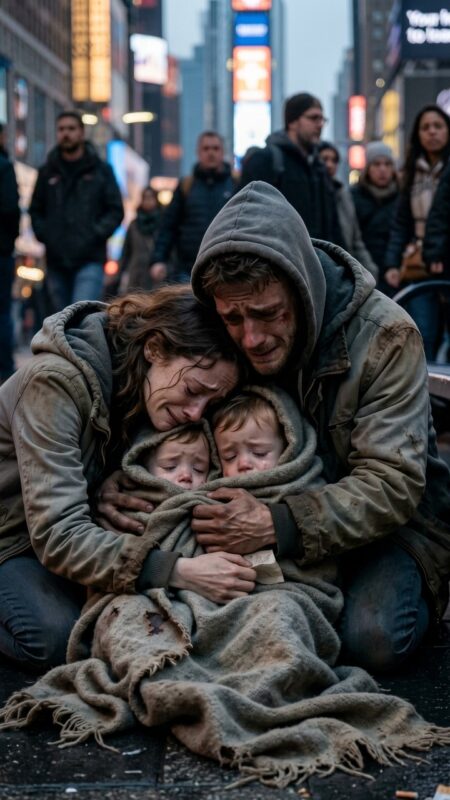
Then, on a bitter December evening, I witnessed something that changed my understanding forever.
A young couple stood beneath freezing rain on a deserted city sidewalk, each holding a small child close. The father gently pressed one last kiss to his son’s forehead, lingering as though he feared he would never see him again. The mother clutched her little daughter, whispering tearful apologies between sobs she couldn’t control.
They weren’t saying goodbye because they lacked love.
They were saying goodbye because they believed love alone could no longer keep their children alive.
When they finally forced themselves to turn away, the silence shattered.
“Mommy! Daddy! Please don’t leave us!”
The children’s cries echoed through the empty street with heartbreaking desperation. Even the police officer who arrived shortly afterward admitted he had never witnessed anything so painful.
Some stories seem simple—until you discover what came before them.
This was one of those stories.
Anyone passing through downtown Chicago that winter night would have seen only four figures.
Two exhausted parents.
Two frightened toddlers wrapped in threadbare blankets.
And a family coming apart.
Many people would have judged them instantly.
I nearly did.
Everything changed after I learned what those parents had endured during the previous three days.
Their names were Michael and Sarah Collins.
Michael had spent fourteen years working at a steel fabrication plant. He was dependable, hardworking, and willing to accept every overtime shift available because he dreamed of giving his family a modest home with a backyard.
Then, without warning, the factory shut its doors.
More than eight hundred employees lost their livelihoods in a single afternoon.
Michael believed another opportunity would come quickly.
It never did.
Interview after interview ended with polite rejection. Their savings disappeared. Credit cards reached their limits. Mortgage payments stopped.
Sarah cleaned motel rooms during the day before returning home each evening to care for three-year-old Ben and two-year-old Emma. Whenever food became scarce, she quietly skipped meals so her children would never have to.
The children continued laughing and playing, trusting their parents whenever they promised tomorrow would be better.
Then winter arrived.
Their electricity was disconnected.
Soon afterward, they were evicted.
For a short time they survived inside their aging car—until its engine died during a snowstorm.
After that, they had nowhere left.
Every shelter they visited was full.
Some accepted only women with children.
Others admitted only single men.
None could keep the entire family together.
Michael refused to abandon Sarah.
Sarah refused to leave her children behind.
So they remained outside.
One freezing night, Emma developed a dangerous fever while Ben’s persistent cough grew worse.
At the emergency room, a nurse quietly pulled Sarah aside.
“These children need warmth, stability, and shelter. They can’t survive much longer under these conditions.”
Sarah cried the entire walk back.
That evening she finally spoke the thought both of them had desperately tried to ignore.
“What if someone else can save them?”
Michael answered immediately.
“No. They’re our children.”
Sarah looked at him through tears.
“They need more than parents.”
“They need a chance to live.”
Neither of them slept that night.
The following day they searched once again for help.
Every organization turned them away.
By nightfall they reached the busiest square in the city, glowing with holiday decorations, crowded with strangers, and covered by security cameras.
Michael slowly looked around.
“If someone finds them here,” he whispered, “they won’t be alone.”
Sarah collapsed in tears.
They wrapped Ben and Emma in the warmest blanket they still owned. Emma’s stuffed rabbit rested beside her. Ben’s favorite toy truck remained in his hands.
Michael tucked a handwritten note inside the blanket.
Please don’t believe we stopped loving our children.
We’re leaving because we can no longer keep them safe.
If life ever gives us another chance, we will spend every day searching for them.
Sarah kissed each child over and over, apologizing through uncontrollable sobs.
Finally, Michael reached for her hand.
“If we stay,” he whispered, “none of us will survive.”
They forced themselves to walk away.
Only a few steps.
Then Ben cried out.
“Daddy?”
Michael froze.
A moment later Emma called,
“Mommy!”
Their voices followed them down the frozen street.
Neither parent turned around.
Within minutes, police officers found the children and rushed them to the hospital.
The letter stayed with them.
The story spread across the city almost immediately.
Some people condemned the parents without hesitation.
Others asked a different question.
How desperate must loving parents become before they believe complete strangers can protect their children better than they can?
Investigators uncovered no signs of abuse, addiction, or cruelty.
Instead, they found unpaid bills, eviction papers, stacks of job applications, medical expenses, and overwhelming hardship.
Over time, Michael found steady employment again.
Sarah completed workforce training and worked tirelessly to rebuild their lives.
Together they met every requirement set by child protective authorities—not because anyone forced them to, but because they wanted to prove that they had been defeated by circumstances, not by a lack of love.
Years later, Ben finally asked the question both children had carried for years.
“Why did you leave us?”
Sarah’s eyes filled with tears before she answered.
“We never stopped loving you.”
“We believed poverty would take your future if we didn’t let someone help you.”
Michael quietly placed the old letter on the table.
Ben read every word in silence.
One sentence stayed with him forever.
Our greatest failure wasn’t losing everything.
It was believing we could no longer give our children the future they deserved.
No mother or father should ever face such a choice.
And no child should ever question whether love can survive even the hardest goodbye.