Thirty-Seven Caregivers Quit in Two Weeks—No One Realized Six Grieving Sisters Were Quietly Testing Every Adult Who Entered Their Home
In just fourteen days, thirty-seven nannies resigned from the Whitmore estate.
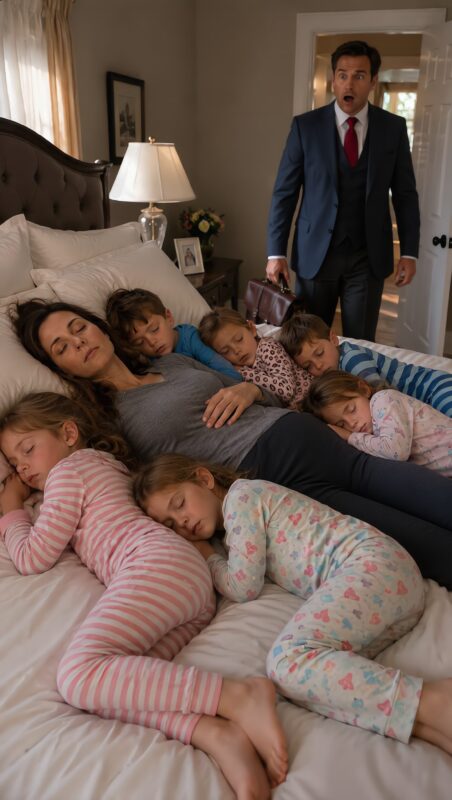
Some left in tears before they even reached the gate. Others stormed out, refusing to look back. The final caregiver left with streaks of dried paint in her hair and bite marks on her arm.
At the gate, she told security one thing:
“They don’t need another nanny. They need their father.”
From a glass-walled office overlooking San Francisco Bay, Daniel Whitmore watched another car disappear down the long drive. At thirty-eight, he had built a cybersecurity empire in Silicon Valley—outsmarting competitors, investors, and entire industries.
But none of that mattered inside his own home.
Eighteen days earlier, his wife Grace had died. Since then, every caregiver hired for his six daughters had failed within hours or days.
His assistant Miles entered carefully, holding a tablet.
“I’ve contacted every agency on the West Coast,” he said. “No one will accept the job anymore. Your residence is effectively blacklisted.”
A loud crash shook the mansion. Then came laughter—sharp, chaotic, broken.
Daniel shut his eyes.
“Find someone anyway,” he said quietly.
Across the bay, Maya Bennett didn’t hesitate when she saw the offer.
She was twenty-five, balancing night shifts cleaning houses with online studies in child psychology. The pay wasn’t just attractive—it was life-changing.
Still, nothing about the job description mentioned what waited inside the Whitmore estate.
The moment she stepped through the doors, the contrast was staggering. Elegance was buried beneath disorder. Food stains marked the marble floors. Ink drawings covered the walls. Broken glass glittered under expensive furniture.
Daniel greeted her without standing, exhaustion heavy in his voice.
“You’re here to clean,” he said. “Stick to that.”
In the hallway stood six girls.
Harper, fourteen, watched like a guard at a border.
Avery held a dripping bucket of paint.
Lily and Nora—identical twins—absently clicked a pair of scissors together.
Sophie dragged a damp blanket behind her like a trail.
And little Ella hugged a worn rabbit tightly to her chest.
Avery tilted her head.
“So you’re number thirty-eight.”
“I guess I am,” Maya replied calmly.
“Let’s see how long you last,” Avery said.

Maya didn’t argue. She simply opened her cleaning kit.
“I’m starting with the glass,” she said. “No one gets hurt on my first day.”
That wasn’t the response they expected.
Ella frowned. “What if we make noise again?”
Maya glanced at her gently.
“You’ve been making noise since your mother died. Has it helped you feel any better?”
The question landed softly—but deeply.
Silence spread through the hallway.
Then, unexpectedly, Ella whispered her name.
One by one, the others followed. No shouting. No defiance. Just introductions.
For the first time in weeks, the house felt still.
Daniel stepped out of his office expecting another crisis.
Instead, he found Maya sweeping glass while the girls stood nearby—not attacking, not destroying. Just watching.
She looked up at him.
“They’re not the problem,” she said. “You are avoiding them.”
The words cut deeper than he expected.
Daniel exhaled slowly.
“Their mother died eighteen days ago,” he said. “I don’t know how to reach them anymore.”
Harper stepped forward, holding an old phone.
“We already know everything,” she said.
She opened messages—long conversations between Grace and her sister.
He’s always working.
The girls keep asking when he’ll come home.
He says he’s busy again.
Avery’s voice broke.
“You chose work over us.”
“I was trying to secure your future,” Daniel replied.
Harper shook her head.
“You were running away from us.”
Then came the moment that shattered him.
“The day Mom couldn’t breathe, we called you twelve times.”
Daniel froze.
“I was in Seattle… in meetings.”
“And you didn’t answer once.”
His voice fell apart.
“I didn’t know it was happening.”
“You never knew anything that mattered,” Harper said quietly.
Years of success, negotiations, and achievements suddenly felt hollow.
Daniel lowered his head.
“I was afraid,” he admitted. “I didn’t want to watch her die. So I buried myself in work. I failed all of you.”
Harper hesitated, then showed him photographs.
Images of Daniel and Grace’s sister Claire together.
“We thought you replaced her.”
Before he could respond, Maya stepped in.
“Bring Claire here,” she said. “Truth doesn’t survive in pieces.”
Claire arrived within the hour, holding a sealed letter.
“There was no betrayal,” she said calmly. “Daniel was helping me manage medical documents and legal arrangements. Grace knew everything. What hurt her wasn’t another woman—it was his absence.”
The room fell silent.
Harper unfolded her mother’s final letter.
“My girls… don’t let grief turn you against the people who love you.”
Avery read the next lines, voice trembling.
“Your father failed in many ways. But love is not measured by perfection—it’s measured by intention.”
Daniel’s composure finally broke.
He covered his face, unable to hide his tears.
Ella walked to him slowly, holding her rabbit.
“Did you love Mom?”
“Completely,” he whispered.
“And us?”
“More than anything I’ve ever built.”
Harper wiped her face.
“I’m not forgiving you yet.”
“I don’t expect you to,” Daniel said. “I’ll earn it.”
Maya looked around the broken hallway.
“I don’t think this family needs another nanny.”
Daniel nodded.
“It needs something else. Time. Honesty. And me—actually here.”
The next morning, he cleared his schedule without hesitation.
Meetings were canceled. Board seats were left behind. His office was turned into a shared family space.
Nothing healed quickly.
The house was still damaged. The grief still lingered.
But the silence changed.
The girls stopped destroying things.
They started remembering.
Talking about Grace.
Laughing through tears.
Rebuilding something fragile but real.
And Daniel finally understood a truth success had never taught him:
Children don’t create chaos because they want destruction.
They create it because silence hurts more than noise—and because love, when ignored too long, will always find a way to be heard.