Three years after losing my daughter Phoebe, I stood on the steps of a small church and watched my granddaughter Margot whirl around in her pink dress. She was five years old and absolutely thrilled about her father’s wedding. For days, she had talked about only one thing: getting dressed up and posing beside her dad for the photographs.
Margot had barely turned two when Phoebe died.
Afterward, her father, Emmett, and I became closer than either of us expected. Losing Phoebe had shattered both of us, but Margot gave us a reason to keep showing up. I became part of their weekly routine—Sunday meals, birthdays, doctor visits, school events, and evenings spent telling Margot stories about the mother she remembered mostly through photographs.
Years later, Emmett met Claire.
I welcomed the relationship. Emmett had spent so long rebuilding his life that seeing him happy again felt like progress. Claire was friendly with Margot, and nothing initially gave me a reason to worry.
When they became engaged, I hoped their marriage would expand Margot’s family rather than change it.
On the wedding day, I discovered how fragile that hope was.
Shortly before the ceremony, I was walking down the hallway near the bridal room when I heard Claire speaking. The door wasn’t completely closed.
Her words stopped me instantly.
“Your dad has a wife now. You can’t expect to be the center of everything. And I don’t want you in the main family pictures.”
I couldn’t believe what I had heard.
A few seconds later, Margot came through the doorway.
The excited child I had seen outside was gone. Her shoulders were lowered, and tears slipped quietly down her cheeks.
She sat on a bench near the window and looked down at her new shoes.
I joined her.
“Grandpa?”
“Yes?”
“Is Daddy going to love Claire more than me now?”
That question hurt more than Claire’s words.
“No,” I said firmly. “A wife and a daughter have different places in someone’s heart. Nobody is taking yours.”
She wiped her cheek.
“Then why can’t I be in the pictures?”
“You can. And you will.”
I found the photographer before the formal photographs began and quietly explained that Margot was Emmett’s daughter and needed to be included.
There was no argument.
When the cameras came out, Margot stood exactly where she belonged—beside her father.
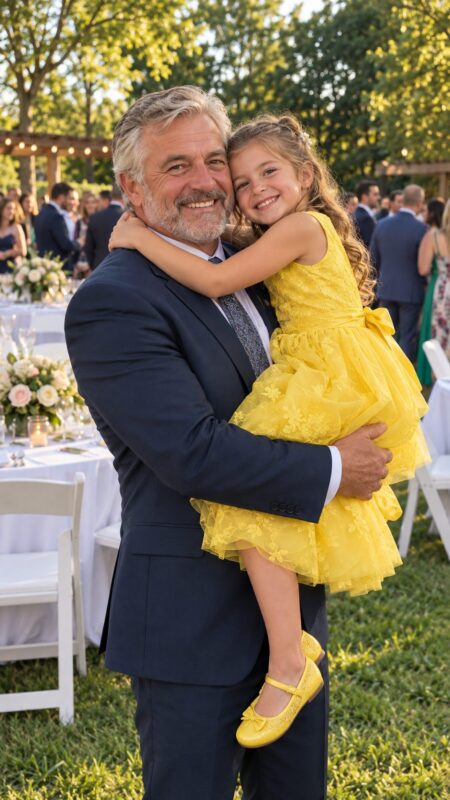
She held Emmett’s hand in one photograph. In another, he picked her up while she laughed. She made faces at the camera and nearly ruined one formal shot because she couldn’t stop giggling.
Those became some of the best pictures of the day.
But I still had something to say.
Emmett had asked me weeks earlier to give a reception toast. My original speech was sitting folded inside my jacket. It was cheerful, safe, and completely inappropriate after what had happened.
So when I was handed the microphone, I ignored it.
“I once believed the hardest thing Margot would ever have to understand was why her mother couldn’t come home.”
Conversation around the room stopped.
I continued.
“Phoebe died when her daughter was two. Since then, Emmett has worked incredibly hard to make sure Margot grows up knowing she is wanted, protected, and loved.”
Emmett looked at me, clearly realizing this was not the speech we had discussed.
“Today, someone made Margot question whether she still had a place in her father’s new life.”
The room became silent.
I didn’t repeat Claire’s exact words. I didn’t need to.
“A child should never be made to compete for belonging. Marriage creates a new relationship, but it should never erase an existing one.”
I looked at my granddaughter.
“Margot is not a piece of Emmett’s past. She is his daughter. She is part of his present, and she will be part of his future.”
Then I turned toward the newlyweds.
“My hope for this marriage is simple. Years from now, when you look through your family photographs, I hope Margot appears in the middle of them—not because someone remembered to include her, but because nobody could imagine the family without her.”
I raised my glass.
“To a new marriage, a growing family, and a home where nobody has to wonder whether they belong.”
Silence lasted another moment.
Then the guests began applauding.
Emmett approached me outside later that evening.
His expression told me everything.
“I had no idea,” he said.
“I know.”
He looked back toward the reception hall. “What do I do now?”
“You make sure your daughter never asks that question again.”
He nodded.
Claire found me before the night ended.
She didn’t seem angry about the toast. She looked ashamed.
“You heard everything, didn’t you?”
“I did.”
She was quiet before finally saying, “There’s no excuse for it.”
Then she told me something I hadn’t known.
Becoming part of Emmett’s life had been harder for her than she admitted. Phoebe’s pictures were still around the house. Family members mentioned her often. Margot talked about her mother whenever a memory surfaced.
Claire had begun comparing herself to Phoebe.
“I felt like there would always be another woman in our marriage,” she admitted. “Someone everyone loved before me.”
“That feeling may be real,” I said. “But Margot didn’t create it.”
“I know.”
“She’s five.”
Claire swallowed hard.
“I hurt a child because I was jealous of a memory.”
There wasn’t much I could add.
Finally, she asked, “Can I repair this?”
“You can start repairing it. That’s different.”
“How?”
“Tell Margot the truth. Tell her you said something cruel and that it wasn’t her responsibility. Don’t ask her to understand your insecurity. She’s a child. Just apologize.”
Claire looked across the room.
Margot was dancing without her shoes, laughing while Emmett tried unsuccessfully to copy her moves.
“I want her to trust me.”
“Then give her reasons to.”
The following morning, Claire did exactly that.
She sat with Margot and apologized without excuses. She told her that she had said something unfair and promised she would never ask her to disappear from family moments again.
Margot considered this with the seriousness only a five-year-old can manage.
Then she ran upstairs and returned carrying her favorite pair of sparkly shoes because apparently Claire urgently needed to see them.
That wasn’t instant forgiveness.
But it was a beginning.
Over the following months, Claire seemed determined to prove that her apology had meant something. She stopped treating Phoebe’s memory like competition. When Margot wanted to talk about her mother, Claire listened. She even helped Margot choose a photograph of Phoebe for her bedroom.
About a year after the wedding, my phone buzzed.
Claire had sent me a picture from Margot’s sixth birthday.
Emmett was standing on one side of her, Claire on the other. Margot was squeezed between them, laughing with frosting on her cheek.
Nobody had placed her at the edge.
Nobody had needed to remind anyone to include her.
She was exactly where she should have been.
In the center.
Underneath the photograph, Claire had written:
“Our girl. Always.”
I stared at it for a long time before printing a copy.
It now hangs on my refrigerator next to one of my favorite photographs of Phoebe holding Margot as a baby.
Two photographs.
Two different chapters of the same family.
Losing Phoebe taught me that moving forward doesn’t require leaving someone behind.
And watching Margot taught all of us something equally important:
Making room for new love should never require a child to surrender the love she already has.