When I walked into my son and daughter-in-law’s tenth-anniversary dinner, fourteen people had already finished eating.
I checked my phone.
I wasn’t late.
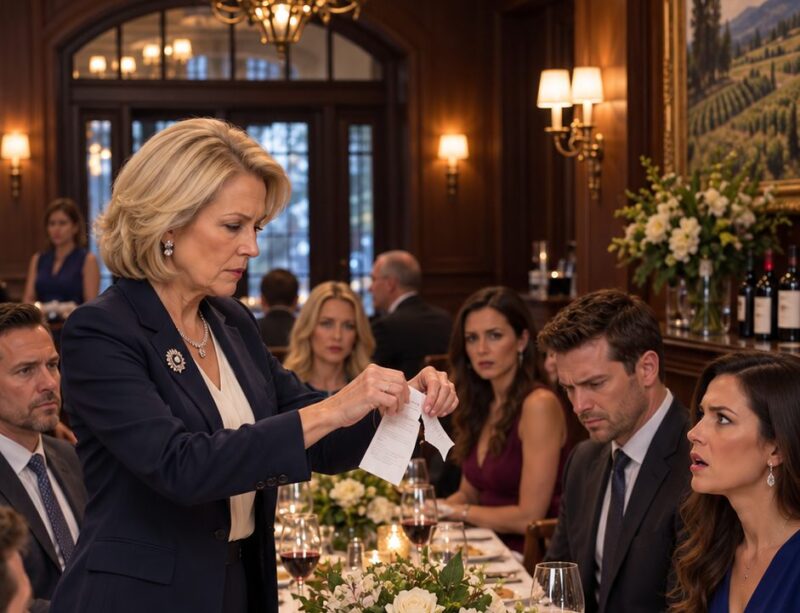
In fact, I’d arrived at exactly the time Chloe had given me—and I’d confirmed it with her twice that afternoon.
Yet the table was covered with empty plates, used glasses, and the remains of dessert.
Nobody had saved me a chair.
Nobody had ordered me dinner.
Then Chloe reached across the table and pushed a folded piece of paper toward me.
The bill.
$2,243.50.
“We knew you’d cover it,” she said, grinning. “That’s what our family ATM is for.”
A few guests laughed nervously.
My son, Logan, wouldn’t look at me.
He kept his eyes fixed on the napkin in his lap.
And suddenly, everything became perfectly clear.
There had been no scheduling mistake.
They had deliberately eaten before I arrived.
Apparently, my presence wasn’t necessary for the celebration.
My credit card was.
I picked up the check.
Chloe leaned back as if the matter had already been settled.
Without saying a word, I tore the bill down the middle.
Then I tore the pieces again and let them fall onto the table.
Chloe stopped smiling.
I picked up my purse and left.
At home, I went straight to my office.
In the bottom drawer of my desk was a binder labeled FAMILY SUPPORT.
For years, I’d kept records of everything I paid on Logan and Chloe’s behalf.
They lived above me in a duplex that belonged entirely to me.
Their rent was zero.
I paid most of the utilities, property insurance, repairs, maintenance, and landscaping.
When Chloe decided she needed a newer SUV, I’d even helped finance it.
That night, I finally totaled everything from the previous three years.
$58,412.30.
Nearly sixty thousand dollars.
And somehow, after all of that, I’d become someone they could deliberately exclude from dinner and still expect to pick up a two-thousand-dollar check.
My phone buzzed.
Chloe.
TONIGHT WAS HUMILIATING. WHEN YOU’RE READY TO APOLOGIZE, LET US KNOW.
I stared at the message.
Then I did something I should have done long before.
I canceled the monthly deposit I sent them.
Next, I removed Chloe from my credit card.
No argument.
No warning.
No apology.
Three days later, Logan nearly shook my front door off its hinges.
“Mom! Why did you stop the transfer?”
“Because it’s my money.”
“We have bills!”
“Then pay them.”
He stared at me as though I’d said something outrageous.
“We planned our budget around that money.”
“That was your mistake.”
Chloe appeared behind him.
“You can’t do this to family.”
I almost laughed.
“Interesting. Apparently family matters now.”
Her face hardened.

“We live here too.”
“You live in my upstairs apartment without paying rent.”
“We’re your son and daughter-in-law!”
“Exactly. You’re not my dependents.”
Chloe stepped closer.
“You think you can control everything because you own the property?”
“No. I think I can decide what happens to my own money.”
Her expression turned cold.
“We’ll see about that.”
I didn’t understand what she meant until the following Tuesday.
My bank called.
The representative asked whether I had recently authorized Logan to act on my behalf through a power-of-attorney document.
For several seconds, I couldn’t speak.
“I did no such thing.”
The banker explained that the paperwork had been flagged because the signature didn’t match previous examples on file.
“Lock down my accounts,” I said immediately.
Then I added, “Keep whatever was submitted. I want the original preserved.”
I drove to the branch that afternoon.
The moment I saw the document, my stomach turned.
Someone had attempted to copy my signature.
It wasn’t convincing.
But another section contained handwriting I recognized instantly.
I’d seen it on birthday cards, school assignments, and notes taped to the refrigerator for decades.
My son’s.
The bank restricted access and secured my accounts.
When I returned home, Logan was waiting outside.
“You froze everything?”
I looked at him in disbelief.
“You forged my name.”
“We were desperate.”
“So you tried to access my savings?”
“The car needed repairs!”
“Then repair it with your money.”
His frustration exploded.
“You have more than enough sitting in the bank!”
And there it was.
Not remorse.
Entitlement.
My son genuinely believed that because I had money, he had some right to take it.
I walked inside and returned carrying an envelope.
Inside was formal written notice.
Starting the following month, Logan and Chloe would be responsible for their portion of household expenses.
And in ninety days, they needed to be gone.
Chloe read the notice and started shouting.
“You would actually evict your own child?”
“I would stop housing adults who tried to gain control of my bank accounts.”
“This is unbelievable!”
“No,” I said. “What’s unbelievable is how long I allowed this arrangement to continue.”
The next few weeks were tense.
Then one night, Logan knocked on my door without Chloe.
He looked defeated.
“We don’t have any money left.”
This time, I didn’t reach for my checkbook.
I listened.
Their finances were far worse than I’d realized.
Credit cards had paid for vacations.
More credit had covered furniture.
Then came car payments, restaurants, clothes, and purchases neither of them needed.
They weren’t living according to their income.
They were living according to what they assumed I’d eventually cover.
“Why did you sign my name?” I asked.
Logan stared at the floor.
“Chloe said she couldn’t keep living like this. She told me she’d leave unless I found the money.”
I understood that he was hurting.
But understanding someone’s reason isn’t the same as excusing their choice.
“Chloe gave you an ultimatum,” I said. “She didn’t forge the signature.”
He said nothing.
“You did that.”
For once, I let the silence remain.
I didn’t fix anything.
Ninety days later, they moved out.
Their new apartment was much smaller than mine.
It didn’t have the finishes Chloe liked or the space they were accustomed to.
But it was within their means.
Afterward, I rented the upstairs apartment to Clara, a retired schoolteacher.
She was quiet, considerate, and wonderfully predictable.
Rent arrived when it was due.
She took care of the place.
Occasionally, I’d find vegetables from her garden sitting outside my door with a handwritten note.
I’d forgotten what it felt like to live in my own home without constantly waiting for someone else’s financial crisis.
Six months later, my savings account finally started moving in the right direction again.
I booked the Oregon coast vacation I’d postponed more times than I could remember.
Meanwhile, Logan and Chloe separated.
Without my money constantly patching holes in their finances, they were forced to confront the reality of their marriage.
Eventually, it fell apart.
I didn’t celebrate that.
Whatever Chloe had done, Logan was still my son, and watching him hurt wasn’t easy.
But I also knew I couldn’t save him from every consequence without teaching him that consequences were optional.
The morning I was leaving for Oregon, Logan called.
“Have a safe trip, Mom.”
“Thank you.”
There was a brief pause.
“I also sent the last payment for the utilities.”
That surprised me.
“Good. I’m glad you handled it.”
Another silence.
Then Logan spoke more quietly.
“I’ve been thinking about everything.”
I waited.
“We treated you terribly.”
There was no “but.”
No explanation about Chloe.
No reminder that he’d been desperate.
Just the truth.
“I convinced myself that because you had money, taking from you wasn’t really taking,” he continued. “I know how wrong that was now.”
His voice cracked slightly.
“I’m sorry, Mom.”
An apology couldn’t restore trust overnight.
But responsibility was something I hadn’t heard from him in years.
“Thank you for saying that.”
“Do you think we could talk when you’re back?”
“Yes.”
And I meant it.
When the car arrived, I carried my suitcase outside and looked back at the duplex.
For years, I’d believed supporting my son meant preventing him from struggling.
Whenever money was tight, I paid.
Whenever something broke, I solved it.
Whenever Logan and Chloe made choices they couldn’t afford, I softened the consequences.
I called it generosity.
But eventually, generosity without boundaries had become permission.
Permission to depend on me.
Permission to avoid responsibility.
And finally, permission to treat what belonged to me as though it belonged to them.
Saying no hadn’t ruined Logan’s life.
It had forced him to start living it.
And it had forced me to reclaim my own.
The duplex was peaceful again.
My savings were recovering.
My suitcase was packed for a trip I’d wanted to take for years.
Most importantly, I no longer felt responsible for keeping every adult around me comfortable.
I still loved my son.
I simply understood now that loving him didn’t require financing his choices.
My home was mine.
My money was mine.
My future was mine.
And the peace I’d spent years sacrificing for everyone else?
That belonged to me too.
I wasn’t giving it away again.