A barefoot girl begs for leftovers for her little brother—but the truth she carries breaks the most feared man in town and changes everything
Part One
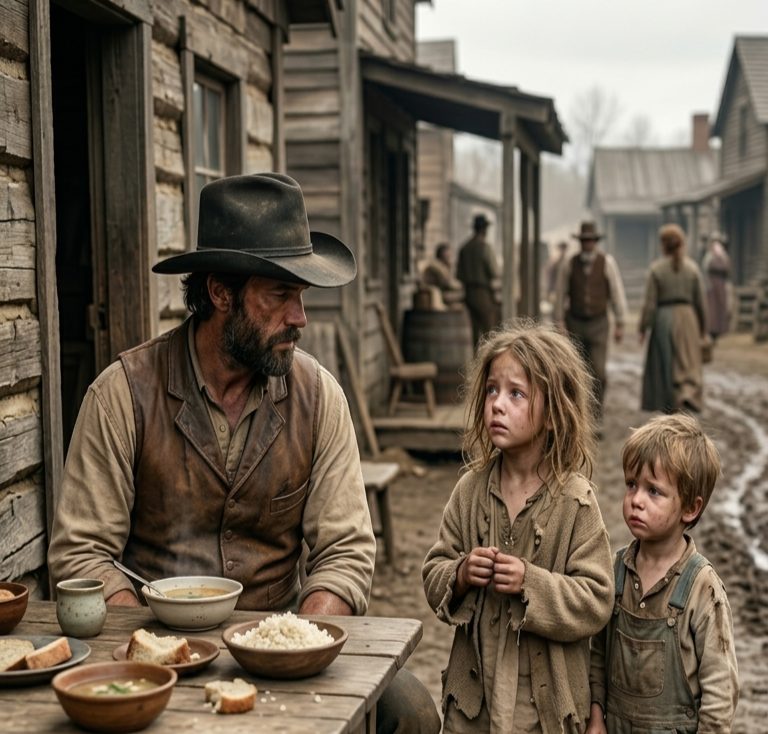
The sun blazed over the red tarps of the city market, turning the air heavy and sharp, yet beneath a forgotten wooden stall, a colder reality lingered—fear, thick enough to press against the ribs.
Eight-year-old Lucía covered her brother’s mouth with a shaking hand.
Mateo, barely four, held onto a worn stuffed toy as if it were the only solid thing in his world. Dust clung to his face. He made a tiny sound, then quickly swallowed it back down, learning far too early how to disappear into silence.
They had been hiding for two days—tucked between broken crates and sacks that smelled of decay. From there, Lucía saw life pass at their level: polished shoes, dusty boots, and children laughing as they ran past with sweet churros dripping oil onto the stones.
Not far away, behind the market’s waste piles, their mother lay on a thin sheet of damp cardboard. Mariela burned with fever, her breathing shallow, as if each breath might be her last.
“I’m hungry, sis,” Mateo whispered, his voice fragile, almost fading.
“Just a little longer,” Lucía said softly. “I’ll find something. I promise.”
Her own stomach ached, but that pain had become secondary. Something heavier lived inside her now—fear mixed with helplessness, tightening with every passing hour. Since their father died of untreated pneumonia and the bank took their home, the streets had swallowed everything they once were.
“Mamá said not to beg,” Mateo murmured, clutching his toy tighter. “She said it’s wrong.”
Lucía looked at him, then toward the dim shape of their mother barely moving in the distance.
“Mamá can’t say anything now,” she replied quietly. “So I will.”
She stepped out from their hiding place—barefoot, dirty, and small—and walked into the roaring life of the market.
The scent of grilled meat and warm tortillas surrounded her instantly, overwhelming and almost painful. No one stopped. No one looked down. She was just another shadow among too many.
Then she saw him.
Impossible to miss.
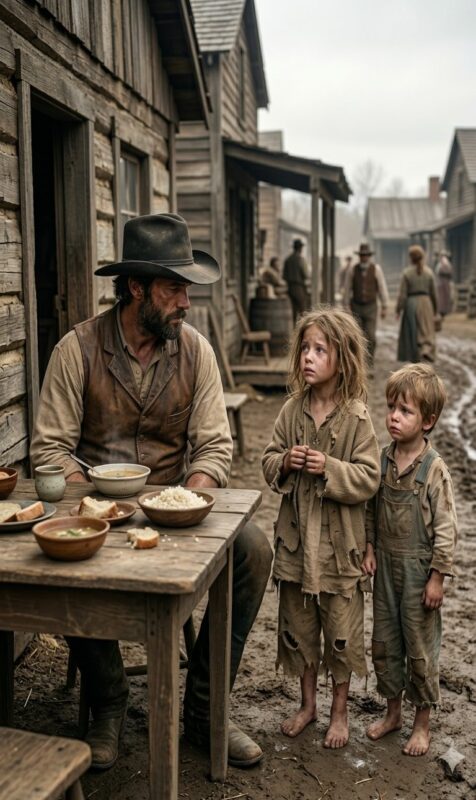
A towering man dressed in a crisp white shirt, pearl buttons catching the light, heavy leather boots worn but expensive. A straw hat cast a shadow over a face hardened by years of loss. In front of him sat a plate of untouched meat, still steaming, and a glass of water beading with condensation.
He wasn’t eating. He was somewhere far away, trapped in silence only he could hear.
Don Santiago Mendoza.
Everyone knew his name. The wealthiest rancher in the region. A man spoken about in lowered voices since the tragedy that destroyed his family five years ago—fire, loss, and a heart that never returned to the world.
Lucía hesitated. Her legs trembled.
Then she thought of Mateo’s weakening voice… and her mother’s fading breath.
She stepped forward.
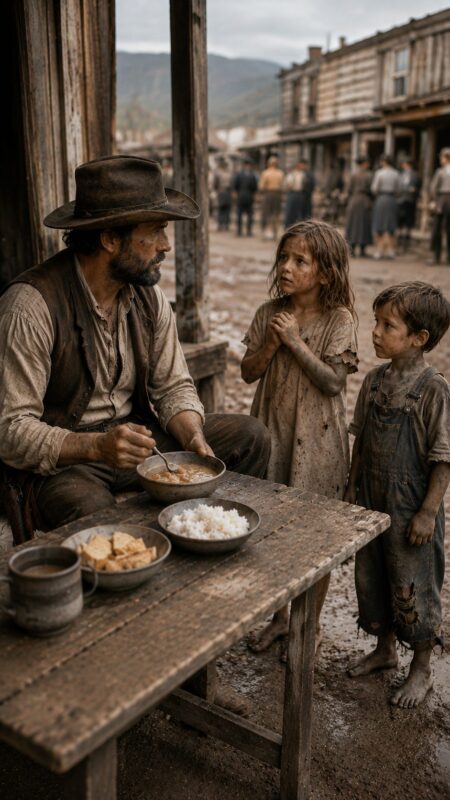
“Sir… excuse me,” she said, barely audible.
His gaze dropped instantly. Cold. Heavy. Measuring.
“What do you want?”
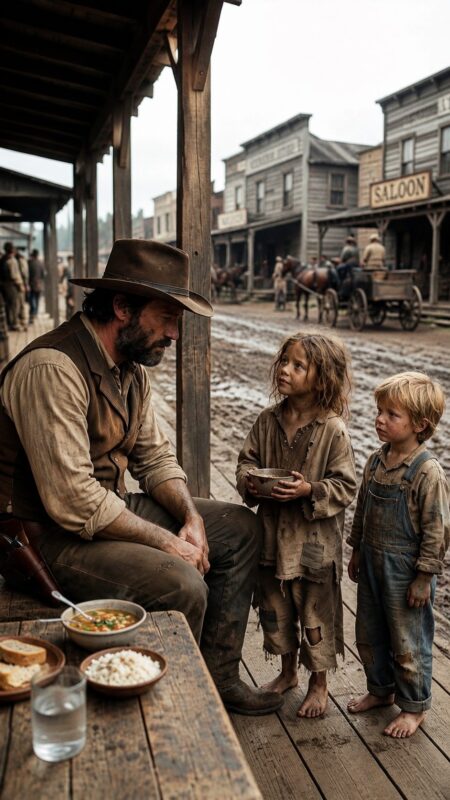
“When you’re done…” She paused, swallowing fear. “Could we have what you leave behind?”
His eyes narrowed. “We?”
She pointed shakily toward the crates. “My brother. He’s four. He hasn’t eaten in two days.”
Silence settled between them.
“And your parents?” he asked, voice flat. “Why are you alone?”
“My father is gone,” she said. “And my mother is sick… behind the garbage piles.”
For a moment, something in him fractured—not loudly, but like something old finally giving way under pressure.
He rose abruptly, pushing his chair back with a harsh scrape. Reaching into his pocket, he pulled out a thick stack of bills and placed it on the table.
“Feed them,” he said to the vendor. “Everything you have. Now.”
Then he gathered food himself—meat, tortillas, broth still steaming—and followed the small girl through the crowd.
Past the noise. Past the heat.
Straight toward the place where a dying woman lay on cold cardboard.
Beside her, a worn plastic bag held everything they had left in the world: two sets of children’s clothes, a faded photograph, and a small rosary.
Santiago stood frozen.
He had seen livestock die under open skies. He had buried his own family, watched coffins lowered into unforgiving soil. He had once believed that experience had made him untouchable.
He was wrong.
He knelt, checked the woman’s pulse, and placed the back of his hand against her forehead. When he rose again, his expression had hardened into something controlled, deliberate.
“Can she walk?” he asked Lucía.
“She can’t,” the girl whispered.
Without another word, he lifted Mariela with careful strength, as though even the slightest jolt might undo her completely, and carried her through the crowded market toward his armored vehicle. He settled the children into the back seat. Mateo, clutching a worn stuffed horse, stared at the leather interior in stunned silence.
Santiago started the engine.
A black pickup truck suddenly swerved in front of them and stopped, sealing off the road. Three men jumped down from the bed. The driver’s door opened slowly, and Evaristo stepped out.
The most feared moneylender in town.
He moved with effortless authority, wearing cruelty like something familiar. A faint, confident smile rested on his face. In his hand, he held a document, gripping it as if it carried more power than ink and paper.
The nearby crowd instinctively stepped back. They knew that expression too well.
Part Two
Santiago drew his pistol before Evaristo had even finished speaking.
The entire market seemed to hold its breath. Even the usual noise of trade and movement faded into an uneasy silence.
“Step aside,” Santiago said, his voice low and steady. “The woman is dying. She needs a doctor. I won’t repeat myself.”
Evaristo’s smile didn’t fade, but something sharpened in his gaze. He raised the document slightly.
“Her husband owed me money,” he replied. “One hundred and eighty pesos—for medicine that obviously failed.” He gave a small, indifferent shrug. “Debt doesn’t die with the debtor. I collect from whoever is left.”
Santiago reached into his coat, pulled out a thick bundle of cash, and tossed it onto the ground between them.
Then he climbed back into the truck.
He drove forward.
Evaristo stepped aside at the last possible moment.
Dust rose behind the vehicle as it disappeared down the road.
They reached Hacienda Los Agaves before nightfall—a vast estate of old stone arches, climbing bougainvillea, and air scented with dry grass and woodsmoke.
Dr. Patterson arrived within the hour. His assessment confirmed what Santiago already suspected: fluids, warmth, rest, and time. The woman would survive—if given the chance.
Doña Rosa, who had run the estate longer than most memories and asked fewer questions than most people, prepared the rooms without being told. That night she fed Mateo three bowls of chicken soup. He ate quickly, almost desperately, then fell asleep mid-motion, still clutching his stuffed horse, in a real bed with clean white sheets.
Lucía waited until the house grew quiet before she allowed herself to cry. She sat on the edge of the bed, releasing everything in silence, the way she had learned—carefully, without sound, as though even grief had to remain hidden. The sheets beneath her hands felt unreal, like something belonging to another life entirely.
Down the hallway, Santiago stood before a closed door at the end of the corridor. Behind it hung yellow curtains. He had not opened that door in five years.
His wife, Irene, had chosen those curtains.
His son’s painted handprints still marked the doorframe, left there long before the fire, when time was measured in height rather than memory.
He stood there for a long moment.
Then he walked outside to the stables and brushed his gray horse in the dark until the trembling in his hands finally faded.
In town, the story spread quickly.
Those who once ignored the girl now had opinions. They called it improper. Scandalous. A widow and her children living under the protection of a wealthy man, moving through rooms that were never meant for them.
Mariela woke on the third day.
Weak, disoriented, unsure whether she had returned from death or only drifted near it. When Lucía explained what had happened—that she had begged a stranger for scraps and that the stranger had carried her from the market—Mariela covered her face and wept uncontrollably.
Later that afternoon, she found Santiago in the stables.
He was brushing the same gray horse, his movements slow and distant, as though the world had stopped rushing around him long ago. When he turned, she saw him clearly for the first time: the deep lines etched into his face, the restrained posture of a man held together by habit, and beneath it all, a grief that had never found release.
A grief that doesn’t disappear.
Only learns how to stay silent.
She recognized it instantly. It was the same presence she saw staring back at her each morning in the mirror.
“I need to thank you,” she said quietly.
“You don’t,” he answered, not lifting his eyes, already turning back to the horse he was working on.
They stood in silence after that. Long enough for it to stop feeling like nothing and start feeling like something whole.
For nine days, peace remained intact.
On the tenth, Evaristo arrived at the gates of the hacienda with three armed men. He came not for the money Santiago had thrown onto the road—that, he called an insult—but for the full debt: the original amount, the accumulated interest, and compensation for what he claimed was public humiliation.
Santiago stepped into the courtyard. In front of every worker on the estate, he counted out three hundred pesos, pressed the notes into Evaristo’s hand, and told him in a voice like crushed stone to forget the woman’s name.
Evaristo took the money with a faint smile. He said nothing. He left the same way he came.
Men like him do not release grudges. They store them.
A week later, the rumor arrived through several channels: Mariela Morales had once been accused of theft by an employer in Guadalajara. A seamstress, they said, caught with stolen money. A warrant was supposedly being prepared. It would surface soon.
Fear returned so abruptly it felt practiced—as if it had been waiting just beneath the surface the entire time. The calm meals, the whitewashed walls, the warmth of soup and safety suddenly felt like a borrowed dream that had already ended.
That evening, Mariela entered Santiago’s study with her bags half packed, her hands steady only by force.
“I won’t let you be pulled into this,” she said. “We leave tonight. If that’s what you want.”
“Sit down,” Santiago replied.
“Santiago—”
“Sit down, Mariela.”
She sat.
A long silence stretched between them. Then Dr. Patterson, who had apparently been listening from the hallway, knocked once on the open door and said with the tired clarity of a man who had spent a lifetime delivering unbearable truths:
“Marry her. If she carries your name, even the governor will think twice.”
The silence that followed felt almost physical.
That night, Santiago walked alone to the old chapel at the edge of the estate. He knelt in the dark and, for the first time in five years, allowed himself to break—for Irene, for Daniel, for everything fire had taken from him, and for this strange family that had somehow arrived through a barefoot child asking for leftovers.
He stayed there until the night gave way to dawn.
When morning came, he found Mariela in the kitchen and asked for a private conversation. He sat opposite her at the table and spoke without softening a single edge.
“I won’t pretend this is love,” he said. “I’m not an easy man. I don’t know how to be gentle all the time. But I can give you my name as protection, a roof no one can take from you, and the certainty that your children will never go hungry while I live.”
He paused briefly.
“Since your daughter came to me that day in the market, I’ve felt something I thought I had lost. Like my life still has meaning.” His voice tightened. “I wanted you to know that before you decide anything.”
Mariela asked for a moment with her children first.
She took them into the room with the yellow curtains—finally opened again—and sat them on the bed’s edge.
Mateo, only four, spoke first. “Can I call him Papá now?”
Lucía was quiet for a long time before answering. “Mamá… Don Santiago looks at us like we belong somewhere.”
Mariela closed her eyes.
“Yes,” she said softly. “He does.”
The wedding was set for Saturday in the old church in town. Doña Rosa altered one of Irene’s stored dresses; when Mariela wore it, it fit as though it had been waiting for her, though Santiago refused to call it anything but coincidence.
The priest had barely begun the words husband and wife when the church doors opened.
Evaristo entered with six armed men and a sealed document raised high enough for everyone to see.
“Arrest warrant,” he announced. “Mariela Morales. Fraud, Guadalajara. Nine years ago.”
The atmosphere shifted instantly. Silence fell—not empty, but heavy, expectant, suffocating.
Mariela turned pale. The accusation had roots in something she remembered too well: a falsified record, a corrupt employer, a convenient sacrifice.
Santiago’s hand moved slightly at his side, then stopped.
He looked at Evaristo for a long moment.
“No one,” he said quietly, “touches my wife in this church.”
Evaristo only smiled. He had already achieved what he came for—the rupture, the spectacle, the stain. He folded the paper, tucked it away, and walked out with his men behind him.
The nightmare lasted four days. Mateo, who had recently stopped wetting the bed, began again without explanation. Lucía started hiding bread rolls under her pillow—three now, slowly hardening with time—because her body still carried the memory of hunger, even when safety was beginning to feel real.
Santiago discovered them at dawn, as he had quietly taken to checking on the children every night without ever making a conscious decision to do so. He stood in the doorway for a moment, staring at the small hidden shapes beneath the pillow, then sat down on the bed’s edge and waited until Lucía stirred awake.
“I’m sorry,” she said instantly, reaching for the bread. “I’ll get rid of it—”
“Don’t,” he interrupted softly.
She paused, confused.
“After the fire,” he said after a moment, “I kept things no one else would have kept. A scorched button. A child’s tiny shoe. A broken cup.” His eyes shifted to the bread in her hands. “When people go through something, the mind holds onto strange things. It’s not shameful. It’s how survival stays alive in us.”
Lucía watched him in silence for a long time. Then something in her seemed to loosen, and she leaned her head against his arm—the arm of a man shaped by loss, rebuilt into something steadier but marked forever by what he had endured—and fell back asleep.
He remained there until morning light filled the room.
On the fifth day, his brother arrived from the city. A lawyer, precise and composed, he brought documents and unsettling clarity: the warrant for Evaristo’s arrest had been falsified. The official seal was incorrect. The judge’s signature belonged to someone who had died two years earlier.
By that afternoon, federal officers detained Evaristo in the center of the town square. It happened in front of the same crowd that had once looked down on Mariela, in the same market where Lucía had stood barefoot asking strangers for food to keep her brother alive.
Heads lowered this time. Even the shopkeeper who had once refused them water tried to reach for Lucía afterward, stepping forward with open arms and a late-arriving guilt that only appears once danger has passed.
Lucía stepped away and took Santiago’s hand.
That was enough. They didn’t need anything else from him.
That evening, Doña Rosa cooked carnitas and beans, and a small mariachi group played in the courtyard until the sky turned dark. For the first time in years, Mariela danced—awkward, laughing at herself while Mateo stood on her feet, as children do when they believe nothing can fall apart again.
Santiago stood quietly in the doorway, a glass of water in his hand, watching with an expression that those who had known him before everything burned might have recognized as peace.
Later, he walked Mariela out to the corrals and showed her a newborn filly—unstable, trembling, forcing herself up again and again with a stubborn will too large for her fragile body.
“That’s us,” he said. “Born from wreckage. Shaking. But still rising.”
He told her then, plainly and without ornament, that he loved her. Not as salvation. Not as repayment. Not as the comfort of loneliness ending. But as a man who had spent years in a certain darkness and, without expecting it, had finally found his way out.
“I’m afraid,” Mariela admitted quietly. “That everything could fall apart again.”
“It will,” he said simply. “And we’ll face it together.”
She believed him.
Time passed. The town moved on, as towns always do, replacing old stories with newer ones. Mateo no longer knew hunger. The bread under Lucía’s pillow disappeared completely. The yellow curtains stayed open in daylight, and the painted handprints on the doorway became something Santiago would occasionally touch as he passed—not grief, but a quiet form of remembering.
One autumn afternoon, sunlight poured through the house and turned everything gold. Lucía stood in the doorway and looked at her mother laughing with Doña Rosa, Mateo building impossible towers on the floor, and Santiago returning from the corrals, dust on his boots, moving like someone who finally belonged to the place he stood in.
He noticed her and lifted a brow: Are you all right?
She nodded.
And in that moment, she finally understood what had really happened in the market. She hadn’t been begging. She hadn’t been asking for scraps. She had been asking—without knowing how to say it—for a chance. To be seen. To exist in someone’s eyes.
And that man—heavy with his own broken history—had looked at her and given her that chance without hesitation.
He believed he was feeding two hungry children.
What he was really doing was saving himself.
Because family is not always something you are born into. Sometimes it arrives when everything has fallen apart, takes your hand without asking permission, and refuses to let go.
And that is how broken lives begin, slowly, to become whole again.