Everyone in the neonatal unit noticed Wade Holden the moment he walked through the doors.
It was impossible not to.
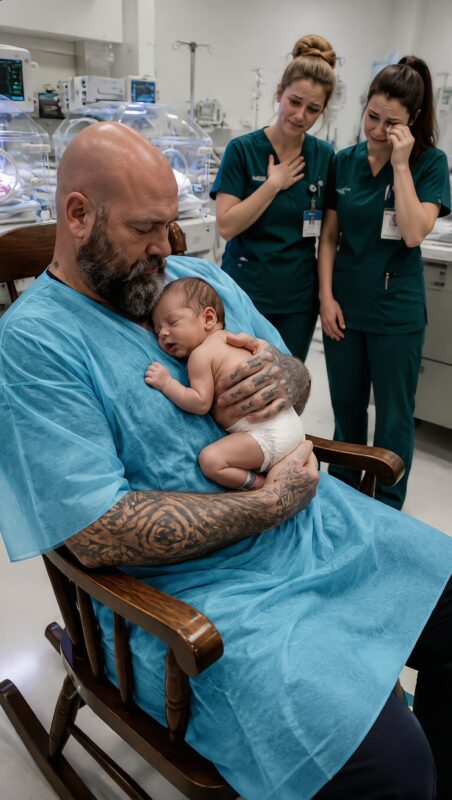
The man known as “Grizzly” stood almost six feet seven inches tall. His head was shaved, a thick white beard covered much of his face, and tattoos disappeared beneath the sleeves of his shirt. Old scars crossed his massive hands.
Against the quiet glow of incubators at Pine Valley Children’s Hospital, Wade looked like he belonged almost anywhere else.
I had spent thirteen years working as a NICU nurse, and my first thought was embarrassingly simple:
He must be lost.
Then Wade showed me his volunteer badge.
“I’m here for the infant-comfort program.”
Before I could answer, crying came from bed nine.
Baby Boy Nolan.
Everyone in the unit knew his story.
His incubator had none of the things that usually appeared around babies who had been hospitalized for weeks. There were no family pictures taped nearby, no stuffed animals waiting for him, and no cards from grandparents.
His mother, Shelby, had left shortly after giving birth. She had been emotionally overwhelmed and unable to care for him at the time.
No father had appeared.
No relatives had called.
That morning, the little boy had been especially restless.
We had fed him, checked his temperature, adjusted his blankets, and examined every monitor.
Medically, nothing appeared wrong.
But he kept crying.
Wade glanced toward the incubator.
“Is he all right?”
“He’s stable,” I said. “He just won’t settle.”
Wade hesitated.
Then he asked, “Would it help if someone held him?”
I studied him again.
The hospital had already approved him. He had passed his background checks and completed every required training session.
Still, I found myself staring at those enormous, scarred hands.
Wade caught me looking.
He didn’t seem offended.
Instead, he walked to the sink.
He washed his hands carefully, following the procedure exactly. Then he sat in the rocking chair and waited.
No argument.
No impatience.
Just patience.
Finally, I lifted the infant from the incubator and placed him against Wade’s chest.
The baby protested immediately.
His crying became louder.
A few nurses glanced in our direction.
Wade didn’t panic.
He supported the tiny body exactly as he had been taught and began moving gently in the chair.
Back and forth.
Back and forth.
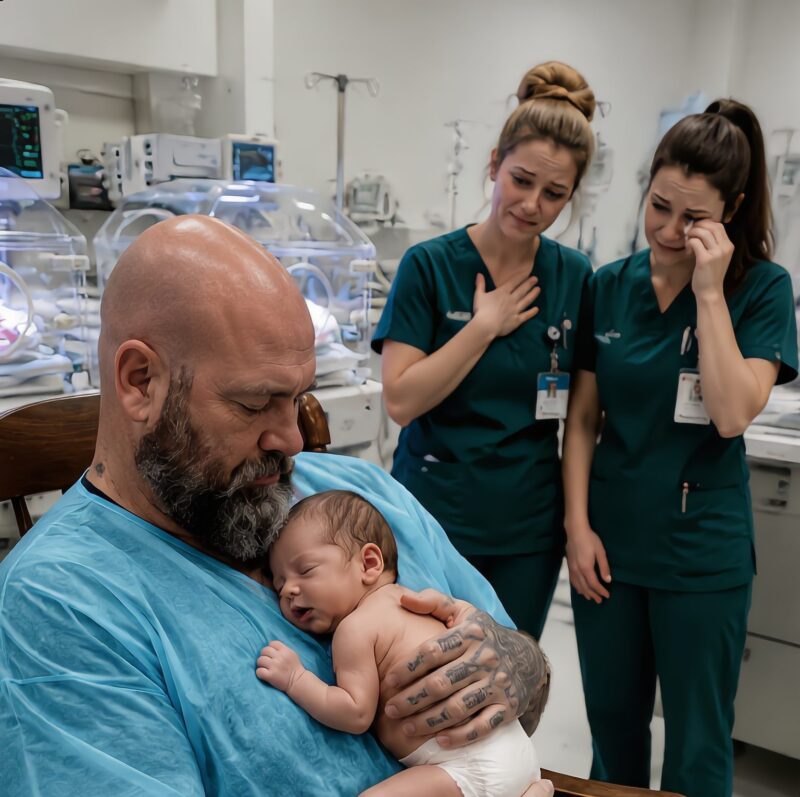
“You’ve had a rough day, haven’t you?” he whispered.
The crying softened.
Wade continued rocking.
“I’ve got nowhere else to be, little bear.”
A few moments later, the nursery became quiet.
Baby Nolan was asleep.
His breathing had become calm, and the numbers on the monitor settled into a steady rhythm.
I looked at Wade.
He wasn’t smiling proudly or waiting for anyone to praise him.
He was simply watching the sleeping child.
For almost an hour, he barely moved.
When I finally returned Nolan to the incubator, Wade quietly stood.
“Thanks for giving me a chance,” he said.
Then he left.
I assumed his volunteering might be a one-time experience.
Three days later, he returned.
Then he came back again.
And again.
Within a few weeks, Wade became such a familiar presence that nobody stared when he entered the NICU anymore.
When parents couldn’t visit, he sat with their babies.
When an infant refused to settle, someone inevitably said, “Where’s Grizzly?”
He could spend hours in the same chair, gently rocking one child after another.
The strangest thing was how quickly the babies seemed to recognize his voice.
The moment they heard that deep rumble, some of them visibly relaxed.
Eventually, we stopped seeing Wade as the enormous biker covered in tattoos.
We saw the man who always showed up.
One afternoon, while the nursery was unusually peaceful, I sat beside him.
“Can I ask you something?”
“Go ahead.”
“Why here?”
Wade understood exactly what I meant.
He stared through the glass for a long moment.
Then he said, “I had a daughter once.”
His voice became quieter.
“My wife and I were supposed to take her home.”
He stopped.
“We never did.”
There was nothing useful I could say, so I remained silent.
Wade looked down at his hands.
“For years, I kept thinking about all the things I couldn’t change.”
Then he looked toward the incubators.
“One day I realized I could either keep thinking about what I lost or use what I had left to help somebody else.”
His eyes settled on Nolan.
“I couldn’t be there for my daughter the way I wanted.”
He paused.
“But I can be here for them.”
After that conversation, I never looked at Wade the same way again.
Neither, apparently, did Baby Nolan.
Over the following weeks, the little boy made remarkable progress.
He gained weight.
His breathing became stronger.
One piece of equipment after another was removed as he became less dependent on medical support.
Wade celebrated every improvement.
“Another good day, little bear,” he would whisper beside the incubator.
Then something happened none of us expected.
Shelby returned.
Our social worker told us she had spent the previous weeks receiving counseling and practical support. She had been terrified after giving birth and had convinced herself that leaving was the only thing she could do.
Now she wanted to come back.
More importantly, she wanted to become the mother her son needed.
But before seeing Nolan, she asked us a question.
“Where is Wade?”
He was sitting near another incubator when she approached him.
Wade stood.
Shelby looked up at him.
“You’re Grizzly?”
He gave a small nod.
“I’m Wade.”
“They told me you’ve been holding my son.”
“Sometimes.”
Shelby struggled to keep her voice steady.
“I wasn’t here.”
Wade said nothing.
“I should have been,” she continued. “But I wasn’t.”
Tears appeared in her eyes.
“Thank you for making sure he wasn’t alone.”
Wade shook his head gently.
“You came back.”
Shelby looked at him.
“That matters more than anything I did.”
Several days later, Nolan was cleared to leave the hospital.
The staff gathered around as Shelby carefully placed him into his car seat.
He looked completely different from the fragile newborn Wade had first held weeks earlier.
Before leaving, Shelby carried him over to Wade one last time.
“When he’s old enough to understand,” she said, “I’m going to tell him about the man who sat beside him when his family couldn’t.”
Wade smiled.
“Just tell him there were people here who cared about him.”
Shelby reached for his hand and guided one of his fingers toward Nolan.
The baby immediately wrapped his tiny fingers around it.
For once, Wade had nothing to say.
Then he leaned closer.
“Keep getting stronger, little bear.”
Shelby thanked the nurses and carried her son toward the exit.
The doors closed behind them.
Wade stood silently for a moment, staring at the place where they had disappeared.
Then a cry came from another corner of the NICU.
Wade turned his head.
A newborn had begun fussing inside an incubator.
He looked at me.
I already knew what he was going to ask.
“That one need some company?”
I smiled and pointed him toward the sink.
Wade washed his hands and pulled the familiar rocking chair closer.
Watching him, I thought about the man who had walked into our unit weeks earlier.
Back then, I had noticed everything that seemed intimidating about him.
His height.
His tattoos.
His scars.
His rough hands.
I had looked at Wade and wondered whether someone like him belonged in a room filled with vulnerable newborns.
But the babies had never cared about any of those things.
They understood Wade in the simplest possible way.
When they were frightened, he held them.
When they cried, he stayed.
And when they needed gentleness, the biggest man in the room somehow knew exactly how much to give.
I learned something from Wade that I never forgot.
A person’s scars don’t always tell you how dangerous they are.
Sometimes they tell you how much they’ve survived—and why they’ve learned to hold fragile things with extraordinary care.