The first thing I learned about our new street wasn’t where the nearest grocery store was or which day the trash was collected.
It was that everyone had an opinion about the man living next door.
His name was David.
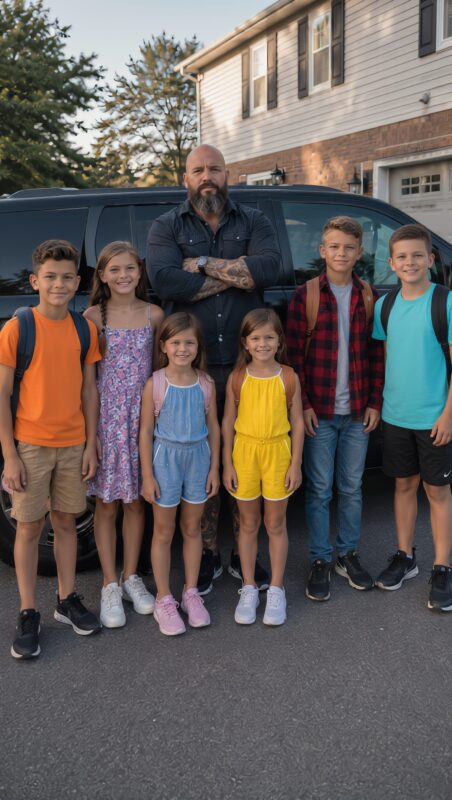
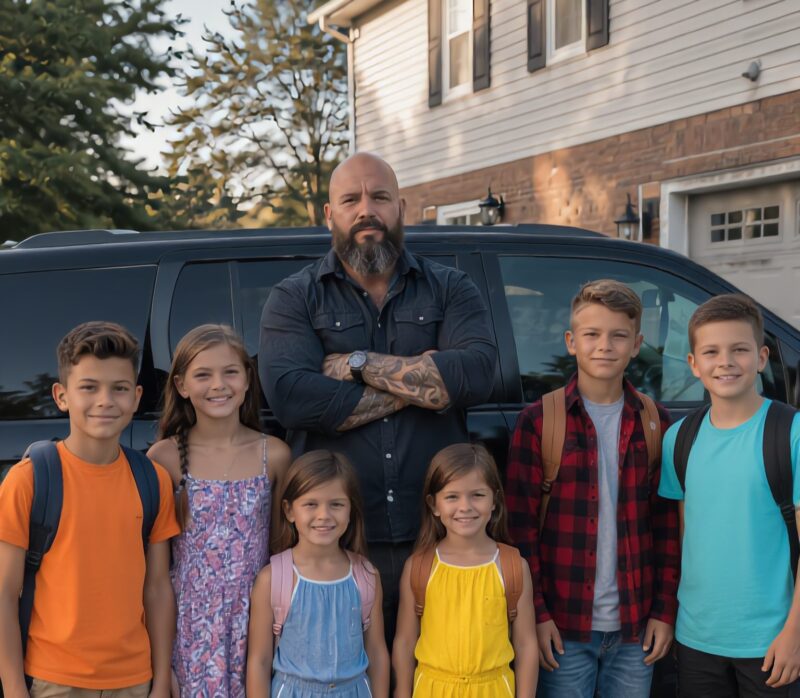
He was raising seven children alone, and according to our neighbors, his house operated more like a training camp than a family home.
“You’ll hear the whistle soon enough,” one woman told me.
I thought she was joking.
She wasn’t.
The morning after Mark and I moved in, a piercing whistle woke me while it was still dark.
The clock read 5:00 a.m.
I went to the window.
Seven children were standing in a row on David’s porch.
Emma, sixteen, stood at one end. Five-year-old Ben stood at the other, struggling to keep his eyes open.
David walked along the line, checking that everyone was dressed and prepared.
Then he handed out responsibilities.
Breakfast.
Laundry.
Cleaning.
Garden.
Trash.
Household repairs.
Within seconds, the children scattered to begin their jobs.
Mark joined me at the window.
“That’s impressive.”
I wasn’t convinced.
“They’re children, Mark.”
The whistle became part of our mornings.
So did David’s lessons.
His children weren’t simply expected to clean their rooms or wash dishes.
They were learning how to run a household.
The older ones taught the younger ones how to prepare meals. They learned basic sewing, bicycle repairs, budgeting, and how to keep track of household expenses.
Every child who was old enough memorized important phone numbers.
Even little Ben knew his address.
People on the street found David’s methods disturbing.
“No child should live on a schedule like that.”
“He treats them like recruits.”
“He controls everything they do.”
I listened.
And eventually, I began seeing David the way they did.
Then an ambulance arrived.
It stopped outside his house one morning.
I watched from my window as the children emerged.
What surprised me was how calm they were.
Emma carried a folder and immediately gave it to the paramedics.
David stood near the doorway, pale and visibly exhausted.
After several minutes, he refused transportation to the hospital.
The ambulance eventually left without him.
After that incident, the children’s training changed.
The lessons became less about chores and more about emergencies.
I heard them practicing what to say when calling for help.
One afternoon, David was sitting with Lily near an open window.
“My name is Lily,” she recited. “My father is unconscious. There are seven children at this address. We need an ambulance. Our address is…”
David listened carefully.
“Start again.”
Lily repeated it.
“Again.”
She did.
This time, without making a mistake.
I stood frozen in my kitchen.
For the first time, I wondered whether David’s strange routines had nothing to do with control.
Maybe he was preparing them for something he knew was coming.
Three days later, I found out.
A loud crash came from next door.
Then someone screamed:
“Plan Red!”
I ran outside.
David had collapsed on the patio.
The children didn’t freeze.
They moved.
Emma dropped beside her father.
One child called emergency services.
Another retrieved a medical folder.
Someone opened the gate so the paramedics wouldn’t lose precious time getting inside.
Another child gathered David’s medication information.
Every one of them knew exactly what to do.
When the ambulance arrived, a paramedic looked at Emma.
“You’ve handled this before?”
“Three times.”
He seemed impressed.
“Your dad prepared you well.”
Emma’s face changed.
“He wasn’t preparing us for this.”
She looked at her father.
“He was preparing us for what happens afterward.”
As the paramedics took David away, Emma dropped the folder.
I bent down to help gather the papers scattered across the ground.
One page landed beside my shoe.
I picked it up.
Then I saw the words.
Advanced pancreatic cancer.
The diagnosis was nine months old.
Everything inside me went still.
Nine months.
David had known for nine months that his children might soon have to live without him.
Suddenly, every morning I had judged looked different.
The whistle wasn’t punishment.
The chores weren’t about obedience.
The cooking lessons weren’t excessive.
Neither were the emergency drills, budgeting exercises, phone numbers, or repair lessons.
David wasn’t trying to control his children.
He was trying to prepare them for a life he knew he might not be there to share.
Emma saw the document in my hand.
“He knows he can’t stay,” she whispered.
Her voice cracked.
“So he’s trying to leave us knowing how to do everything.”
Two days later, David invited me over.
Inside his home, I finally understood the scale of what he had been doing.
One wall was covered with calendars.
Another held emergency numbers.
There were schedules for meals, school, laundry, grocery shopping, medication, and bills.
Every important part of family life had been written down.
David was turning everything he carried in his head into instructions his children could keep.
Then he showed me a notebook.
It contained individual goals for each child.
**Emma: prepare dinner without help. Completed.**
**Noah: replace a bicycle tire. Practice again.**
**Lily: make an emergency call without panicking. Completed.**
**Ben: memorize home address and Emma’s phone number. Completed.**
I continued reading.
Then I reached an entry that had nothing to do with practical skills.
**Ben asked who will tuck him into bed after I’m gone. I don’t know what to tell him.**
I closed my eyes.
Near the end of the notebook, David had written:
**My job isn’t to make them depend on me forever. My job is to make sure they can keep going when I’m no longer here.**
“I’m trying to make myself unnecessary,” he said.
I looked around the room.
“You can teach them to make dinner.”
He nodded.
“To pay bills.”
Another nod.
“To call an ambulance. Fix something that breaks. Take care of each other.”
“That’s what I’m trying to do.”
“But you can’t teach them how not to miss you.”
David looked away.
“And you can’t prepare them for everything alone.”
He looked back at me.
I said the words that should have been spoken months earlier.
“Let us help you.”
For a long moment, David said nothing.
Then he nodded.
Word spread quickly.
But this time, the neighbors weren’t gathering to criticize him.
They were coming to help.
A retired electrician began teaching the older children simple household repairs.
A nurse showed Emma how to organize medical information.
An accountant taught them how to plan a monthly budget.
A mechanic offered basic car-maintenance lessons.
A retired teacher started helping with homework.
People brought meals.
They gave rides.
They stayed with the younger children when David had appointments.
Nobody called it charity.
It became what a neighborhood was supposed to be.
A community.
And gradually, something beautiful happened.
David stopped trying to carry everything alone.
The children started playing more.
They laughed louder.
They spent afternoons outside without turning every activity into another lesson.
One day, David watched them running through the yard.
“I thought my job was to teach them how to survive without me,” he said.
Then he smiled faintly.
“I forgot to teach myself that they might have other people.”
Winter arrived.
David’s strength faded.
The whistle still came in the mornings, but it grew less predictable.
Five became six.
Sometimes six became seven.
And eventually, there were mornings when Emma stepped onto the porch with the whistle instead.
By then, the sound no longer bothered me.
I understood it.
It meant the day had started.
It meant there was breakfast to make, school to attend, laundry to wash, and life to continue.
Several weeks later, the whistle stopped.
David died during the night.
Emma called me before dawn.
I crossed the yard immediately.
By sunrise, half the neighborhood was there.
Someone cooked breakfast.
Someone made coffee.
Someone sat beside Ben.
Someone helped Lily get dressed.
Nobody asked what needed to be done.
We had learned that from David.
At his funeral, neighbors who had once criticized him stood together in silence.
More than one person admitted the same thing.
“We thought we understood him.”
“We didn’t.”
That night, Ben sat staring at David’s empty chair.
Finally, he asked:
“What happens to the whistle?”
Emma disappeared into the hallway.
She returned holding their father’s old jacket.
From its pocket, she removed the silver whistle.
She looked at her brothers and sisters.
Then she blew it once.
The sound traveled through the house.
All seven children looked up.
There was no fear in their faces.
Only recognition.
Emma walked toward the kitchen.
The others followed.
Nobody assigned chores.
Nobody gave instructions.
They simply began preparing dinner together.
In the months that followed, arrangements were made so the children could remain together while trusted adults provided the care, supervision, and stability they needed.
Nobody tried to become their new David.
He couldn’t be replaced.
Instead, we became the thing he had forgotten to include in his original plan:
a safety net.
Years may pass, but I don’t think I’ll ever completely stop expecting that whistle before sunrise.
Sometimes I still wake early and listen.
There is only silence.
Then I look next door.
Seven children are getting ready for another day.
Once, I saw their father standing on that porch and thought I was watching a man control his family.
Now I know better.
I was watching a father race against time.
Every whistle gave him another morning.
Every lesson gave his children another skill.
Every routine was his attempt to leave behind something useful when he could no longer leave them his presence.
David knew he couldn’t teach his children how to live without missing him.
So he taught them something else.
How to make breakfast.
How to solve problems.
How to ask for help.
How to look after one another.
And most importantly, how to begin another day.
Even when the person who once blew the whistle was no longer standing on the porch.