A BILLIONAIRE COMES BACK AFTER NINE YEARS… AND IS SHOCKED BY WHAT HIS EX-WIFE NOW CALLS HOME
Daniel Whitmore held the letter as though it were the only thing keeping him from sinking. His fingers trembled, even though nothing in his glass office moved.
Outside, New York pulsed with its usual certainty—towers cutting into the sky, taxis weaving through traffic, people moving with the quiet arrogance of those who believe time belongs to them.
Daniel had once been one of them.
But at sixty-five, the billionaire behind Whitmore Industries felt something unfamiliar pressing in on him—uncertainty.
The envelope carried no return address.
Just one name, written carefully:
Emily Whitmore.
His former wife.
A name he had not seen—or allowed anyone to mention—for nine years.
Beneath it was an address in a remote town in Kentucky, so distant that even his GPS paused before confirming it.
For nearly a decade, Daniel had avoided everything tied to that past. That place. That night—the moment everything broke—when he raised his voice, humiliated her, forced her out, and shut the door as if she had never existed.
Yet the letter held no accusation.
No anger.
Only a location.
As if something unfinished had finally come back to claim him.
“Are you certain you want to go through with this, sir?” Marcus, his driver of many years, asked as the highway stretched ahead.
“This time… I’m going alone,” Daniel replied.
He rented a pickup truck, left his designer suits behind, and drove for hours.
The city slowly disappeared.
Steel and concrete turned into open land.
The sound of sirens faded into quiet.
Even the air felt older, heavier somehow.
As he drove, Daniel rehearsed apologies in his head—phrases refined and structured like business deals.
But there was one thing he couldn’t prepare for…
The feeling waiting at the end of the journey.
Something heavy.
Something final.
When the GPS announced he had arrived, Daniel slammed the brakes—
and went still.
Because what stood before him wasn’t a home.
It looked worn down, almost forgotten.
A small wooden house leaned slightly. The paint had peeled away. The roof sagged, and the steps leading up to the porch were uneven and cracked.
The kind of place his wealth had always kept him far away from.
And yet… this was her address.
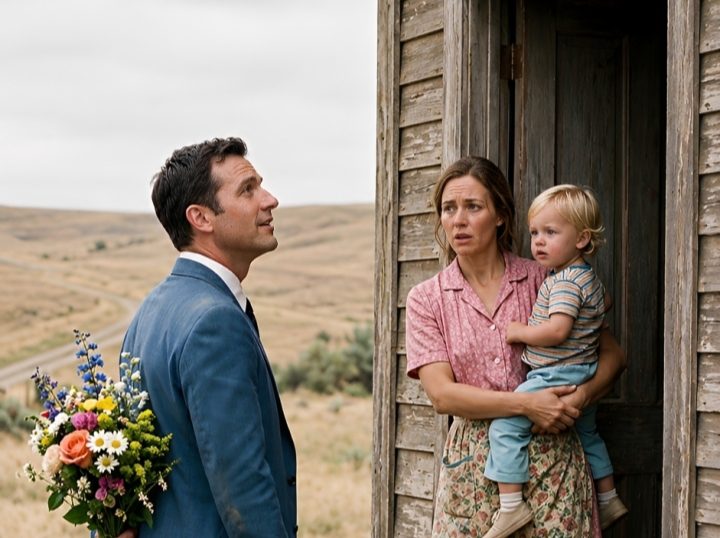
He stepped out, holding a simple bouquet of wildflowers he had picked up on the way.
It suddenly felt ridiculous.
Flowers?
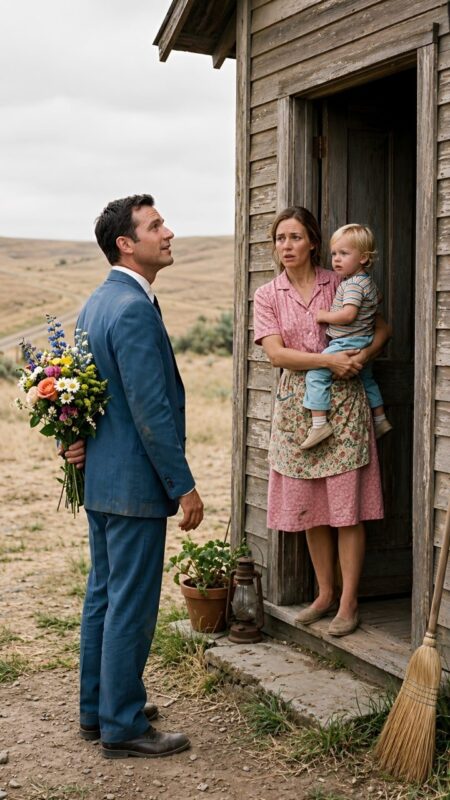
After nine years?
A light breeze lifted one petal and carried it across the dusty yard.
Daniel swallowed and knocked.
“Emily?” he called.
His voice sounded unfamiliar—even to him.
The door creaked open.
And there she stood.
Emily.
But not the woman he remembered.
Her once-bright hair was now threaded with gray, pulled back simply. Her hands looked rough, shaped by years of work.
But it was her eyes that stopped him.
Still blue.
But no longer gentle.
Calm… in a way that felt colder than anger.
“What are you doing here, Daniel?” she asked, keeping the door only partly open.
Every word he had prepared vanished.
“I needed to see you,” he said quietly. “We need to talk.”
Emily crossed her arms.
“After everything you did?”
“After nine years?”
Daniel raised the flowers, unsure of himself.
“I didn’t come to argue,” he said. “I came because… I’m losing everything.”
She looked at the bouquet without interest.
“You came to buy forgiveness?” she asked softly.
“Like you used to buy everything else?”
At that moment, an older man appeared along the dirt path, carrying a bucket of water.
He gave Emily a polite nod.
“Everything alright, Miss Emily?”
“All fine, Mr. Harris,” she replied gently. “Just someone from the past.”
When he walked away, she exhaled quietly and stepped aside.
“Come in,” she said. “Before people start talking.”
Inside, the house hit Daniel even harder.
One small room served as both kitchen and living area. A worn fan turned slowly overhead. The furniture didn’t match, aged by time.
But everything was clean.
Orderly.
Respectable.
“Sit,” Emily said, pointing to a plastic chair.
Daniel sat down, still trying to understand what he was seeing.
“How did this happen?” he asked softly.
Emily held his gaze.
“Do you really want to know?” she asked.
“Or do you just want to feel better about yourself?”
He hesitated—but she continued anyway.
“After you threw me out, I tried to rebuild. I sold my jewelry. Rented a tiny place. Looked for work.”
She paused.
“Do you know what I found?”
“Closed doors.”
Daniel shook his head. “I never—”
“Yes, you did,” she said calmly.
“You told people I was unstable. That I might reveal company secrets. That I couldn’t be trusted.”
His chest tightened.
“You didn’t just remove me from your life,” she continued. “You erased me from everything.”
Silence settled between them.
“When the money was gone, I was evicted,” she said. “I spent months in a women’s shelter.”
Daniel’s hands clenched.
“I didn’t know.”
“You didn’t want to know.”
She turned her eyes toward the window.
“I ended up taking work cleaning hospital rooms,” she said softly. “After that, I came back here… to my grandmother’s old house. It was barely standing, but it was the one thing no one could strip away from me.”
Daniel lowered his eyes. mThe bouquet in his hands suddenly felt like a burden.
“The company is failing,” he admitted. “Whitmore Industries is close to breaking apart.”
Emily tilted her head slightly, studying him.
“And why exactly should that concern me?”
“You were the one who designed our strongest strategies,” he said quietly. “Without you, I only ever understood how to make money.”
She reached out, took the flowers from him, and for a moment, he thought there might still be a chance.
Then she let them fall.
“I’ve learned something living here,” she said.
“Flowers don’t put food on the table.
Beautiful words don’t pay debts.
And empty promises don’t fix what’s been destroyed.”
Daniel swallowed, his voice tightening.
“So you’re refusing to help me?”
“I didn’t say that.”
She opened a small wooden box and retrieved a worn folder from inside.
“These are the plans you chose to ignore.”
Daniel began to read. His expression shifted as page after page revealed a detailed system—sustainable development, long-term stability, global-scale impact.
“This… this is remarkable,” he said under his breath.
“It was,” she replied calmly. “A decade ago.”
Her gaze held his.
“But it could still become reality… if you’re willing to change who you are.”
In the following weeks, Daniel rented a modest home nearby.
They began working together again.
But Emily was no longer the same person.
She didn’t speak about profits or expansion.
She spoke about people.
Children without access to education.
Families struggling for clean water.
Elderly people forgotten by the system.
At first, Daniel only listened.
Then something in him began to shift.
He repaired a neighbor’s damaged roof.
He helped carry water alongside Mr. Harris.
And slowly, exhaustion became something different—something meaningful, even grounding.
Using Emily’s framework, the company began to recover step by step.
But the real transformation was happening within Daniel himself.
One night, beneath a sky crowded with stars, Emily finally spoke again.
“When you sent me away,” she said quietly, “I was expecting a child.”
Daniel felt the air leave his chest.
“I lost the baby a few weeks later,” she continued. “Stress. Hunger. Isolation.”
Something inside him collapsed completely.
For the first time in years—maybe ever—Daniel Whitmore broke down, not as a powerful executive, but as a man facing the weight of his own past.
“I’m sorry,” he said, barely audible. “For everything I did.”
Emily gently held his face, steadying him.
“If you stay chained to what happened,” she said, “you’ll never become who you could still be.”
Months passed.
The company stabilized—stronger than before.
Then Daniel made a decision no one expected.
He refused a billion-dollar acquisition offer.
“For the first time,” he said, “I’ve found something that matters more than money.”
“Purpose.”
Emily gave a small, quiet smile.
They made an agreement.
Six months.
Not as husband and wife.
Not as strangers.
But as partners rebuilding something new—honestly this time.
When the six months ended, they returned to the same worn yard where everything had restarted—where he once stood with those meaningless flowers.
“If you say no,” Daniel said gently, “I’ll understand.”
Emily studied him for a long time—not the man he had been, but the man he had become.
Then she nodded.
“Yes,” she said. “Yes… to trying again. But only as equals.”
Years later, when they married again, there were no chandeliers, no luxury halls, no cameras.
Only the small community center they had built together.
No spectacle. No press. No excess.
Just people.
Warmth.
Laughter.
Children running through open rooms.
Families gathered without fear of tomorrow.
And something rarer than success—
Peace.
That night, walking home under the quiet Kentucky sky, Daniel spoke softly.
“I lost almost everything,” he said, “before I finally understood what mattered.”
Emily squeezed his hand.
“Sometimes life removes what you cling to most,” she said, “so you can finally notice what you ignored.”
And for the first time, Daniel truly understood.
Because wealth had never been what he owned.
It was what he had finally learned to build—
with his hands,
with his heart,
and with the people who chose to stay beside him.