A compassionate waitress paid for an elderly man’s meal—never expecting that his wealthy daughter would walk in moments later.
The old man stood quietly at the café counter, carefully spilling a small pile of coins onto the surface. His hands trembled as the metal pieces clicked softly.
“Soup and rice cost twelve dollars,” the cashier said without emotion.
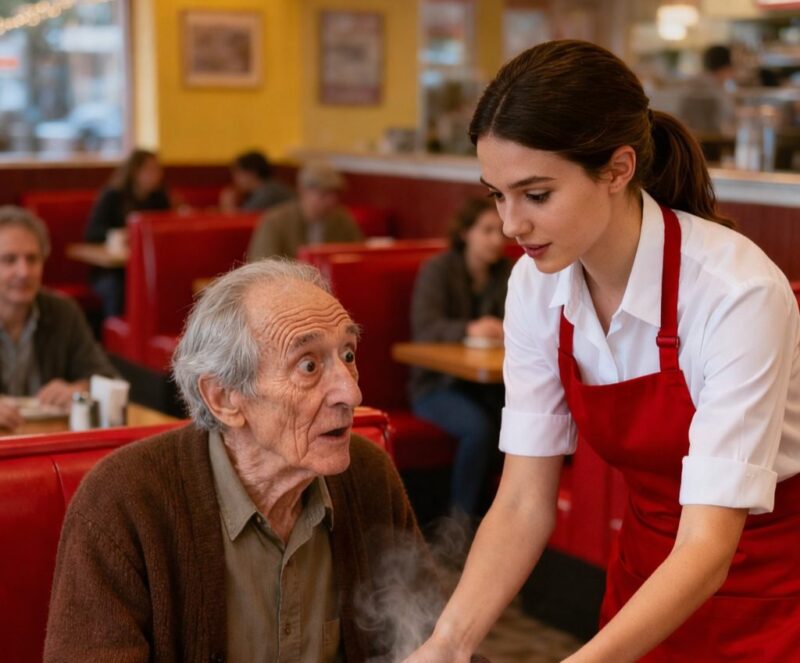
He counted again, slowly pushing the coins together.
“Alright… just a second…”
He set a few aside, then added them back, unsure.
Behind the counter, two workers whispered.
“He’s paying with coins again.”
“Should we remind him this isn’t a charity?”
“Just tell him to order less—we’re busy.”
The man looked up, clearly hearing them.
“Do you want the soup?” the cashier asked impatiently.
“I… I can take less,” he said quietly. “Maybe just the soup.”
Before the cashier could reply, a young waitress stepped forward.
“No, sir,” she said gently. “Please take the full meal.”
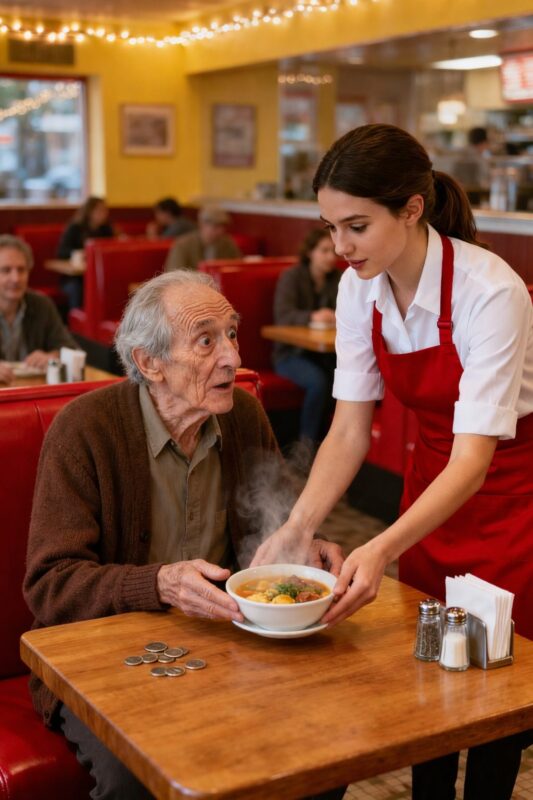
She placed a hot bowl onto a tray.
“He’s a little short,” she added softly. “I’ll pay for it.”
The cashier frowned. “Why? He’ll keep coming back.”
The waitress shrugged. “He’s hungry.”
“Then let him be hungry somewhere else,” the cashier muttered.
A few minutes later, she returned with the tray.
“I didn’t order rice,” the man said, noticing the extra dish.
“It’s included,” she said with a warm smile. “Enjoy it while it’s hot.”
He lifted the spoon slowly, almost cautiously, as if afraid the meal might disappear.
At that moment, the manager stepped out from the kitchen.
“Who told you to add rice?” he snapped.
“I did,” the waitress answered calmly. “I paid for it.”
“This is a business, not your personal charity,” he said sharply.
The old man immediately stood up. “I can leave. I’m sorry.”
“No, please stay,” the waitress said quickly.
But the manager continued, “If you can’t afford it, don’t come here.”
The man lowered his head. “I didn’t mean to cause trouble.”
He sat down again, his shoulders heavy.
The waitress leaned toward the cashier. “Mark it as unpaid. Don’t tell him.”
Then she returned to the table and sat briefly across from him as he ate.
“My daughter is very busy,” he said quietly. “I don’t want to bother her.”
“You’re not a burden,” she replied softly.
He gave a faint, sad smile. “Most people don’t even notice me anymore.”
“I do,” she said.
He continued eating slowly, savoring every bite.
Then the door opened.
A well-dressed woman walked in, scanning the room with concern.
“Excuse me—who’s the manager?” she asked.
“That would be me,” he replied confidently.
“I’m looking for my father.”
Before he could answer, she spotted the old man.
“Dad?”
He looked up. “Claire?”
She hurried over and knelt beside him. “Why are you here alone? Did you eat?”
“I tried,” he said softly. “She helped me.”
Claire turned to the waitress. “You paid for him?”
“It was nothing,” the waitress said modestly.
Claire stood and faced the manager. “And you?”
“We treat all customers equally,” he said stiffly.
Her father spoke quietly, “He told me not to come back.”
Claire’s expression changed instantly. “Your name,” she said.
The manager scoffed. “Why would I give you that?”
She took out her phone. “Hello, it’s Claire. Shut it down.”
He laughed. “You can’t shut down my restaurant.”
She lowered the phone calmly. “It isn’t your restaurant.”
The room fell silent.
“I own the building,” she continued. “And your lease ends today.”
His confidence disappeared. “You’re bluffing.”
“Try me.”
He said nothing.
Claire turned to the waitress. “What’s your name?”
“Mia.”
“Mia, gather your things.”
Mia froze. “Am I fired?”
Claire smiled gently. “No. You’re being promoted—to manager.”
Gasps spread through the room.
“Why me?” Mia asked quietly.
Claire glanced at her father. “Because you were the only one who treated him with dignity.”
Moments later, a lawyer arrived with official documents.
The manager’s face went pale.
“You can’t run a place on kindness,” he muttered.
Claire met his eyes. “But cruelty will destroy it.”
Then she turned to Mia. “When does the lunch rush begin?”
“In about twenty minutes.”
“Good. Let’s get ready.”
“I don’t know how to manage a restaurant,” Mia admitted.
“You’ve already proven the most important thing,” Claire said.
“What’s that?”
“Knowing when someone needs help.”
Across the room, the old man walked to the counter and placed a folded bill down.
“For the meal,” he said softly.
“You don’t have to,” Mia replied.
He smiled. “Kindness should always come full circle.”
Claire gently touched his shoulder. “You never have to do this alone.”
He looked at Mia. “You remind me of my wife. She always helped people.”
“She sounds wonderful,” Mia said.
“She truly was.”
As they prepared to leave, Claire turned back.
“I’ll be here tomorrow. We’ll go through everything together.”
Mia nodded slowly.
“You’re going to do just fine,” Claire said. “This place only needs someone who remembers why people come here.”
At the door, the old man paused.
“That was the best soup I’ve had in months,” he said.
Mia smiled. “I’m glad.”
They stepped outside.
For a moment, silence filled the room—until a customer raised a hand.
“So… are we still being served?”
Mia looked around, then picked up her notepad.
“Yes,” she said.
And for the first time, it didn’t feel like just a job.
Because sometimes a small act of kindness can change everything.
And sometimes, the person you help…
opens a door you never knew existed.