A flight attendant shamed a starving boy in front of the entire cabin—until his grandmother rose and exposed something that stopped everything cold.
The air on the plane already felt tight—too many people, too little space—when the calm shattered.

“STOP—THAT’S ALL WE HAVE!!”
The cry ripped through the cabin—raw, desperate, impossible to ignore.
A phone camera jerked wildly—faces blurred, hands lifted, passengers twisted in their seats—until it locked onto the aisle.
There, a flight attendant snatched a small paper bag of food, tore it from the boy’s hands, and tossed it to the floor.
Food scattered across the narrow aisle.
Voices erupted.
Phones shot up.
Chaos.
Pure chaos.
The grandmother dropped to her knees, her hands shaking as she tried to gather the scattered food.
“Grandma… I’m hungry…”
The boy’s voice trembled—soft, fragile—cutting deeper than the scream before.
The camera edged closer—capturing every stare, every whisper, every judgment.
“Maybe you shouldn’t be flying if you can’t follow the rules!”
The attendant’s voice cut through the cabin—cold, sharp, humiliating.
Gasps rippled from row to row.
Then—
everything shifted.
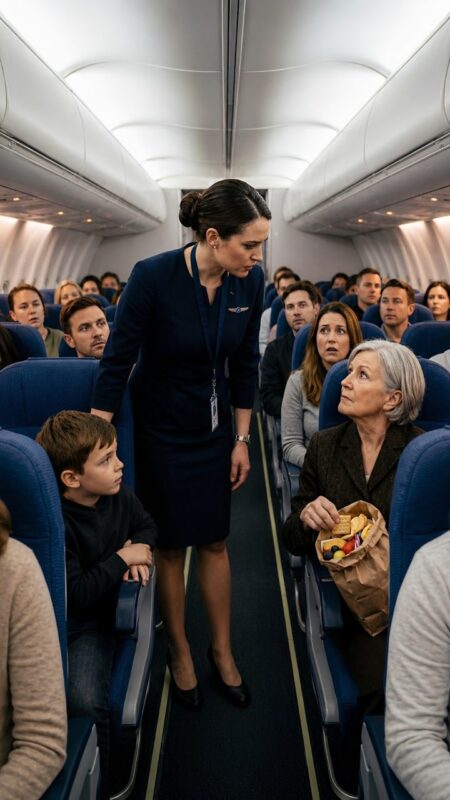
The grandmother froze.
Completely still.
An unnatural silence settled over the cabin.
Slowly, she lifted her head.
Her eyes had changed.
No longer weary.
No longer afraid.
“…Say that again.”
Her voice was low.
Measured.
Dangerous.
The attendant hesitated—just for a second, but it was enough.
Then—
the boy raised his hand.
Pointed straight at her.
“Grandma… she took Daddy’s medicine too…”
Silence fell—total, suffocating.
The camera tightened on the grandmother’s face.
Something inside her hardened.
She rose to her feet—slowly, deliberately.
“Lock the doors.”
No hesitation.
No doubt.
Passengers froze.
The attendant stepped back, her voice suddenly uncertain.
“…What?”
The grandmother slipped her hand into her coat and pulled something out.
The camera zoomed in—too close, too tense to breathe.
Her voice dropped again, sharp as steel.
“This plane isn’t going anywhere.”
A wave of shock swept through the cabin.
Fear spread instantly.
The lens pushed in on the attendant’s face—panic breaking through—
and just before anyone could react—
darkness swallowed the scene.
For a heartbeat, no one moved.
The air itself seemed to stop.
Then—
the captain’s voice broke through the intercom, firm and controlled:
“What’s going on back there?”
The grandmother never took her eyes off the flight attendant.
She didn’t raise her voice when she spoke.
“She took my grandson’s medication from his bag—and then embarrassed him when he needed it.”
Her words rippled through the cabin, spreading fast. Conversations collided, voices rising as confusion turned into anger and people began demanding answers.
The flight attendant reacted instantly, shaking her head, though the strain was already visible.
“That’s not true—I was just following—”
“Then explain this.”
The grandmother opened her hand with deliberate calm.
Inside lay several blister packs—clearly marked, the boy’s name printed across them. There was no room for doubt.
Passengers leaned forward. A sharp gasp cut through the noise.
A man seated a couple of rows back stood up.
“I saw her take something earlier,” he said. “I thought it was part of her duties.”
Another voice followed right away.
“She went through their bag before all of this started.”
The attendant’s composure collapsed. Her eyes flickered, her hands unsteady.
“I—I was checking for restricted items—”
“You dumped food on the floor,” someone snapped. “That’s not part of any protocol.”
The pressure in the cabin tightened, closing in from all sides.
Then the captain stepped into the aisle, his presence silencing the chaos. His expression was stern, controlled.
“What’s going on here?”
The grandmother shifted slightly, revealing the boy beside her—small, pale, clutching her sleeve.
“He needs that medication,” she said quietly. “Instead of helping, she took it from him.”
The captain turned his gaze to the attendant.
“Is that accurate?”
Silence.
One second. Then another.
“…Yes.”
The answer was barely more than a whisper—but it was enough.
The cabin reacted again—not with disorder this time, but with unified outrage. Focused. Unshakable.
The captain acted immediately.
“Bring the medical kit. Now.”
Another crew member hurried forward, already apologizing as she knelt beside the boy.
“I’m so sorry… we’re going to fix this.”
The grandmother’s face softened as she gently ran her hand through the boy’s hair.
“It’s okay,” she whispered. “You’re safe now.”
Within minutes, he had his medication. His breathing steadied, and slowly, color returned to his face.
The mood in the cabin shifted. The tension remained—but it no longer felt suffocating.
Standing upright, the captain addressed the passengers.
“This incident will be formally reported once we land.”
He paused briefly, then added with firm clarity:
“There is no justification for what happened.”
No one disagreed.
The attendant was quietly led away, her earlier confidence replaced with silence and lowered eyes.
At the center of it all, the grandmother sat back down, holding the boy close. There was no anger left in her expression—only quiet strength.
The kind that doesn’t need to be loud to be felt.
Outside, the plane continued its journey through the night.
But inside, everyone knew—something had shifted.