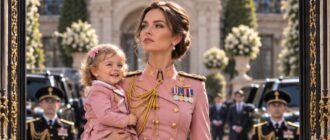
A miraculous recovery exposes a haunted past when a ragged boy gives a wealthy woman back the power to walk—only to force her to face a devastating family truth.
The gala shimmered with silk and subdued conversation until the boy appeared, moving through the crowd like something out of place in that polished world. His worn, dust-streaked clothes stood in stark contrast to the gleaming marble floor beneath him. He ignored the trays of delicacies and the stunned security guards, heading straight for Eleanor Vance.
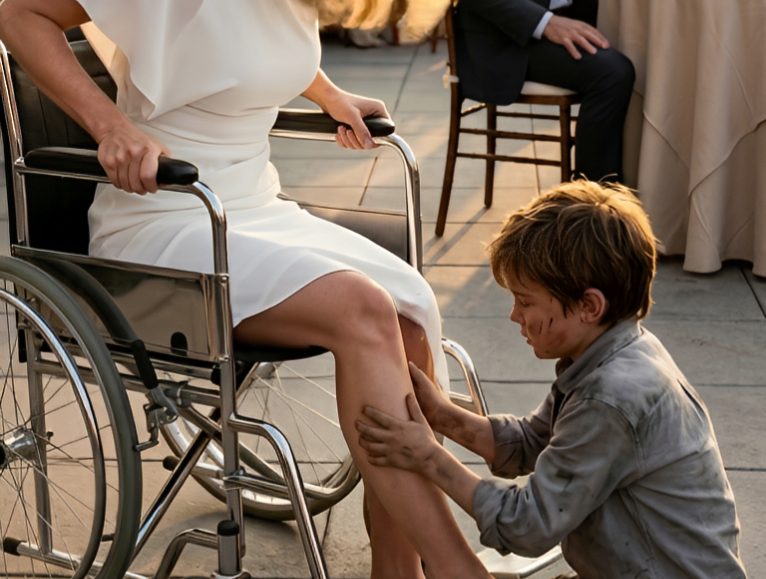
She, the formidable matriarch of the Vance legacy, sat in a gilded wheelchair, her legs hidden beneath a soft cashmere wrap that concealed their long-standing stillness. Before anyone could intervene, the boy sank to his knees, gripping her calves and beginning a steady, deliberate massage with his rough, weathered hands—an act that broke every unspoken rule of decorum in the room.
A wave of shocked murmurs spread through the guests as Eleanor drew in a sharp breath. Fear was her first reaction; she tightened her grip on the armrests, ready to call for help. But suddenly, something shifted. A sharp, electric sensation sparked through her legs—a feeling she had not experienced in ten long years.
“I can feel it,” she whispered, her voice trembling between disbelief and fragile hope.
The boy kept his gaze lowered, his face set in deep concentration.
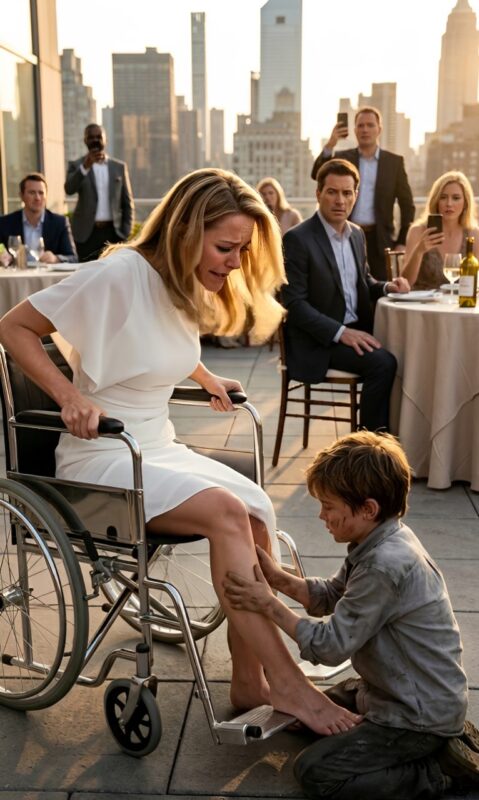
“Do not resist—just try,” he said quietly, his tone carrying an odd, ageless authority. “My mother used to tell me the same thing. She stood on her feet the day she left us. She said the strength had always been there—you only have to choose to take it back.”
The entire hall fell silent as Eleanor strained, her face drained of color. With a painful surge of effort, she pushed herself up from the armrests. For the first time in years, her feet touched the cold floor with purpose. As she slowly straightened, the shawl slipped away, revealing her standing—unsteady, yet undeniably upright. Applause burst out across the room, but it quickly faded when people noticed her expression. Eleanor was not looking at her legs; her gaze was locked on the boy, filled with raw horror.
Under the bright lights, his features became unmistakable—the line of his jaw, the striking green of his eyes. They were identical to those of the daughter she had cast aside years before, banishing her over what she had called a disgraceful love affair.

At last, the boy let go and rose to his feet. He reached into his pocket and drew out a worn silver locket. Opening it, he revealed a faded photograph of a young woman who looked exactly like Eleanor in her youth.
“She said you were the one who broke her,” the boy spoke, his voice steady and cold. “She told me she forgave you with her last breath. But she wanted you to walk again—so you would have no excuse not to go to her grave and beg for forgiveness.”
Eleanor sank back into her chair—not because her legs failed her, but because the crushing weight of her guilt finally overwhelmed her. Without another word, the boy turned and disappeared into the crowd, leaving behind a woman who could stand again—yet had never felt more broken.