A self-assured black belt instructor once decided to make an example of a seemingly ordinary woman by inviting her to spar, convinced it would be an effortless win.
The dojo grew quiet as Sarah Foster, a calm and unassuming mother, stepped onto the mat. To everyone present, she appeared completely inexperienced.
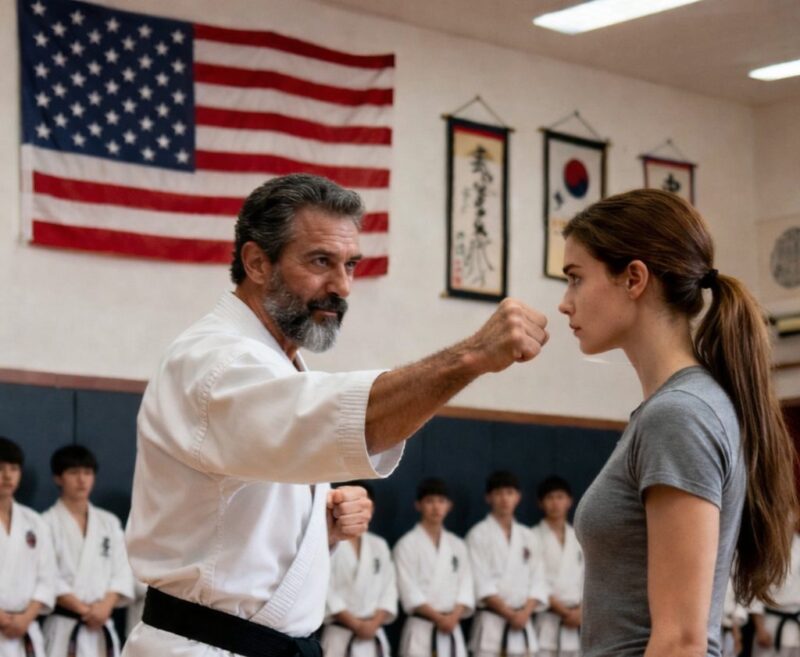
From the beginning, the instructor’s attitude made his intentions obvious. His tone was laced with mockery, certain that he would dominate within seconds. But as the match began, the situation took an unexpected turn. Sarah moved with quiet confidence, slipping past his attacks with surprising ease. The room fell silent as his certainty began to unravel.
What was meant to be a display of superiority quickly became something else entirely. Sarah’s movements were not accidental—they were precise, controlled, and composed. The instructor, known for his strict and ego-driven approach, started to lose his rhythm. For the first time, uncertainty crossed his face.
Then came the moment no one expected.
After bringing him down with ease, Sarah revealed the truth. She was not just a spectator or a concerned parent—she was Rebecca Chen, a former world MMA champion who had walked away from her career after a devastating personal loss. The revelation left everyone stunned.
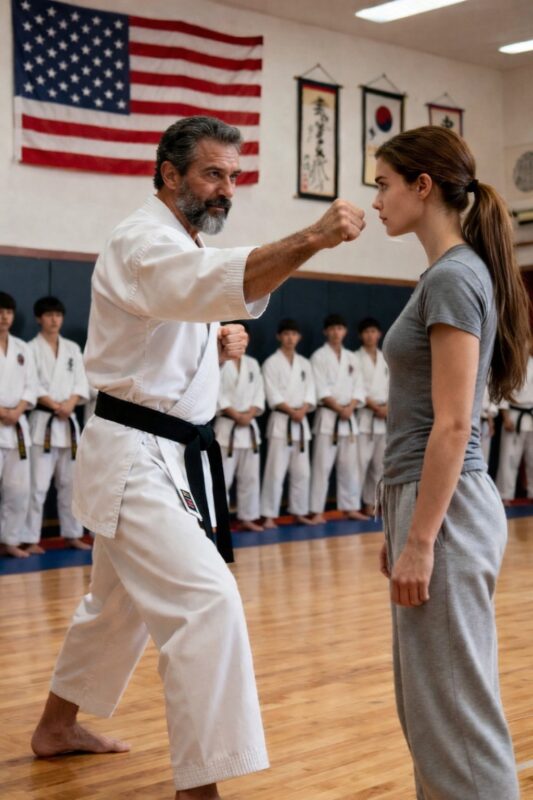
The instructor stood there, stripped of his confidence. Yet Sarah did not seek to embarrass him. Instead, she chose to teach. Calmly, she spoke about respect, humility, and what true strength really means. Strength, she explained, is not about overpowering others or feeding one’s ego, but about control, awareness, and lifting people up rather than putting them down.
Her message resonated more deeply than any physical defeat.
From that point forward, the atmosphere in the dojo shifted. The instructor, once driven by pride, began to reflect on his behavior. In front of his students, he admitted his mistakes and committed to change. His teaching style softened, replacing harsh criticism with guidance and encouragement.
Sarah’s influence reached far beyond that single moment. The students began to rethink their understanding of martial arts. It was no longer just about winning or proving strength—it became about discipline, patience, and personal growth.
Gradually, Sarah stepped into a new role. She was no longer a fighter in the spotlight but a mentor guiding others. She helped her students overcome their struggles, teaching them resilience and self-control. Even those who were once driven by ego began to understand that real progress comes from consistency and humility.
At the same time, Sarah was on her own journey. Returning to the dojo forced her to confront her past, but it also allowed her to rediscover a deeper sense of purpose. Through teaching, she found a new kind of strength—one rooted not in competition, but in impact.
In the end, the dojo transformed into more than a place to train. It became a space where people grew—not just as athletes, but as individuals. The lesson was simple yet powerful: real strength is not defined by victories, but by character, perseverance, and the willingness to keep improving.
And often, the strongest person in the room is the one who no longer needs to prove anything at all.