A young barista was dismissed on the spot for helping a collapsing biker—never suspecting the quiet stranger would soon return with an entire group of riders behind him.
Traffic flowed steadily along Route 17 near Flagstaff, Arizona. Travelers pulled over briefly at a small roadside café called Morning Ember, drawn in by the rich scent of fresh coffee before continuing on their way.
For 23-year-old Hannah Whitaker, that café was more than a workplace—it was her lifeline. After a year of unstable jobs and constant relocation, she had finally found something steady. The work wasn’t glamorous, but it paid her bills and gave her a sense of routine she desperately needed.
Every morning, she arrived before sunrise, carefully tying her apron and polishing the counter until it gleamed. She believed that even the smallest efforts mattered. More than anything, she believed in being kind. She never imagined that belief would soon cost her everything.
Hannah had left Kansas City in search of a fresh start in Arizona. The quiet desert gave her the space to rebuild her life step by step. She worked diligently, avoided conflict, and quickly earned the trust of customers—and even her boss.
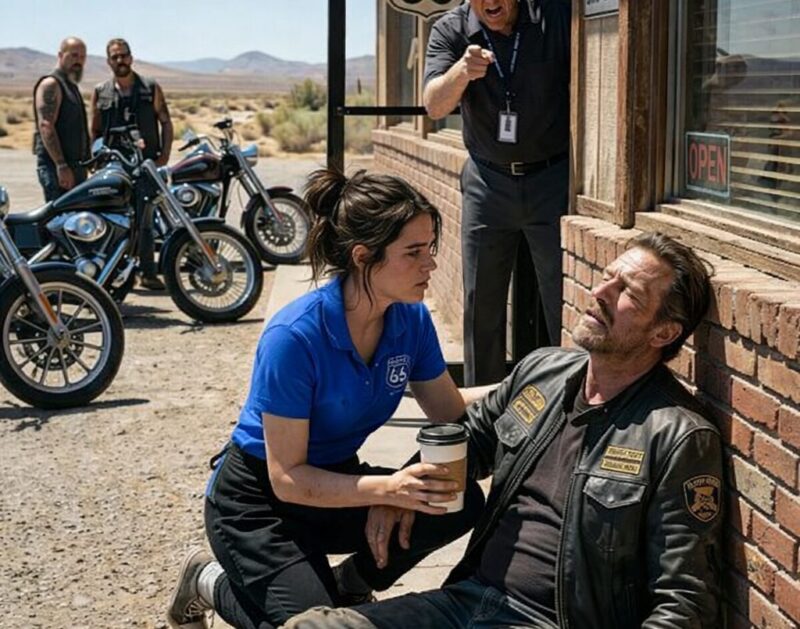
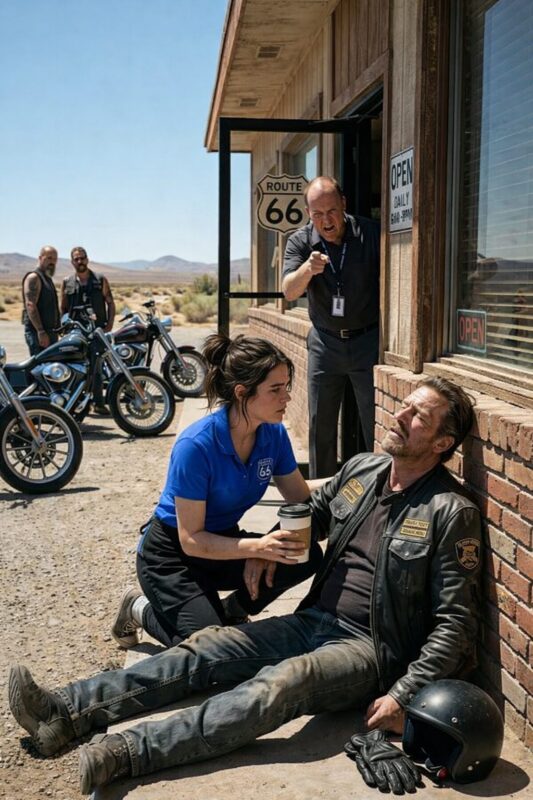
That morning, the café was packed. A long line stretched toward the door when Hannah noticed a man outside near the entrance. At first, he seemed fine—until he suddenly lost his balance.
He grabbed the railing, struggling to stay upright, but couldn’t hold on. Slowly, he slid down the wall and collapsed onto the pavement.
No one stepped in.
Customers passed by without a second glance. A driver honked impatiently. Inside, laughter and conversation continued as if nothing had happened.
Hannah hesitated.
The man looked rough—broad-shouldered, tattooed, dressed in a worn leather vest. A biker. The kind of person people often avoided.
Her manager saw where she was looking.
“Don’t go out there,” he said sharply.
“Why not?”
“We don’t get involved with people like that.”
But Hannah didn’t listen. She grabbed a cup of water and hurried outside.
“Are you okay?” she asked softly.
The man looked up, trying to remain steady. “Just a little dizzy,” he said, though his breathing suggested something more serious.
She stayed beside him, offering water and support. When he tried to stand and nearly fell again, she instinctively caught him.
Suddenly, the café door slammed open.
“Hannah! What do you think you’re doing?” her manager shouted.
“He needs help,” she replied.
“That’s not our concern,” he snapped. “You can’t abandon your shift for strangers.”
Within moments, in full view of the customers, he fired her.
Just minutes earlier, she had been doing her job. Now she was unemployed—simply for choosing compassion.
The biker, still unsteady, spoke in a calm voice. “She was only trying to help.”
“That’s not her responsibility,” the manager responded coldly.
The situation quickly drew attention. Phones came out. Someone called the police.
Then the biker quietly pulled out his phone and made a call.
“It’s me. I’m outside Morning Ember. I might need some assistance.”
Minutes later, police arrived.
But before anything escalated, a new sound echoed through the air—motorcycles.
At first, just one. Then several. Then many.
Within minutes, the parking lot filled with riders—ten, twenty, more—lining up in silence. They removed their helmets and stood calmly behind the man Hannah had helped.
There were no raised voices. No aggression. Just a powerful, quiet presence.
An officer stepped forward cautiously. “What’s happening here?”
A woman from the group spoke calmly. “We’re here because someone showed kindness when no one else would.”
The officer turned to the biker. After checking his identification, his demeanor changed instantly.
Suspicion faded into respect.
No arrests were made. The tension dissolved as quickly as it had formed.
Later that day, Hannah was offered her job back. There was no formal apology—only an uneasy explanation.
“I didn’t realize who he was,” her manager admitted.
Hannah simply replied, “That shouldn’t make a difference.”
Outside, the biker thanked her. “You did the right thing.”
She gave a small smile. “I just didn’t want to ignore someone who needed help.”
He nodded. “The world could use more people like you.”
Soon after, the motorcycles roared back to life and disappeared down the highway, leaving behind a lasting impression.
Kindness doesn’t wait for approval. It often demands risk—whether it’s comfort, stability, or security. People are quick to judge by appearances, but real character lies far deeper.
Sometimes, bravery isn’t loud or dramatic. Sometimes, it’s simply choosing to care when everyone else walks away.
And every so often, a single act of compassion becomes the moment that changes everything.