An elderly woman stepped into a jiu-jitsu academy, her silver hair pulled back neatly and her uniform perfectly pressed. The moment she crossed the threshold, quiet laughter spread among the students.
“Looks like you’re in the wrong place, Grandma,” Coach Jackson said with a smirk, prompting a few chuckles.
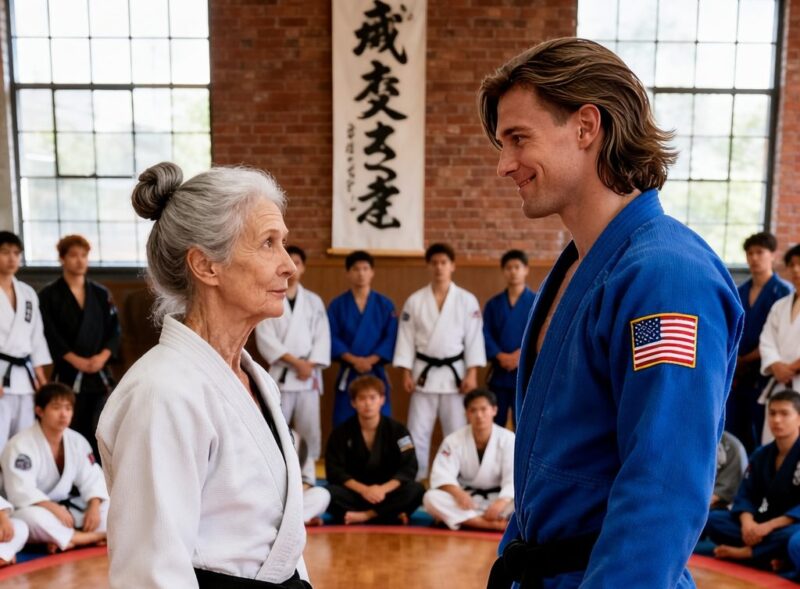
No one expected what would happen next.
Her name was Edith Simmons, seventy-two years old, carrying herself with a calm, controlled grace that came from decades of training. That morning, she had prepared with the same steady focus she had maintained since first stepping onto a mat in 1980.
The past months had been difficult. After losing her husband, she had relocated to a new town, forced to rebuild her life from the ground up. Still, giving up had never been an option. Jiu-jitsu had been part of her life for over forty years—it was as natural to her as breathing.
She had trained under Master Hiroshi Takahashi, earning her black belt at a time when women in the sport were rare. Titles and recognition had never mattered to her. Her experience lived quietly in her movements, her balance, and her unwavering composure.
At the academy, she was met with skepticism. The receptionist looked doubtful. The students exchanged amused glances. Coach Jackson, confident in his authority, barely concealed his disbelief.
“This isn’t easy training,” he warned. “You could get hurt.”
“I understand,” Edith replied calmly. “I’ve been practicing since 1980.”
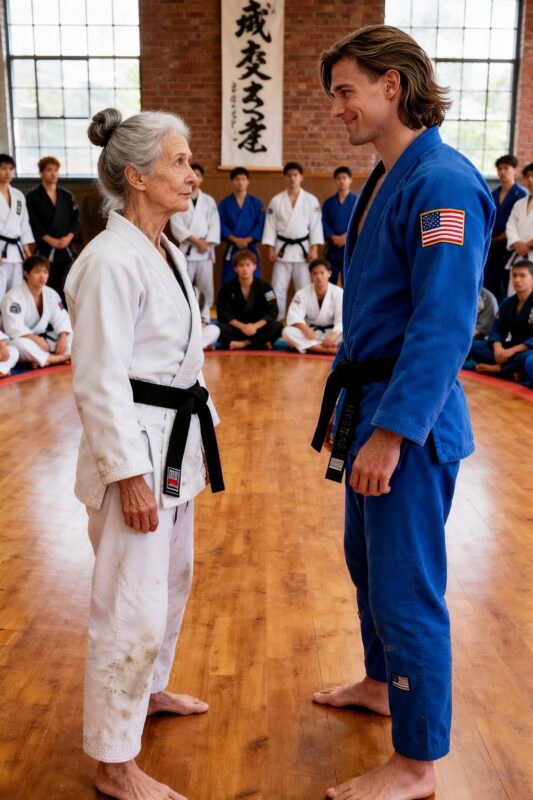
A few students laughed under their breath.
When asked about her rank, she answered without hesitation: a second-degree black belt under Takahashi. The name briefly caught Jackson’s attention, but he quickly dismissed it.
He suggested she observe instead.
“I didn’t come to watch,” she said softly. “I came to train.”
The tone of the room shifted.
Reluctantly, Jackson agreed to evaluate her. He initially called over a student, but Edith stopped him.
“I’d rather train with you.”
The room went silent.
Jackson hesitated, then nodded, unwilling to back down. The students gathered around, eager to see what would unfold.
“We’ll keep it light,” he said.
They bowed.
“Begin.”
Jackson moved first, reaching toward her casually—but in an instant, everything changed.
Edith reacted with precision. She disrupted his balance, redirected his momentum, and, in one seamless motion, brought him down. Before anyone could process what was happening, she had already secured a dominant position.
Seconds later—an armbar.
Tight. Controlled. Unavoidable.
“Tap!” Jackson called out sharply.
It was over in less than ten seconds.
Silence filled the room.
Edith released him immediately, rose to her feet, and straightened her uniform as if nothing unusual had happened.
“Thank you for assessing me,” she said politely.
No one laughed anymore.
Jackson stood up slowly, clearly shaken. “Who are you?” he asked.
“I’ve already told you,” she replied. “Edith Simmons.”
Recognition began to spread. A few students whispered her name, recalling stories and competitions from years past.
Jackson lowered his head in respect. “I owe you an apology.”
“We all make assumptions,” she said gently. “What matters is being willing to change.”
The atmosphere transformed. The mockery was gone, replaced by genuine curiosity.
Soon, Edith began demonstrating techniques, explaining them with clarity and quiet authority. The students listened intently, absorbing every movement, every detail.
Even Jackson joined in, no longer the instructor—but a student.
At the end of the session, he approached her again. “We’d be honored if you taught here.”
“I only came to train,” she replied.
“And we have a lot to learn,” he said sincerely.
She considered for a moment before agreeing—on one condition: respect must be the foundation of the academy.
He agreed without hesitation.
Within months, the gym had changed. More people joined, including older beginners who had once felt out of place. The culture shifted—less pride, more humility.
One afternoon, Edith noticed an elderly man standing uncertainly at the entrance, leaning on a cane.
Before she could step forward, Jackson approached him first—with kindness and respect.
Edith smiled quietly.
Because some of the most important lessons have nothing to do with fighting—
And everything to do with respect.