At 7:30 p.m., downtown Chicago was being battered by one of the worst storms of the season.
Rain swept sideways across the streets, gutters overflowed, and thunder shook the windows of Harrison Premier Motors.
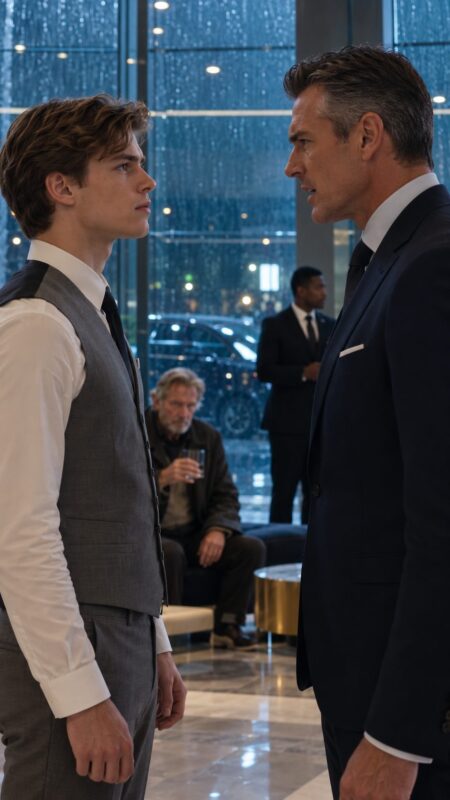
Inside, the dealership felt like another world.
Expensive cars stood beneath flawless showroom lights while salespeople served coffee to customers discussing six-figure purchases.
Then a blast of cold air rushed through the lobby.
An older man had entered.
His thinning hair was plastered to his forehead. Water streamed from a worn green coat, and his scuffed shoes left dark footprints across the polished floor. In one hand, he carried a faded canvas bag.
People noticed immediately.
One customer moved aside.
The receptionist reached toward the phone used to contact security.
But Luke Miller reached the stranger first.
Luke was twenty-two and occupied one of the lowest positions in the dealership.
“Sir, are you all right?”
The man gave an embarrassed smile.
“Just cold. May I have some water?”
Luke disappeared and returned with water and a towel.
Then he pulled over a chair.
“You can sit here until you warm up.”
“Thank you, son.”
Luke was heading back to work when Charles Harrison intercepted him.
Charles managed the showroom and measured nearly everything in sales figures.
“Why is that man still here?”
“He got caught outside.”
Charles glanced dismissively at the stranger.
“He isn’t shopping.”
“I didn’t ask him to buy anything.”
Charles stepped closer.
“Give him a few minutes, then escort him outside.”
Luke looked through the windows.
Visibility was terrible.
“You want me to send him back into that?”
“I want you to remember who signs your paycheck.”
Those words struck harder than Luke wanted to admit.
He couldn’t afford unemployment.
His mother depended on his help with household expenses, his sister needed money for college, and his savings wouldn’t last long.
For several minutes, Luke tried convincing himself that obeying was simply part of having a job.
Then he remembered his mother’s favorite rule:
Never decide how much kindness someone deserves by what they can give you in return.
Charles appeared again.
“Time’s up.”
Luke didn’t move.
“Luke.”
“He stays.”
Charles stared at him.
“Think carefully.”
“I have.”
“If you refuse a direct instruction, you’re suspended.”
Luke swallowed.
Then he removed his badge and placed it on the reception counter.
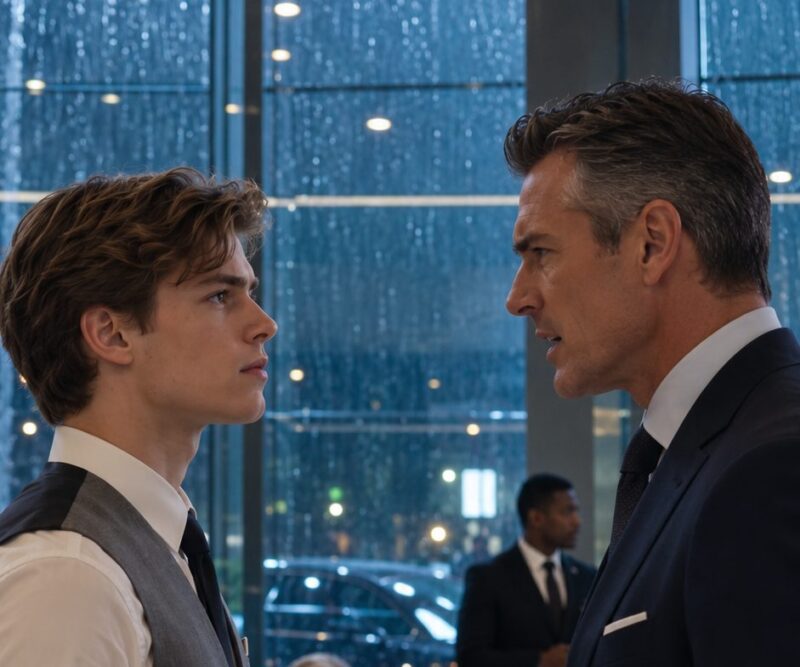
“All right.”
Charles seemed almost surprised.
Across the room, the elderly stranger had heard everything.
Without saying a word, he reached into his bag, found his phone, and called someone.
“Cancel the vehicle scheduled for tomorrow,” he said. “I won’t be purchasing it.”
Charles barely reacted.
Then a finance employee came hurrying from the back offices.
“Mr. Harrison!”
“What now?”
“The Blackwood transaction just disappeared from the system.”
Charles’s expression changed instantly.
The Blackwood account represented one of the dealership’s largest individual sales that quarter: a bespoke automobile costing more than $400,000.
“Canceled by whom?”
The employee looked toward the soaked stranger.
Charles followed his gaze.
For the first time that evening, he looked at the old man carefully.
“What’s your name?”
The stranger stood.
“Henry Walker.”
Then he thanked Luke for the water and walked away.
The following morning, Luke woke convinced he had ruined his future.
Instead, his phone rang.
The caller represented Blackwood Holdings.
Henry Walker wanted to see him.
During their meeting, Luke discovered that Henry had spent decades building businesses and investing in companies. He also funded vocational training programs for young people who couldn’t afford traditional education.
Luke immediately asked the obvious question.
“Did you come into the dealership dressed like that to test us?”
Henry laughed.
“No.”
He had attended an apprenticeship workshop earlier that day. The weather deteriorated while he was traveling home by bus, flooding forced passengers off the route, and Harrison Premier Motors happened to be the nearest open building.
“I wasn’t pretending to be poor,” Henry explained. “I was simply wet.”
That made what happened even more meaningful.
Henry was preparing to launch a different kind of automotive business—part luxury dealership, part restoration workshop, part vocational training center.
He wanted Luke on the team.
Luke couldn’t understand why.
“I got fired after refusing one order. That doesn’t exactly make me qualified.”
Henry smiled.
“Qualifications can be earned.”
He leaned forward.
“But yesterday you believed I had no money, no influence, and nothing useful to offer you. Helping me actually cost you something.”
Luke said nothing.
“That tells me more about you than a résumé could.”
He accepted.
Half a year later, Walker Motor House welcomed its first customers.
The facility contained a premium showroom at the front, restoration bays at the rear, and classrooms where apprentices learned alongside experienced technicians.
Luke started in sales.
The money Henry had planned to spend on his customized automobile became part of the investment that helped launch the center.
On opening day, Luke spotted Charles Harrison among the visitors.
For a moment, neither man spoke.
Then Charles extended his hand.
“I handled that night badly.”
Luke listened.
“I thought my responsibility was protecting an expensive showroom from people who didn’t belong there.”
Charles glanced around Walker Motor House.
“You understood something I didn’t. A person’s bank account shouldn’t determine whether they’re allowed basic dignity.”
Luke shook his hand.
Charles returned to his dealership with a different policy. Employees were no longer permitted to turn people into dangerous weather simply because they weren’t customers.
Years later, Luke was running Walker Motor House’s sales department.
During another Chicago winter, an older laborer entered wearing a heavy jacket and boots covered in slush.
A recently hired assistant noticed him.
She hesitated before approaching Luke.
“He doesn’t look like he’s here to buy anything.”
Luke raised an eyebrow.
The assistant immediately realized how her words sounded.
“I mean… should I see if he needs something?”
Luke nodded.
“That’s always a good place to start.”
She walked over.
Soon the man was sitting comfortably with a hot drink while she helped him dry his coat.
Henry had witnessed the entire exchange.
He smiled at Luke.
“Still remember that storm?”
“How could I forget? It got me fired.”
Henry chuckled.
“It redirected you.”
Luke looked around.
Several apprentices were working nearby. One had once been unable to afford technical school. Another had struggled for months to find anyone willing to give him his first job.
Luke thought about how easily none of this might have happened.
All he’d done that night was bring a stranger a glass of water and refuse to send him into a storm.
But there was something important about not knowing who Henry was.
Had Luke recognized the millionaire investor, his kindness could have been mistaken for ambition.
Had he known about the expensive vehicle, helping Henry might have been nothing more than protecting a sale.
Had he known Henry would eventually offer him a career, every polite gesture could have served his own interests.
Luke knew none of those things.
To him, Henry had been a cold, exhausted stranger carrying a battered bag.
Someone who appeared to have nothing to offer.
Luke helped anyway.
Years later, he realized that was the entire point.
Character rarely announces when it’s being tested.
Sometimes it looks like an ordinary decision nobody will remember.
A chair.
A towel.
A glass of water.
Or refusing to close the door on someone simply because you believe they’ll never be important to you.