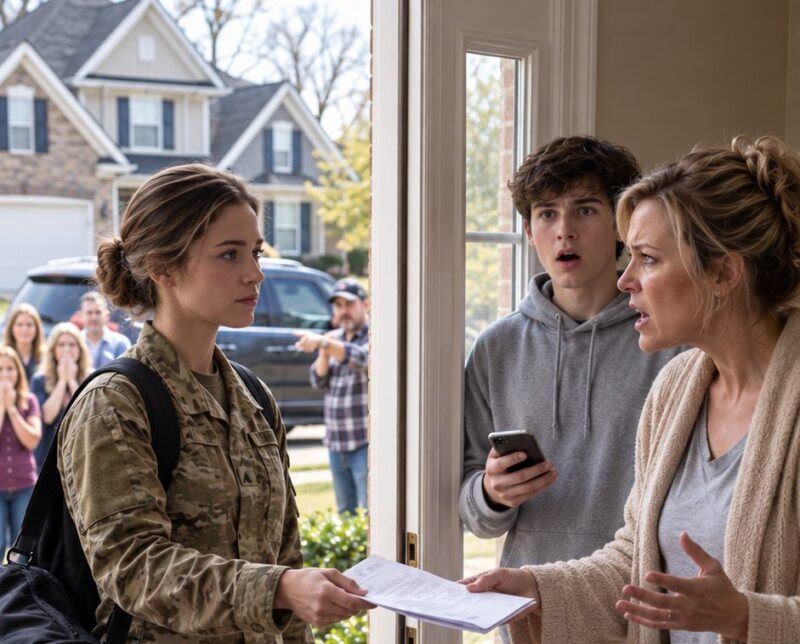
Nine months after leaving Texas for an overseas deployment, I dragged my suitcase through my front door expecting Ethan to rush toward me.
Instead, I wondered whether I’d entered the wrong house.
A laminated notice had been attached to the wall beside the foyer.
FAMILY HOUSE RULES.
I stared at it, confused.
Then my mother-in-law, Diane, appeared at the top of the stairs wearing the champagne-colored silk robe I’d left hanging in my closet.
“Well,” she said. “You’re back.”
Not exactly the reunion I’d imagined.
I followed her into the kitchen and found Ethan’s sister, Megan, drinking coffee from the blue ceramic mug I’d used every morning for years.
Neither woman seemed particularly surprised to see me.
“Where’s Ethan?”
“At work,” Diane replied. “He thought you weren’t coming until Friday.”
It was Wednesday.
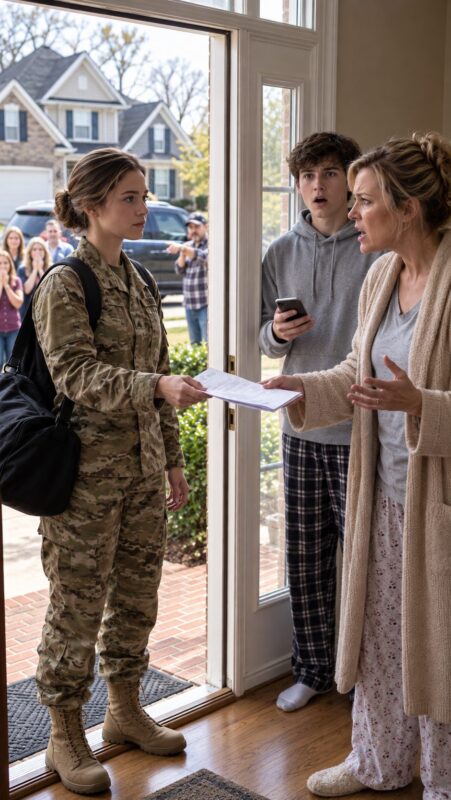
Then she handed me a printed sheet.
“I made this so there won’t be any confusion.”
My name appeared at the top.
Laura’s Responsibilities.
I almost laughed.
Dinner prepared by 5:30.
Laundry completed in the morning.
Kitchen cleaned before bed.
Groceries divided equally.
Then came my sleeping arrangement.
Downstairs office.
I looked toward the second floor.
“Why would I sleep in the office?”
Diane folded her arms.
“I’m using the main bedroom.”
“My bedroom?”
“You’ve been gone nine months.”
Apparently absence had become a transfer of ownership.
Then I saw the final line.
$900 monthly contribution toward household expenses.
I held up the paper.
“You want me to pay you to live in the house I own?”
Diane’s expression remained perfectly calm.
“Adults contribute, Laura.”
Before I could respond, Ethan came through the door.
His smile disappeared the second he saw my suitcase.
“You’re home.”
“That generally happens after deployment.”
His eyes moved from me to his mother.
I asked one question.
“What happened here?”
The explanation arrived in pieces.
Diane and Megan had lost their apartment.
Ethan had allowed them to stay temporarily.
Temporary became several months.
Several months became Diane taking over our bedroom and reorganizing the house as though she owned it.
“It’s still our home,” Ethan said.
I looked directly at him.
“No. It’s my property. I bought it before we married.”
He rubbed his forehead.
“Laura, please. You just got back. Don’t turn this into a war.”
That sentence almost worked.
Almost.
I was exhausted. I wanted a shower, my bed, and one peaceful night with the husband I’d missed for nine months.
But something felt wrong.
Not merely rude.
Calculated.
So instead of arguing, I picked up my suitcase.
“Fine. I’ll use the office tonight.”
Diane smiled.
That smile convinced me I’d made the correct decision.
I locked myself downstairs and opened my laptop.
The account I used for taxes, repairs, insurance, and property expenses should have contained roughly $14,800.
It contained $1,126.
I started tracing withdrawals.
Furniture.
Beauty treatments.
Restaurant charges.
Jewelry.
Several payments toward Megan’s credit card.
None authorized by me.
Then I found a $2,400 payment listed only as professional consultation.
I searched the recipient.
Property and mortgage services.
Now I wasn’t tired anymore.
I was alert.
Around midnight, I heard Diane walking through the hallway.
She was speaking quietly on her phone.
I opened my door just enough to hear.
“No, she hasn’t signed anything yet.”
Pause.
“Ethan will deal with her.”
Another pause.
Then:
“Once her name is off the deed, we’ll refinance. After that, she can’t threaten anyone with eviction.”
I closed the door without making a sound.
At 2:47 a.m., I contacted a property attorney.
By breakfast, we had enough information to know I wasn’t imagining anything.
Documents involving my home had recently been printed from our home office.
There were refinancing estimates, equity calculations, and paperwork discussing a possible transfer of ownership.
Then my attorney discovered Ethan had already communicated with a mortgage broker.
One document contained a handwritten note:
Laura will sign after she gets settled. Mom will convince her.
I knew every curve of Ethan’s handwriting.
I had stared at his letters during deployment.
There was no possibility of misunderstanding who had written it.
I found him alone in the kitchen.
I placed the page on the counter.
“What’s this?”
His face answered before his mouth did.
“Laura, I can explain.”
“Then start.”
He tried.
His mother needed financial security.
Megan was drowning in debt.
The house had significant equity.
Diane believed refinancing could solve everyone’s problems.
“And you agreed?”
“We hadn’t done anything yet.”
“You contacted a broker.”
“We were exploring options.”
“You wrote that I would sign.”
Ethan went silent.
That silence hurt more than any excuse could have.
“You thought I’d come home exhausted,” I said. “You thought I’d be so desperate for normality that I’d sign whatever you put in front of me.”
He looked away.
There it was.
The truth.
Later that morning, my attorney arrived.
She handed Diane and Megan written notices ending their permission to occupy my property.
Diane barely finished reading before she started shouting.
“You cannot evict me from my son’s home!”
My attorney placed a certified copy of the deed on the table.
“Your son’s name does not appear here.”
Diane turned toward Ethan.
“Tell them this is ridiculous.”
He looked at me.
Then at his mother.
Finally, he said something I hadn’t expected.
“Mom, pack.”
Diane’s expression hardened.
“You’re choosing her?”
I almost corrected the question.
A husband shouldn’t have needed to choose between protecting his wife and helping someone take her property.
Before Diane could continue, Megan broke down.
“Mom didn’t tell him everything.”
The room went quiet.
Ethan turned toward his sister.
“What does that mean?”
Megan revealed that the $30,000 Diane claimed she needed was only the beginning.
Her actual target was closer to $120,000.
Some would eliminate Megan’s debts.
Some would help Diane purchase a condo.
And if I deployed again, Diane had discussed renting my house and keeping the income.
I looked at the laminated rules still hanging near the entrance.
For the first time, I understood them.
The chores weren’t random.
Neither was taking my bedroom.
Neither was the supposed rent.
Diane had been establishing a new hierarchy inside my own home.
If she could make me behave like a guest, perhaps eventually I would begin feeling like one.
Then the refinancing proposal would arrive disguised as another way to “help the family.”
She expected me to be tired.
She expected me to avoid confrontation.
She expected gratitude and guilt to do the rest.
What she hadn’t expected was for me to investigate.
“You have two hours,” I said.
Diane stared at me.
“For what?”
“To leave.”
Two hours later, her belongings and Megan’s were outside.
The house became silent.
Ethan remained.
“I’ll replace the money.”
I said nothing.
“I’ll go to therapy. I’ll cut Mom off financially. Whatever it takes.”
I looked at him and remembered six years of birthdays, vacations, late-night conversations, and ordinary mornings.
Those memories still mattered.
That didn’t erase what he’d done.
Trust doesn’t disappear because love was fake.
Sometimes it disappears despite the love being real.
“I want a divorce, Ethan.”
He moved out four days later.
Over the following months, the financial damage was repaired.
Ethan returned every dollar he owed.
Megan eventually paid back part of what had been spent on her and sent me an apology without asking for forgiveness.
Half a year later, Ethan contacted me.
We met at a quiet café.
“I kept telling myself Mom pressured me,” he said. “She did. But nobody forced me to cooperate.”
I appreciated that he finally understood the difference.
“I convinced myself you were strong enough to handle whatever happened,” he continued. “Really, I was using your strength as permission to betray you.”
He asked whether I hated him.
I didn’t.
Then he asked the harder question.
“Could you ever forgive me?”
“I already have.”
His eyes lifted.
“But forgiveness doesn’t return us to where we were.”
He understood.
We finished our coffee and walked in opposite directions.
Eighteen months after the day I came home, another Texas storm approached Austin.
I stood on my porch watching dark clouds roll across the sky.
Inside, my bedroom was exactly how I’d chosen to arrange it.
The property account was whole again.
There were no laminated instructions on my walls.
No unauthorized guests.
No secret plans hidden in printer trays.
And nobody inside my house confused my kindness with permission.
For years, deployment had taught me to think of home as the safe place waiting at the end of a dangerous journey.
I eventually learned that safety is more than locked doors and familiar rooms.
Home should be the one place where your absence isn’t used against you, your trust isn’t treated as an opportunity, and your place at the table isn’t something another person gets to rewrite.
A house can have your name on the deed.
But it only becomes a home when the people inside respect that you belong there.