At 8:12 on the morning the board intended to name me CEO, I was told I wasn’t important enough to use the elevator.
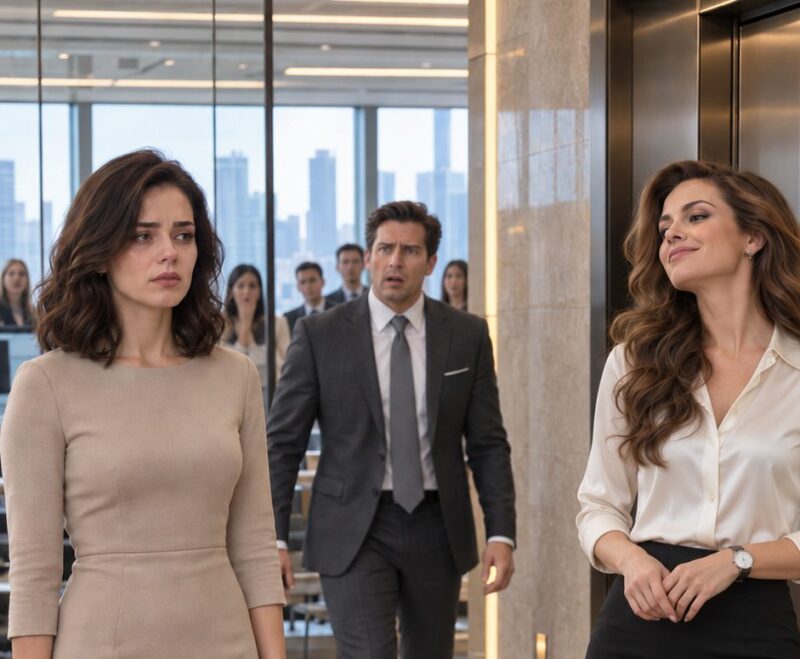
The woman blocking the doors was Jang Chin Tong, my husband’s executive secretary.
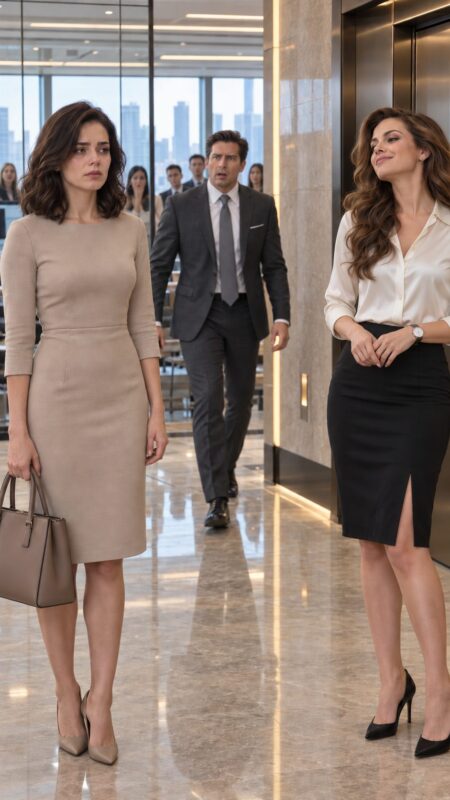
She had never met me.
Her eyes traveled from my simple navy suit to the leather folder under my arm.
“New hire?”
“You could say that.”
She pressed the elevator button but kept herself directly between me and the doors.
“This one is reserved for executives. Staff use the service lift.”
“What about interns?”
A faint smile appeared.
“Definitely the service lift.”
I glanced at the directory.
“And if they work above sixty-three?”
“The service elevator ends there.”
“My meeting is on sixty-eight.”
“Then you have stairs.”
Five floors.
I looked around and noticed several employees deliberately avoiding eye contact.
Nobody appeared surprised.
That interested me.
I stepped around Jang and entered the elevator.
Her heels clicked sharply behind me.
“You clearly don’t understand how this company works.”
“That’s why I’m here.”
“You’ll be unemployed by lunchtime.”
I smiled.
“Let’s see.”
The board had voted on my appointment before sunrise. Only final formalities remained.
Shiaoza, my husband of ten years and the company’s president, knew I was coming back to headquarters after months working abroad.
He did not know I would soon outrank him.
Apparently, neither did Jang.
On the sixty-eighth floor, employees quietly confirmed what I’d already suspected.
Jang operated by her own rules.
“She controls access to President Shiao.”
“He trusts her completely.”
One woman hesitated before adding, “People have complained. Nothing happens.”
Then sunlight reflected from Jang’s wrist.
I stopped listening.
White ceramic.
Diamond-set markers.
A distinctive platinum clasp.
I knew exactly what she was wearing.
Four weeks earlier, I’d spent days locating that limited-edition watch for Eleanor, my mother-in-law’s birthday.
Only ten had been manufactured.
Price: $60,000.
I’d sent the model information to Shiaoza and asked him to purchase it.
Now it was on his secretary.
I approached her.
“Beautiful watch.”
Jang deliberately turned her wrist so I could see it better.
“It’s extremely rare.”
“I know. Who gave it to you?”
Her smile became almost triumphant.
“President Shiao.”
Something cold settled in my stomach.
For years, Shiaoza had explained away late nights, private dinners, sudden trips, and calls he needed to take outside the room.
I’d never seriously questioned him.
Jang misread my silence.
“If you’re hoping to attract his attention,” she said, “don’t waste your time.”
I looked at her.
“Why?”
“Because I’ve been important to him much longer than you have.”
The conference-room doors opened behind us.
Shiaoza emerged.
He saw Jang first.
“Tong Tong? What’s happening?”
The affection in his voice was unmistakable.
She gestured toward me.
“An intern ignored me and used the executive elevator.”
Then he saw my face.
Every muscle in his body seemed to lock.
“Lian?”
Jang frowned.
“You know her?”
I held Shiaoza’s gaze.
“Go ahead. Introduce us.”
He swallowed.
“This is Lian.”
“That doesn’t answer her question.”
A long silence followed.
Finally:
“She’s my wife.”
Jang’s confidence vanished.
Employees nearby stopped pretending not to listen.
But Shiaoza didn’t walk toward me.
He moved beside Jang.
His hand settled protectively on her shoulder.
“Everyone calm down. This is simply a misunderstanding.”
I looked at his hand.
Then at the watch.
Maybe it was.
I decided not to guess.
At 10:00 a.m., the board formally announced my appointment as chief executive officer.
At 10:18, I issued my first directive.
All employees would have equal access to the building’s main elevators unless legitimate security requirements dictated otherwise.
My second directive ordered a forensic examination of procurement, executive expenses, vendor payments, and digital authorization records.
By noon, we learned the so-called executive elevator policy had never been approved.
Jang had invented it.
She had spent years deciding which employees were important enough to ride upstairs.
By midafternoon, however, elevators were the least interesting part of the investigation.
Auditors identified nine unusual vendors.
Together, they had received $18.4 million.
Several addresses, registrations, or contact records led back to Jang.
I summoned her.
When she saw the files, genuine fear replaced her usual arrogance.
“I didn’t create these payments.”
“Your information is attached to the companies.”
“Shiaoza told me they were legitimate reimbursement structures.”
“Why would he discuss financial entities with his secretary?”
She stared at me.
Then she whispered:
“Because I’m not only his secretary.”
I waited.
“He’s my brother.”
For the first time that day, she managed to surprise me.
The story that followed went back decades.
Eleanor had given birth to Jang before her marriage. Circumstances had led to the child being raised by relatives, and the truth was kept within a tiny circle.
Six years earlier, Shiaoza discovered Jang.
He helped her join the company.
He insisted their connection remain confidential.
The private conversations now had an explanation.
So did the affectionate nickname.
Even the watch could be explained.
But millions of missing dollars could not.
Shiaoza didn’t wait for me to finish investigating.
That afternoon, he called an emergency meeting of the board.
When I entered, a stack of financial records was waiting at my seat.
He stood at the opposite end of the table.
“We have discovered unauthorized transactions totaling $41.7 million.”
He pushed the documents toward the directors.
Each transaction had supposedly been approved by me.
My credentials.
My authorization codes.
My signature.
Shiaoza looked almost regretful.
“I didn’t want to believe it either.”
I studied the paperwork.
The signatures were excellent.
They were also fake.
Before I could respond, the boardroom doors opened.
Eleanor walked in accompanied by forensic specialists.
She placed another file beside Shiaoza’s evidence.
“You started this performance too early,” she told him.
The auditors had been investigating independently for weeks.
My digital credentials had been duplicated years earlier.
The fraudulent approvals weren’t coming from my devices.
Their technical trail repeatedly returned to Shiaoza’s executive office.
Jang’s supposed companies told a similar story.
She had once given her brother identity documents after he claimed they were required for investments and employment arrangements.
Those documents were later used to establish corporate entities without her understanding their purpose.
The structure became obvious.
If investigators discovered the scheme, I would appear responsible for approving fraudulent transactions.
Jang would appear to own companies receiving the money.
Shiaoza had created two exits for himself.
His wife would take one fall.
His sister would take the other.
Yet he remained composed.
“You’re forgetting the voting trust,” he said.
There it was.
The reason he still believed he’d won.
Shiaoza claimed a family provision gave him control over 51 percent of the company’s voting power.
Even under investigation, he believed he could remove me and control the board.
Eleanor laughed.
“You haven’t checked the trust this morning, have you?”
His confidence finally cracked.
She had uncovered his intentions months earlier.
The provision he planned to use had already been legally neutralized.
That morning, voting authority had transferred to the company’s newly appointed CEO.
Me.
“You had no authority to do that,” Shiaoza said.
Eleanor looked almost amused.
Then she delivered the truth he’d spent years trying to bury.
“Actually, I did. Because Lian is my only biological child.”
Jang stared at her.
Shiaoza went completely still.
He had been adopted into Eleanor’s family.
An old inheritance provision gave specific rights to Eleanor’s biological line.
For years, Shiaoza had believed those rights could eventually be manipulated in his favor.
Then he discovered Jang existed.
Her identity threatened his entire strategy.
So he hadn’t hidden his sister to protect her privacy.
He’d hidden her because acknowledging Eleanor’s biological daughter could destroy the inheritance claim he intended to exploit.
The doors opened once more.
Investigators entered.
This time, Shiaoza didn’t smile.
His eyes went immediately to Jang.
She answered the question before he asked it.
“I called them.”
He stared at his sister.
“After everything I’ve done for you?”
Her voice shook.
“You didn’t help me. You positioned me.”
That distinction silenced him.
I removed my husband’s executive access card from the table.
“Your employment ends today.”
Then I turned toward Jang.
“Yours does too.”
She looked stunned.
“I helped expose him.”
“And investigators will consider that.”
I gestured toward the hallway.
“But you spent years humiliating employees because you believed proximity to power made you powerful.”
She looked down at the white watch.
After a moment, she removed it.
“I understand.”
Six months later, Shiaoza admitted his role in the fraud and conspiracy scheme.
Our divorce ended shortly afterward.
Jang continued assisting investigators. Her relationship with Eleanor was complicated, painful, and slow—but at least it finally existed without Shiaoza controlling the truth between them.
The company changed as well.
There was no longer an “executive elevator.”
One evening, months after everything ended, I stepped into the same elevator where Jang had once told me to know my place.
A janitor entered carrying cleaning supplies.
Two interns hurried in before the doors closed.
A senior vice president joined us at the next floor.
Nobody moved aside for anyone.
Nobody checked job titles.
We simply rode down together.
Looking at those mirrored doors, I remembered the white watch.
That morning, I’d believed it was evidence that my husband had another woman.
In a way, discovering an affair would have been simpler.
Instead, I discovered a man who viewed relationships as pieces on a board.
A wife whose identity could authorize his crimes.
A sister whose documents could hide his money.
A mother whose family history could be manipulated for control.
Shiaoza hadn’t needed to hate us to betray us.
He simply valued his ambition more than any of us.
That was worse.
On my first morning as CEO, Jang tried to send me toward the stairs because she thought status determined who deserved the easiest path upward.
By evening, I understood why Shiaoza had allowed that culture to grow.
He believed exactly the same thing.
He spent years arranging everyone beneath him.
Then one elevator door opened—
and the entire structure collapsed.