At thirty-five, I married a 72-year-old millionaire.
People probably would have assumed I did it for his money.
The truth was more complicated.
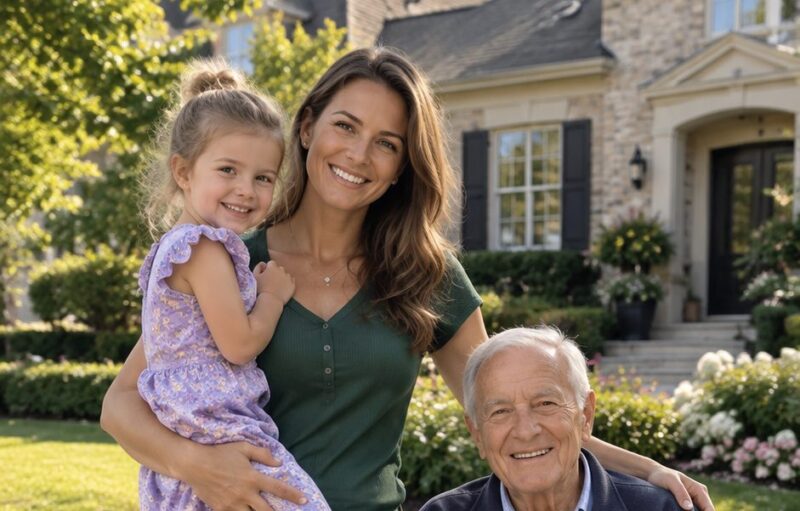
I had a little girl depending on me, almost no money left, and only a few weeks before we would lose the roof over our heads.
Five years later, my husband died.
The day after we buried him, his attorney appeared at my door carrying a leather folder.
Before I could even invite him inside, he said, “Richard always knew why you accepted his proposal.”
My face went cold.
Then he added, “And according to his will, you receive none of his estate.”
I thought I had misunderstood him.
I hadn’t.
But neither had I understood Richard.
Not until that morning.
My childhood had taught me never to expect permanence.
I grew up moving through foster homes, learning to pack quickly and avoid becoming too attached to bedrooms, neighborhoods, or people. Every time I thought I might finally belong somewhere, another move reminded me that nothing was guaranteed.
During those years, I met another foster kid who understood that feeling better than anyone.
Years later, he became my husband.
We weren’t wealthy or ambitious in any extraordinary way. I worked behind the counter at a local store, while he repaired cars. We rented a small apartment, saved whatever we could, and built the kind of ordinary life both of us had dreamed about as children.
Then Emily was born.
For the first time, I had the family I had always wanted.
And then cancer entered our lives.
My husband fought it for nearly a year.
There were appointments, treatments, hospital rooms, hopeful conversations, and terrible ones. We kept believing there might be one more option.
Eventually, there wasn’t.
When he died, Emily had barely celebrated her first birthday.
I was left with a baby, a mountain of bills, and grief I didn’t have time to process.
I needed work immediately.
That’s how I ended up cleaning the home of Richard Hale, a wealthy widower in his seventies.
His house was enormous—beautiful, immaculate, and strangely lifeless.
Richard lived there alone.
At first, our relationship was simple. I cleaned. He paid me. Occasionally, we talked over coffee.
Unlike some wealthy people I had worked for, Richard never treated me as invisible. He remembered Emily’s name. If I looked exhausted, he noticed. If I needed to leave early because she was sick, he never complained.
Still, kindness couldn’t solve my financial problems.
My wages disappeared almost as soon as I received them.
Then Emily became ill.
The medicine she needed cost more than I had available, and while I was trying to figure out how to pay for it, my landlord gave me notice.
One month.
That was how long I had to catch up or leave.
I pleaded with him.
Nothing changed.
That night, I sat beside Emily’s crib staring at my bank balance and wondering how I had managed to fail so completely.
I could survive sleeping in a car.
My daughter shouldn’t have to.
A few days later, Richard asked me to join him in his study.
He seemed unusually nervous.
“I’ve reached an age where pretending seems like a waste of time,” he said.
I waited.
Then he looked directly at me.
“I’ve grown very fond of you. More than fond, actually. I know there’s nearly forty years between us, and I understand how ridiculous this may sound. But I’d like you to become my wife.”
I couldn’t speak.
He didn’t pressure me for an answer.
But I knew what marrying him would mean.
Emily would have a bedroom.
She would have food, medicine, warmth, and security.
I wouldn’t have to calculate which bill could remain unpaid for another week.
So I accepted.
I told myself I was doing it for my daughter.
Yet the marriage that followed was nothing like the arrangement I had imagined.
Richard never expected me to pretend we were some fairy-tale couple.
Instead, he quietly made room for us in his life.
Emily transformed his house almost immediately.
Her toys appeared beneath antique furniture. Finger paintings ended up on the refrigerator of a kitchen that had once looked like a showroom. She wandered into Richard’s study while he was reading and climbed into the chair beside him as though she had always belonged there.
He adored it.
He taught her chess, although she regularly moved pieces illegally and insisted she’d won.
When Emily was sick, Richard checked on her repeatedly throughout the night.
On Sunday mornings, the two of them made pancakes together. Most were misshapen, and the kitchen looked disastrous afterward.
I hadn’t heard Richard laugh like that before.
Over time, his health began to decline.
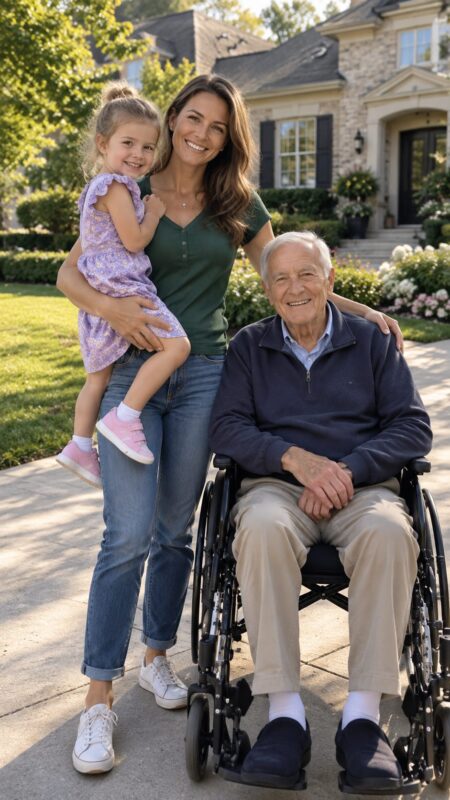
Walking became difficult. Eventually, he needed a wheelchair.
So our roles changed.
I helped him dress. I organized his medication. On sunny afternoons, I pushed his chair through the gardens while Emily skipped beside us, telling him endless stories.
I stopped thinking of Richard as the man who had rescued me from homelessness.
He was simply Richard.
And somewhere during those five years, I began loving him in a way I had never expected.
Then one morning, he was gone.
After the funeral, I returned home with Emily and walked through rooms that suddenly seemed much larger.
I knew Richard had no children and no close relatives.
Naturally, I assumed the house and his assets would pass to me.
Then his attorney arrived the following morning.
“Richard knew exactly what he was doing when he proposed to you,” he said.
I stiffened.
“What does that mean?”
“He knew you were desperate. He knew you would probably accept.”
The words felt cruel.
Before I could respond, he continued.
“But there’s something else you need to hear. Richard’s will leaves his estate to no one.”
I stared at him.
“What about Emily? What about this house?”
Instead of answering, he handed me a sealed envelope.
“Richard asked me to give you this after I explained the will.”
I recognized the handwriting immediately.
I opened it.
The first line almost made me laugh despite everything.
*If my lawyer has followed my instructions correctly, you’re probably furious with both of us right now.*
I glanced at the attorney.
He gave me a small smile.
I continued reading.
Richard explained that the will contained almost nothing because, legally, there was very little left for it to distribute.
Shortly after our wedding, he had begun moving his major assets into a private trust.
The beneficiary wasn’t me.
It was Emily.
Her education was fully funded. Money had been set aside for her adulthood. Investments had been structured so she would have security long after Richard was gone.
And the house?
It was protected separately.
Emily and I could remain there for the rest of my life.
My knees weakened, and I sat down.
Then I reached the part of Richard’s letter that had nothing to do with money.
He wrote about the years before we met.
After losing his wife, he had lived alone in that enormous house surrounded by possessions he no longer enjoyed.
There had been no arguments over breakfast.
No toys on the floor.
No one asking where he was going.
No one waiting for him to return.
He had spent years thinking wealth had given him independence.
Eventually, he realized it had simply made his loneliness more comfortable.
Then a young housekeeper began arriving every morning carrying photographs of her little daughter.
Soon that daughter began visiting.
Emily drew pictures for him.
She interrupted his reading.
She stole biscuits from his plate.
She demanded chess rematches whenever she lost.
And one day, without noticing when it happened, Richard stopped feeling alone.
Then came the sentence that broke me.
You believed I was giving you and Emily somewhere to live.
But you never realized that the two of you gave me somewhere to belong.
I covered my mouth.
The letter continued.
Richard admitted that he had understood my circumstances before proposing. He knew financial desperation influenced my decision.
He had never resented it.
Because he had been desperate too.
Not for money.
For people.
For noise.
For purpose.
For someone to care whether he woke up in the morning.
His final words were simple.
Never feel ashamed of why you said yes.
You gave me five years I thought I would never have.
Emily gave me the chance to be a grandfather.
And you gave me the privilege of being part of a family again.
That was the greatest inheritance anyone ever gave me.
By then, I could barely see the page.
I had spent five years quietly carrying guilt because I knew fear had played a role in my decision to marry Richard.
All along, he had known.
And instead of feeling deceived, he had understood.
A small voice came from behind me.
“Mom?”
Emily stood at the entrance to the room.
I held out my arms.
She crossed the room and climbed onto my lap.
As I hugged her, I looked around the house that had once seemed enormous and empty.
It wasn’t Richard’s fortune that overwhelmed me.
It wasn’t even knowing Emily’s future was secure.
It was realizing what he had actually left me.
For most of my childhood, I had believed families were something other people were lucky enough to keep.
I had spent years being moved from home to home, terrified that love was temporary and belonging could disappear without warning.
Richard had spent his final years afraid of something surprisingly similar.
We had entered each other’s lives for completely different reasons.
I needed shelter.
He needed family.
Somehow, we gave each other both.
And for the first time, I understood that being chosen doesn’t always happen at the beginning of a story.
Sometimes it happens slowly—in shared breakfasts, sleepless nights, wheelchair walks, children’s drawings, and chess games played badly on purpose.
Richard hadn’t simply left us a house.
He had left us proof that, for five years, three people who had once been painfully alone had finally found a place where they belonged.