Six days after Larry’s funeral, I found an envelope in my mailbox.
There was no return address.
There didn’t need to be one.
I recognized the uneven handwriting immediately.
My husband’s.
I stood in the apartment hallway staring at my name for what felt like forever.
Larry had been gone less than a week.
We had been married for only three weeks.
And somehow, he was still about to tell me something.
I opened the envelope.
Sarah, there’s something I should have admitted before you agreed to marry me.
My stomach tightened.
Only a month earlier, Larry had been the man I passed every morning outside a downtown subway entrance.
He slept wherever he could and carried nearly everything he owned in an old backpack.
I’d first spoken to him almost two years earlier.
It was freezing that morning, so I bought an extra coffee.
“Black okay?” I’d asked.
“Coffee is coffee when your hands are this cold,” he’d replied.
The following morning, I brought another.
Soon it became our routine.
Two coffees.
Cream in mine.
Nothing in Larry’s.
I’d sit beside him for a few minutes before work, and we’d talk.
Larry was funny, observant, and surprisingly good at remembering details. He knew when I had an important meeting. He remembered my birthday after hearing it once. If I arrived looking miserable, he’d ask what happened before I even sat down.
Yet he rarely talked about his own past.
Then one Monday morning, everything changed.
Larry was waiting in his usual place with a cardboard sign propped against his knees.
I expected the usual request for food or spare change.
Instead, it said:
MARRY ME BEFORE I RUN OUT OF TIME.
I laughed because I assumed Larry was teasing me.
He didn’t laugh back.
“I’m dying, Sarah.”
The smile disappeared from my face.
Doctors had told him his liver was failing. Treatment could make him more comfortable, but it wouldn’t save him.
“How long?”
“Maybe a month.”
I sat down beside him.
“Why are you asking me to marry you?”
Larry looked toward the commuters rushing past us.
“When I die, I don’t want to be nobody’s responsibility.”
“You’re not nobody.”
“Legally, I pretty much am.”
Then he said something I couldn’t forget.
“I’d like to leave this world knowing at least one person could call me family.”
It was an outrageous request.
I knew that.
Larry knew it too.
But after two years of conversations, he wasn’t simply a homeless stranger outside the station anymore.
And he didn’t have much time.
Two days later, we went to the courthouse.
The ceremony lasted only a few minutes.
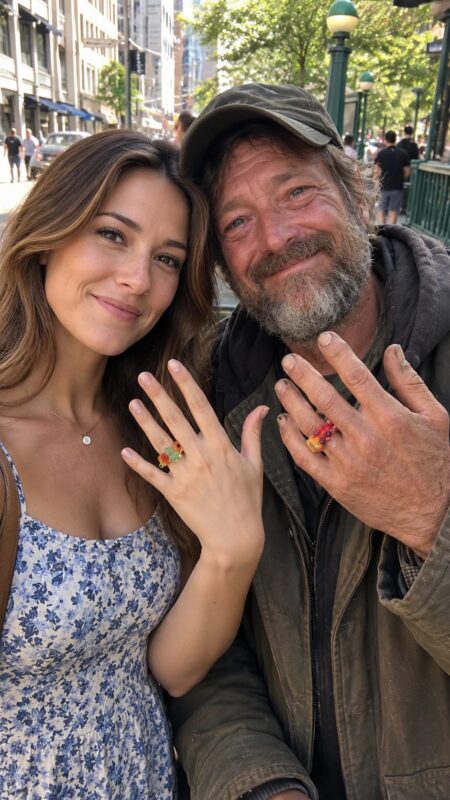
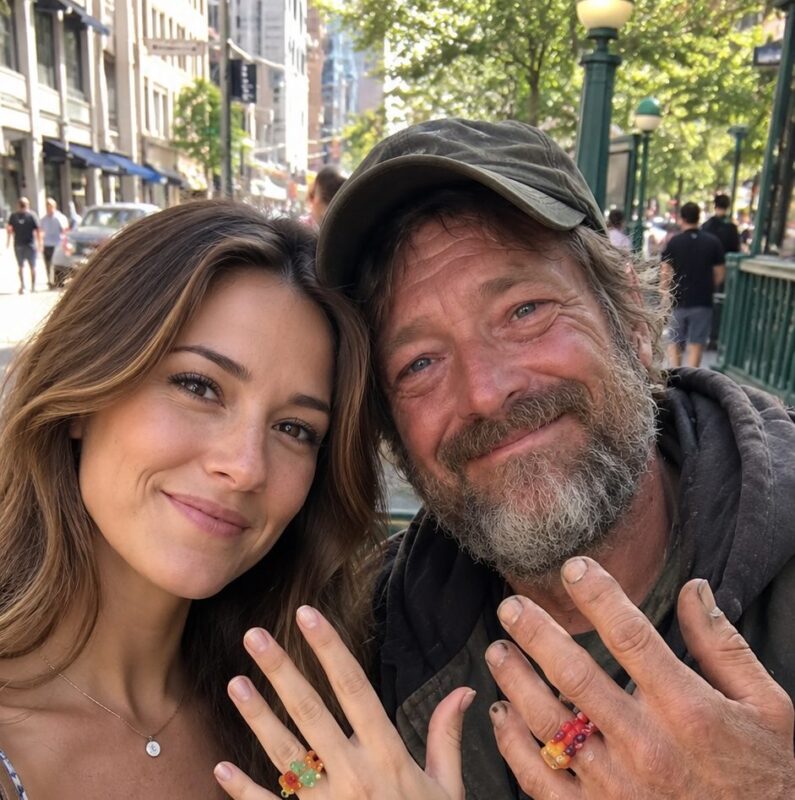
Larry’s hands shook as we exchanged vows.
I assumed it was his illness.
When the clerk told us we were married, Larry stared at our certificate for a strangely long time.
Then he smiled.
I’d never seen him look so peaceful.
Three weeks later, I was sitting beside his hospice bed when he died.
I arranged his funeral.
I signed forms as his wife.
I made sure he wasn’t buried as an unidentified man with nobody there to say goodbye.
At least, that was what I believed our marriage had been about.
Then his letter arrived.
I told you the truth about dying, Larry wrote. But I lied about needing a wife to take care of everything afterward.
I stopped reading.
My face grew hot.
His funeral arrangements had already existed.
The necessary paperwork had been completed.
He hadn’t needed marriage for any of it.
So why had he asked me?
The next line contained only an instruction.
Go back to the courthouse. Find Margaret Ellis. Tell her Larry sent you.
I considered throwing the letter away.
Instead, less than two hours later, I was standing inside the building where I’d become Larry’s wife.
A woman behind the counter looked up.
“I’m looking for Margaret Ellis.”
“That would be me.”
“My name is Sarah.”
Nothing.
Then I added, “Larry was my husband.”
Margaret’s expression collapsed.
“Oh,” she whispered. “You’re Sarah.”
That unsettled me.
“You knew about me?”
“He wouldn’t stop talking about you.”
I stared at her.
“How did you know Larry?”
Margaret looked surprised by the question.
“He worked here.”
“What?”
“For twenty-eight years.”
Larry had spent almost three decades in that courthouse.
And during nearly two years of morning conversations, he had never once told me.
Margaret took me down a corridor.
We stopped outside the same small room where Larry and I had exchanged our vows.
She unlocked the door.
“I think he wanted you to see this.”
From a cabinet, she removed several old record books.
She opened the first one and pointed toward a marriage entry.
I saw two unfamiliar names.
Then, underneath them, another.
Larry’s.
Beside his signature was the word:
Witness.
Margaret turned several pages.
There he was again.
Different couple.
Same signature.
Witness.
She opened another book.
Larry again.
Then another.
His name seemed to follow us through the years.
“How many weddings did he witness?” I asked.
Margaret smiled.
“Nobody ever counted.”
She explained that couples sometimes arrived without relatives or friends.
Some were new to the city.
Some had complicated families.
Others simply wanted a private ceremony.
Whenever someone needed a witness, Larry volunteered.
“He couldn’t stand seeing people get married with nobody there for them,” Margaret said.
Sometimes he signed their papers.
Sometimes he took a picture afterward.
Sometimes he stayed only long enough to clap when the ceremony ended.
But he always made sure somebody was standing there.
I looked at page after page of Larry’s name.
Then I asked the obvious question.
“What about him?”
Margaret frowned.
“What do you mean?”
“Was he ever married before me?”
Her answer came softly.
“No.”
I looked up.
“Never?”
“You were his first wife.”
Margaret removed one final document.
Our marriage certificate.
She placed it beside the old records.
On all those other pages, Larry had occupied the edge of somebody else’s story.
Witness.
Witness.
Witness.
But on this one, his name appeared beside mine.
Spouse.
Margaret told me something else.
Larry had come to the courthouse alone the afternoon before our ceremony.
He asked whether he could sit in the wedding room.
“He stayed in that chair for almost an hour,” she said.
“Why?”
“I think he was trying to imagine what it would feel like when the wedding was finally his.”
Suddenly, I remembered the way Larry’s hand trembled when he signed our certificate.
It hadn’t only been illness.
For the first time in his life, he wasn’t witnessing someone else being chosen.
Someone had chosen him.
I left the courthouse unable to speak.
My feet carried me automatically toward the subway station.
At the coffee shop, I ordered two cups before remembering there was nobody waiting for the second one.
I took it anyway.
Then I sat in Larry’s old spot and continued reading his letter.
You deserve to know why I didn’t tell you the truth.
For most of my adult life, I stood beside strangers while they promised to belong to each other.
I watched nervous people laugh, cry, hold hands, and walk out of that room as families.
I was happy for them.
But eventually, I started wondering what it would feel like if someone came there for me.
A tear landed on the page.
Larry continued.
When the doctors told me I didn’t have much time, that thought became impossible to ignore.
I wanted to know what the word husband felt like.
I whispered into the empty station entrance.
“You could have told me.”
The next paragraph answered me.
I know.
But saying “I’m dying alone and I’m scared nobody has ever chosen me” felt pathetic.
So instead, I made it practical.
I told you I needed someone to deal with things after I died.
I knew that would work because you have always been better at solving other people’s problems than sitting beside them.
I used that kindness.
I’m sorry.
I had to stop reading.
Part of me was angry.
Another part finally understood.
Larry hadn’t tricked me because he wanted money.
He didn’t have any.
He hadn’t married me for convenience.
He’d already handled the practical details.
He had simply been afraid to ask for companionship without giving me a problem to solve.
Then I reached his final message.
Sarah, please don’t remember me as someone you couldn’t rescue.
There was nothing left to rescue.
You didn’t cure me.
You didn’t change the ending.
You did something better.
For three weeks, I woke up knowing I was somebody’s husband.
That was enough.
I lowered the letter.
People hurried around me toward trains, offices, appointments, and lives that seemed terribly urgent.
Larry had spent twenty-eight years appearing in the background of other people’s happiest photographs.
He had signed hundreds of certificates without ever having one of his own.
Then, for three weeks, the word beside his name changed.
He wasn’t the witness.
He was the husband.
A man with a faded backpack stopped nearby.
“Excuse me. Is this seat taken?”
I looked at the empty space beside me.
My first instinct was to ask whether he needed something.
Food?
Money?
Coffee?
Then I remembered one final sentence Larry had added at the bottom of his letter.
*Not everyone needs you to solve something, Sarah. Sometimes they just need you not to leave.*
I moved my bag.
“It’s free.”
The man sat down.
I didn’t question him.
I didn’t reach for my wallet.
I didn’t try to figure out his story.
For several minutes, we simply sat there while the city rushed past.
Beside me was the second cup of coffee I’d bought out of habit.
In my hands was the final letter from a man I’d known for two years and been married to for only three weeks.
For most of our friendship, I’d believed kindness meant doing something.
Buying coffee.
Finding solutions.
Completing paperwork.
Taking responsibility.
Larry’s last gift was teaching me that sometimes kindness isn’t an action at all.
Sometimes another person doesn’t need to be fixed, rescued, or saved.
Sometimes they simply need someone willing to share the bench.
Larry had spent decades standing beside strangers so they wouldn’t begin their marriages alone.
At the end of his own life, he asked me for the same thing.
Not a miracle.
Not salvation.
Just company.
And although I couldn’t keep him here, I could give him that.
For three weeks, Larry had someone beside him.
And when his time came, he didn’t leave this world wondering whether anyone had ever chosen him.
He already knew.
I had.