At 5:58 on a quiet Sunday morning, I heard a key slide into my front-door lock.
Metal turned against metal.
Then stopped.
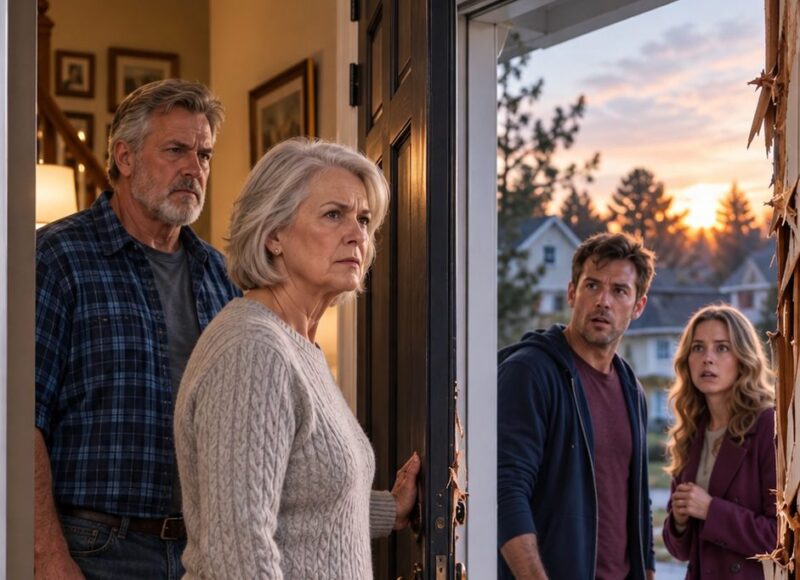
The new lock had done exactly what it was supposed to do.
Seconds later, my son’s voice echoed from the porch.
“Mom! What’s going on? Open the door!”
I stayed at the kitchen island with both hands wrapped around my coffee mug.
Through the front window, I could see David and his wife, Sarah.
They had just returned from their weekend trip.
Beside David rested a sledgehammer.
Apparently, they still believed this was their home.
Three months earlier, I might have believed the same thing.
When David called to tell me their lease was ending before their next apartment would be available, I didn’t hesitate.
“Stay here until you can move,” I told him.
David was my only son.
After my husband died, I had raised him in that house by myself. I had watched him grow from a frightened boy grieving his father into an adult with a life of his own.
If my child needed help, I helped him.
That was how I had always understood motherhood.
Unfortunately, Sarah seemed to interpret my generosity differently.
Within the first week, she began changing things.
I walked into the kitchen one morning and discovered that my vintage espresso machine was gone.
I eventually found it buried behind boxes in the pantry.
Sarah’s enormous blender now occupied its place on the counter.
“Where’s my espresso machine?” I asked.
“I moved it.”
“Why?”
She shrugged.
“The kitchen works better this way.”
I stared at her.
“It worked perfectly well for me.”
She smiled as though I were being unreasonable.
Then came the laundry.
One afternoon, I found a basket filled with Sarah and David’s clothes waiting beside the washing machine.
A handwritten note had been placed on top.
Cold wash.
Delicate cycle.
Air-dry certain items.
I carried the basket upstairs, walked into their bedroom, and dumped everything onto the mattress.
David confronted me later.
“Why would you do that?”
“Because I’m your mother, not your maid.”
He rolled his eyes.
I should have recognized the warning signs then.
Instead, I kept telling myself they would be gone soon.
Then Sarah crossed a line I couldn’t ignore.
I returned home one afternoon and saw an old oak console table sitting beside the garbage cans at the curb.
My husband had restored that table years before he died.
He had spent weeks sanding the wood, repairing the joints, and bringing it back to life.
I dragged it inside and found Sarah.
“Why was my table outside?”
“It doesn’t really fit the style we’re creating.”
I stared at her.
“We?”
She hesitated.
I stepped closer.
“There is no ‘we’ when it comes to decorating this house. You are staying here temporarily.”
After that, the tension became impossible to ignore.
Then my monthly cable statement arrived.
The bill had nearly tripled.
David had added premium channels, sports packages, upgrades, and several pay-per-view purchases.
Without asking.
I called the provider and canceled everything.
That evening, David demanded to know why the television wasn’t working.
“Because I stopped paying for entertainment I never ordered.”
From that point on, the house felt different.
Sarah stopped pretending to like me.
David treated every boundary as an insult.
I began counting the days until they moved out.
Then one evening, I overheard a conversation that changed everything.
I had stepped into the backyard when voices drifted through the partially open kitchen window.
Sarah was talking about me.
“She’s getting more forgetful.”
I stopped.
David said something too quietly for me to hear.
Sarah continued.
“We start documenting things. Missing appointments. Confusion. Whatever we can. Then we talk to a doctor.”
My fingers tightened around the garden railing.
“A doctor for what?” David asked.
“To establish that she needs supervised care.”
There was a pause.
“You mean put her somewhere?”
“Assisted living isn’t prison, David. She’d have people around.”
Then Sarah added the part I would never forget.
“And you’d finally have the house.”
I waited.
Surely my son would stop her.
Instead, David asked, “How would we even do that?”
My heart sank.
Sarah lowered her voice.
“You need legal authority.”
“Power of attorney?”
“That would help.”
David thought for a moment.
“I’d probably need my name added to the deed too. I could tell Mom it would make things easier with taxes.”
I quietly walked away from the window.
I didn’t confront them.
I didn’t cry in front of them.
And I didn’t reveal that I had heard every word.
That night, however, I barely slept.
The following morning, I called Arthur.
He had been my husband’s closest friend for decades and had recently retired after a long career in construction.
After hearing the story, he was silent for several seconds.
“Do you want help getting them out?”
“Yes.”
“When?”
“Friday.”
David and Sarah had planned a weekend trip for a friend’s birthday.
I wanted them gone without screaming, threats, or a confrontation inside my house.
Friday afternoon, I stood at the window until their car disappeared.
Then Arthur and his two sons arrived.
We packed everything David and Sarah owned.
Clothes.
Shoes.
Electronics.
Documents.
Furniture.
Even Sarah’s blender.
Every item was carefully boxed and transported to a storage unit that had been paid for in advance.
Once the house was empty of their belongings, Arthur began working.
He replaced the locks.
Reset the garage code.
Added stronger deadbolts.
Reinforced the front entrance.
By Saturday night, my house felt like mine again.
Then came Sunday morning.
At 5:58, David discovered that his key no longer worked.
The knocking quickly turned into pounding.
“Mom!”
I didn’t move.
Then I heard Sarah.
“She can’t lock us out!”
More pounding.
A few seconds later, Sarah shouted, “Break it!”
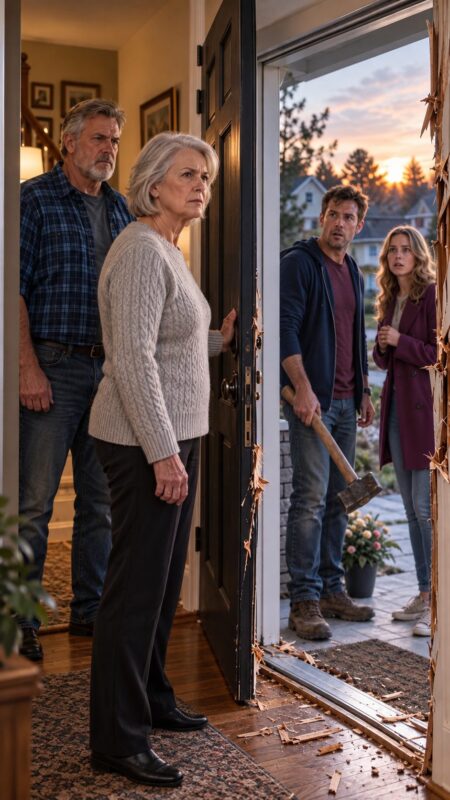
The first strike of the sledgehammer rattled the front entrance.
I stood.
The second blow cracked part of the wooden trim.
I walked toward the door.
David lifted the hammer again.
This time, I unlocked the door before he could swing.
He froze.
I stood directly in front of him.
“Put that down.”
“Mom, what the hell is happening?”
“Language.”
Even then, I was still his mother.
Sarah pushed forward.
“You changed the locks?”
“Yes.”
“You can’t do that! We live here!”
“No, you don’t.”
Her mouth fell open.
I explained that their belongings were safe in storage and gave David the information he needed to retrieve them.
Sarah stared at me in disbelief.
“You’re throwing your own son out of a house that’s going to belong to him eventually?”
I almost laughed.
There it was.
The assumption underneath everything.
I looked at David.
“I heard you.”
His expression changed immediately.
“Heard what?”
“The conversation in the kitchen.”
Silence.
I continued.
“I heard Sarah talking about convincing a doctor that I was becoming mentally incapable.”
Sarah stepped back.
“I heard the assisted-living discussion.”
“Mom—”
“And I heard you talking about power of attorney and getting your name on my deed.”
David’s face went pale.
Sarah said nothing.
My son looked down at the porch.
“I wasn’t going to do anything.”
“That’s supposed to make me feel better?”
“I was just talking.”
“No, David. You were planning.”
His eyes filled with tears.
“I wouldn’t actually take your house.”
I looked at him for a long moment.
“Maybe you wouldn’t have.”
He looked up hopefully.
“But when your wife suggested taking control of my life, you didn’t defend me.”
His face crumpled.
And that hurt more than I expected.
No matter how angry I was, he remained my child.
For a moment, I remembered him at six years old, running into my bedroom during a thunderstorm.
I remembered sitting beside him at the hospital after his father died.
I remembered birthdays, school concerts, scraped knees, graduations, and every sacrifice I had once made without thinking twice.
But love did not erase what had happened.
Maybe that had been my mistake for years.
I had treated motherhood as permission for David to cross boundaries I would never have accepted from anyone else.
“I love you,” I said.
He wiped his eyes.
“Then why are you doing this?”
“Because those two things can exist together.”
He frowned.
“I can love you and still tell you no.”
Neither David nor Sarah spoke.
“I can love you without giving you this house. I can love you without signing documents you put in front of me. And I can love you without allowing you to disrespect me.”
David glanced inside.
“Can we at least come in and talk?”
“Not this morning.”
He slowly lowered the sledgehammer onto the lawn.
Then he noticed the damage around the doorway.
“I’ll fix that.”
“No.”
He looked confused.
“You’ll pay for someone else to fix it.”
For the first time that morning, he almost smiled.
“Okay.”
Three weeks went by before David called again.
I stared at his name on my phone before answering.
“Hi, Mom.”
“Hello, David.”
There was an awkward silence.
Then he said, “Would you have coffee with me?”
“What do you need?”
“Nothing.”
I waited.
“I just want to talk.”
So we met.
That conversation didn’t repair everything.
Neither did the next one.
It took months.
David apologized more than once because sometimes the first apology wasn’t enough.
I learned to say no without feeling guilty.
He learned that disappointment wasn’t the same as rejection.
Some boundaries frustrated him.
I kept them anyway.
Eventually, we began building a different relationship—one based less on obligation and more on mutual respect.
David stopped viewing my love as something that guaranteed him access to everything I owned.
And I stopped believing that motherhood required endless sacrifice.
Arthur eventually repaired the front entrance.
Before he threw away the broken pieces, I asked him to give me one.
A small splinter of the damaged door still sits on a shelf in my garage.
I don’t keep it because I hate my son.
I keep it because that piece of wood reminds me of the morning I finally understood the difference between love and access.
Family deserves the possibility of forgiveness.
People can apologize.
Relationships can heal.
Doors can reopen.
But that doesn’t mean they should never have locks.