At Thirty-Six, I Chose the Woman Everyone Pitied—A Year Later, Three Black Cars Changed Everything
By the time I reached thirty-six, my life had already become a topic of discussion in the village.
“Still single?”
“He’ll end up alone.”
“Something’s not right with him…”
In a place like ours, people never run out of things to say. I heard it all. It bothered me at first, but eventually, I made peace with it.
I had loved once. It didn’t last. After that, I stopped chasing what refused to stay.
Instead, I chose a quieter path.
My days were simple. I woke before sunrise, fed the chickens and ducks, watered my small garden, and worked just enough to keep everything going. It wasn’t much, but it was steady.
Calm. Predictable.
Lonely sometimes.
But still… peaceful.
That peace didn’t last.
One cold afternoon, near the end of winter, I went to the market for a few supplies—and that’s where I saw her.
She sat off to the side, away from the crowd. Her clothes were worn, her hands thin, her whole presence marked by hardship. She looked like someone the world had forgotten.
But it wasn’t her appearance that caught my attention.
It was her eyes.
They were gentle, steady… carrying a quiet sorrow far deeper than her years.
Before I could think it through, I found myself walking toward her.
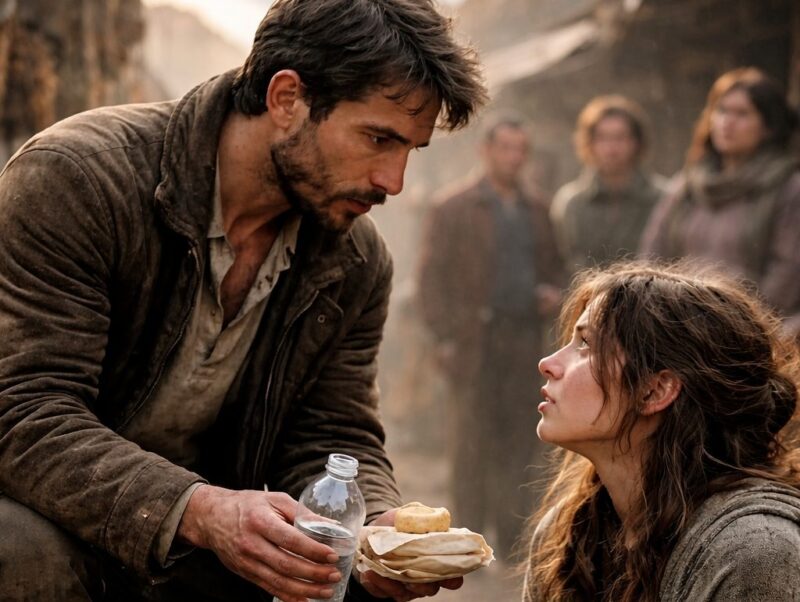
I bought two rice cakes and a bottle of water and handed them over.
“Take this,” I said.
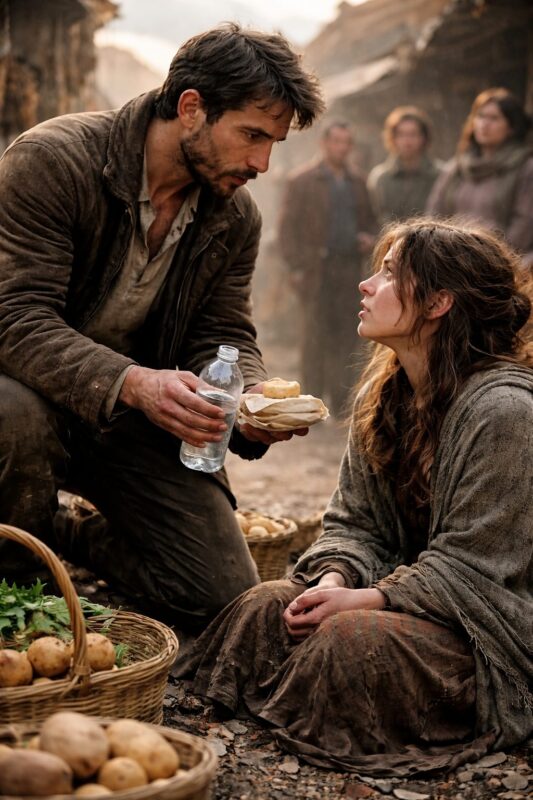
She looked up, surprised, then lowered her gaze.
“Thank you,” she said softly.
I left without another word.
But that night, she stayed on my mind.
A few days later, I returned to the market—and there she was again. Same quiet presence, same distance from everyone else.
This time, I didn’t just give her food.
I sat beside her.
We talked.
At first, she was cautious, answering briefly, choosing her words carefully. But little by little, she opened up.
Her name was Claire Dawson.
She had no family. No home. She had spent years drifting from place to place, surviving however she could.
What struck me most wasn’t her story.
It was how she told it.
No anger. No bitterness.
Just acceptance.
I listened longer than I meant to. And then, without planning it, I said something that surprised even me.
“If you’re willing… marry me.”
The words hung between us.
Claire stared at me, stunned.
“You’re serious?” she asked quietly.
“I don’t have much,” I admitted. “But I have a home. Food. Stability. I can’t offer luxury—but I can promise you won’t have to live like this anymore.”
People nearby had already noticed.
Someone laughed.
“He’s gone mad,” another whispered.
I ignored them.
Claire didn’t answer right away.
Not that day. Not the next.
But a few days later, she came to my house.
“I’ll do it,” she said simply.
And just like that, everything changed.
Our wedding was modest. A few neighbors came, mostly out of curiosity. No decorations, no music—just a quiet ceremony.
Still, I felt something I hadn’t felt in years.
Certainty.
The gossip didn’t stop.
“He married a beggar?”
“She’ll leave him soon enough.”
“This won’t last.”
I paid no attention.
Claire moved in, and everything was unfamiliar to her. She didn’t know how to cook, had never cared for animals, and struggled with even the simplest routines.
But she never complained.
Not once.
I was feeding the chickens when I heard engines—low, unfamiliar, growing louder.
Not one.
Several.
I turned toward the road.
Three long black luxury cars rolled into the village, gleaming like they didn’t belong there.
People stepped outside. Children stopped playing. Even the animals grew restless.
The cars stopped in front of my house.
My heart started pounding.
Behind me, the door opened.
Claire stepped outside, holding one child while the other clung to her dress.
I looked at her—and froze.
Her face had gone pale.
Not confused.
Not afraid.
Recognizing.
The car doors opened. Men in suits stepped out, silent and composed. Then an older man emerged from the center car—silver-haired, perfectly dressed, carrying quiet authority.
His eyes locked onto Claire.
“Claire.”
Her name sounded different in his voice. Heavy. Familiar.
Her lips trembled.
“…Father?”
The word hit like a shock.
The villagers gasped.
“The beggar has a father like that?”
“Who is he?”
My thoughts scattered.
The man walked closer, his gaze never leaving her.
“I’ve been looking for you,” he said.
“You shouldn’t have,” Claire replied softly.
“You disappeared. We feared the worst.”
“I left,” she said. “By choice.”
Silence fell.
I stepped forward.
“She’s my wife,” I said. “This is her home.”
He turned to me.
“And you are?”
“Benjamin.”
He studied me briefly, then gave a small nod.
“I understand.”
His attention shifted to the children.
“…Yours?”
Claire nodded.
Something in his expression softened.
“They have your eyes,” he said quietly.
Then he looked back at her.
“Come home. You don’t have to live like this.”
My chest tightened. Everything we had built—was it nothing compared to what he could give her?
Before I could speak, Claire stepped forward.
“No.”
Her voice was calm, but firm.
“I’m staying.”
He blinked.
“You choose this life?”
“Yes.”
She reached for my hand.
“This is my family.”
He looked around—the modest house, the uneven yard, the barefoot children.
Then back at her.
“…Are you happy?”
Claire paused.
She looked at me. At our children.
A soft smile appeared.
“Yes,” she said. “I am.”
Something shifted in him.
The tension faded.
“…Then that’s all that matters,” he said quietly.
He handed her an envelope.
“For your children. And in case you ever wish to find us again.”
Claire took it with trembling hands.
“Thank you,” she whispered.
He hesitated, then gently touched one of the twins’ heads.
“Take care of your mother.”
Then he turned and left.
Within minutes, the cars were gone.
That night, Claire opened the envelope.
Inside were documents—land, savings, enough to completely change our future.
And a letter.
At the bottom, it read:
“No matter where you choose to be, you will always have a home with us.”
Claire folded it carefully and looked at me.
“We’re staying,” she said.
I nodded.