Every specialist who examined Massimo Rinaldi gave him essentially the same verdict: the damage to his spine was permanent, and he should prepare for a life without walking.
That was why people found it amusing when Nina Bennett, the housekeeper’s three-year-old daughter, appeared one afternoon carrying a little bowl of warm water.
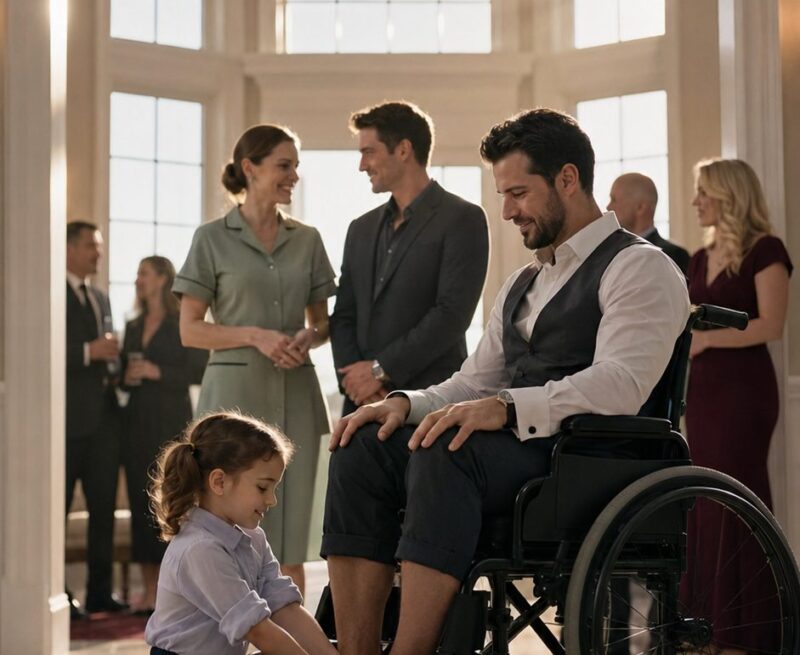
She placed it beside Massimo’s wheelchair and looked up at him with complete confidence.
“Give me your feet, Uncle Massimo. I’m going to wake them up.”
A few people nearby laughed.
Massimo didn’t.
He simply moved his feet toward her and let the little girl begin.
What everyone dismissed as a child’s game would eventually lead Massimo to a truth that doctors, advisers, and men he had trusted for years had failed to reveal.
Six months earlier, Massimo had nearly died on a Brooklyn street.
His convoy had been attacked without warning, and during the ambush, a bullet damaged his lower spine. He survived, but when he woke up, he could no longer move his legs.
There was one man everyone credited with keeping him alive: Dean Foster.
Dean had been at Massimo’s side for twelve years. He wasn’t merely an employee; he was the man Massimo trusted with his business, his security, and often his life.
According to everyone present during the attack, Dean had thrown himself into the line of fire and taken two bullets while protecting Massimo.
That act made him untouchable in Massimo’s eyes.
If Dean offered advice, Massimo listened.
If Dean said someone could be trusted, Massimo believed him.
At thirty-eight, Massimo still commanded enormous influence throughout the East Coast, but his physical condition was slowly changing the balance of power around him.
He began giving Dean greater authority.
His personal life wasn’t much better. Massimo was engaged to Camille Ashwood, a woman who seemed more interested in maintaining appearances than understanding what he was going through. Their wedding was approaching, yet Massimo felt almost nothing when people mentioned it.
Most days inside the mansion felt cold and predictable.
Then Nina would appear.
Her mother, Carla, had been employed in the Rinaldi household for two years. Carla had raised Nina alone since her husband’s death in an accident.
Carla understood exactly who Massimo was and why people feared him.
Nina didn’t care.
She called him Uncle Massimo and spoke to him with the same confidence she used when talking to anyone else.
One afternoon, months after the shooting, Nina had found him alone near the garden fountain.
Massimo had been crying.
Nina stared at his legs for a moment before offering her diagnosis.
“They’re sleeping.”
Massimo wiped his face. “What is?”
“Your feet.”
She pointed at them.
“They’re sleeping now, but they won’t sleep forever.”
The next afternoon, Nina arrived with warm water.
She carefully washed his feet because, in her three-year-old understanding of the world, warm water helped people wake up.
And then she returned the following day.
Soon, it became their afternoon tradition.
Camille rolled her eyes whenever she saw it.
Dean turned it into a joke.
“Careful, Massimo. Your new doctor looks expensive.”
Massimo never told Nina to stop.
Her little ritual accomplished something medicine hadn’t managed to do.
It gave him a reason to smile.
Then Dr. Julian Hale arrived for a routine examination.
Hale had overseen much of Massimo’s treatment since the shooting. After finishing his examination, he packed his medical bag and hurried out.
Something small fell from his coat.
A white pill landed near the edge of the carpet.
No adult noticed.

Nina did.
She picked it up and put it into her pocket.
By the following afternoon, she had nearly forgotten about it.
She was preparing the warm water beside Massimo when she suddenly remembered.
“Wait!”
Nina reached into her pocket.
“The doctor lost this.”
She dropped the pill into Massimo’s palm.
His expression changed.
He recognized its general appearance, but something about it didn’t match what he remembered being prescribed.
Massimo had survived for years by paying attention when something felt wrong.
He decided to trust that instinct.
He told neither Dean nor Hale what Nina had found.
Instead, he quietly contacted an independent laboratory and arranged for the pill to be analyzed. He also requested a private examination from physicians who had no connection to his usual medical team.
The findings changed everything.
The medication he had been receiving was not supporting his rehabilitation as he had been told.
It was interfering with it.
Massimo stopped taking the medication under the supervision of his new doctors and immediately ordered a confidential investigation.
For days, his security team examined records that normally would have seemed unrelated—financial transactions, phone logs, private messages, surveillance footage, and unexplained meetings.
A pattern slowly emerged.
Dr. Hale had been communicating secretly with Dean.
Money had changed hands.
Meetings had occurred that Massimo knew nothing about.
And Dean had been quietly increasing his control over Massimo’s organization while Massimo became increasingly dependent on others.
Then investigators discovered something even worse.
Evidence linked Dean to events surrounding the Brooklyn ambush.
The realization was devastating.
Massimo had spent half a year believing Dean had nearly died protecting him.
Now he had to consider the possibility that Dean’s supposed heroism had been part of a much larger deception.
The betrayal went deeper than Massimo had imagined.
Dean and Hale were exposed, and the evidence gathered against them was turned over to law enforcement.
Camille disappeared from Massimo’s future as well. He ended their engagement after discovering that she had concealed information that could have helped him uncover the truth much sooner.
Years earlier, Massimo would have viewed betrayal as something that demanded retaliation.
Now he saw things differently.
Revenge wouldn’t make him walk.
It wouldn’t return the months he had lost.
It wouldn’t build the life he suddenly realized he still wanted.
So he chose recovery instead.
With a new medical team and an intensive rehabilitation program, Massimo began again.
At first, progress was almost impossible to measure.
Then one morning, he felt a faint sensation in his leg.
Weeks later, he managed a small movement.
Those tiny victories became larger ones.
One cold winter morning, Nina walked into the library carrying the same little basin she had brought countless times before.
Massimo smiled when he saw her.
“Not today, Nina.”
She looked confused.
“But your feet need waking up.”
“I think they might already be awake.”
Massimo locked the wheelchair in place and gripped its arms.
Carla, standing across the room, immediately realized what he was attempting.
Massimo pushed upward.
His arms shook.
Then his legs took his weight.
For several seconds, he stood beside the wheelchair.
Carla covered her mouth in disbelief.
Nina stared at him before breaking into an enormous smile.
“I knew it!” she cried. “I knew they’d wake up!”
Massimo began laughing, even as tears ran down his face.
His strength eventually gave out, and he lowered himself carefully into the chair.
Nina rushed toward him.
Massimo wrapped his arms around her.
“You changed my life,” he whispered.
Nina looked puzzled.
“I didn’t do anything.”
“You did more than you know.”
She shook her head.
“I only found the doctor’s pill.”
Massimo never forgot those words.
His entire adult life had been built around people who claimed they were loyal to him.
They wanted his money.
His influence.
His protection.
His name.
Yet the person who had unknowingly opened the door to the truth was a little girl who expected absolutely nothing in return.
She simply believed his sleeping feet could wake up.
Massimo continued rehabilitation.
Months later, he could walk through the garden using a cane. Nina often walked beside him, holding his free hand and reminding him not to go too fast.
But physical recovery was only the beginning.
Massimo started separating himself from the criminal world that had defined his family for generations. He gradually dismantled his organization and redirected his resources into legitimate companies and charitable programs, particularly those supporting injured workers and families facing sudden hardship.
Carla eventually stopped working for him.
There was no reason for her to remain an employee.
She and Nina had become something far more important.
They had become family.
Years later, visitors to Massimo’s home would occasionally notice an unusual object displayed in his library.
Among valuable paintings, rare books, and expensive antiques sat a small, ordinary basin.
It was worth almost nothing.
Massimo considered it priceless.
When someone asked why he kept it, he would look at the basin and smile.
“After the shooting, everyone around me focused on what I had lost.”
Then he would pause.
“But Nina never looked at me that way.”
To everyone else, Massimo had been a man whose future had disappeared.
To a three-year-old girl, he was simply Uncle Massimo, whose feet were taking a little longer than usual to wake up.
And sometimes, the person who sees possibility when everyone else sees an ending is the person who changes everything.