I hadn’t seen Emily in seven years when I knocked on her door on Christmas Eve.
For all those years, I had convinced myself that our marriage ended because she betrayed me. Now I knew the opposite was true, and I had come to tell her I was sorry.
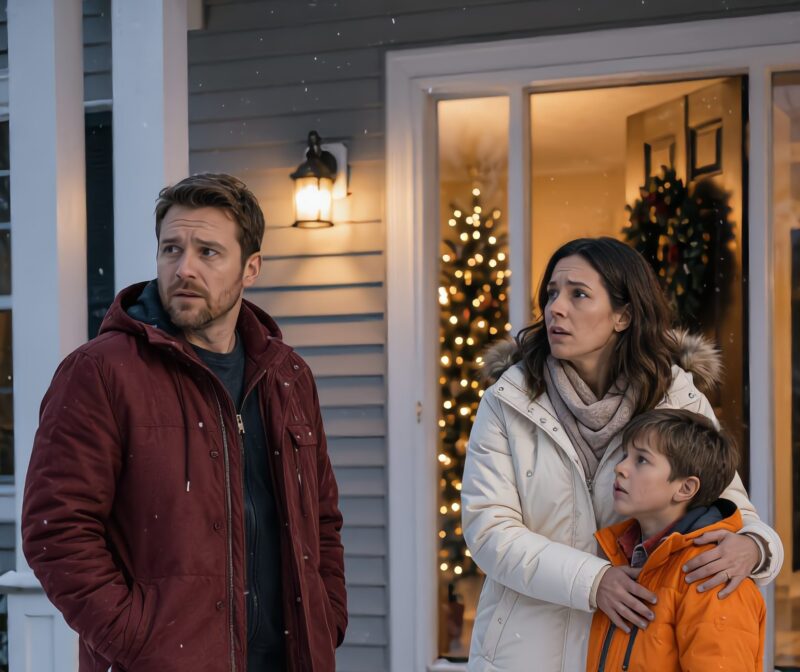
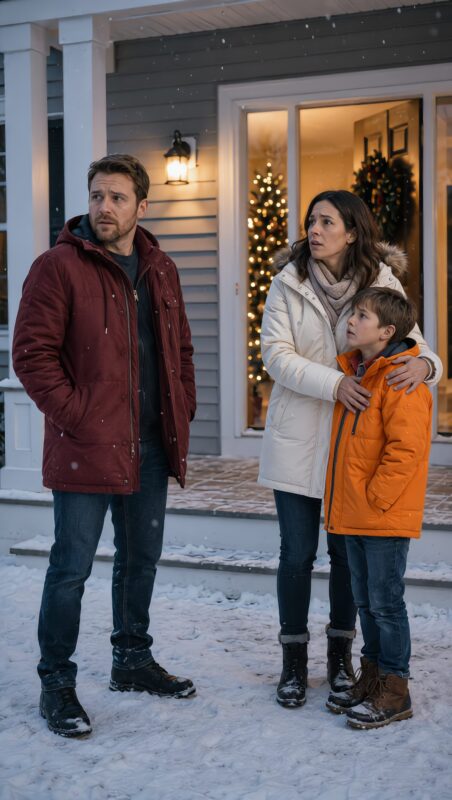
I expected anger.
Maybe she would slam the door in my face.
What I didn’t expect was the little boy standing behind her.
He peeked around Emily’s side and looked directly at me.
My chest tightened.
Those eyes.
Blue-gray.
Exactly like mine.
I looked at Emily.
“How old is he?”
She went still.
“Seven.”
Suddenly, the cold air felt impossible to breathe.
I stared at the boy again.
“Is he my son?”
Emily said nothing.
Her silence answered me.
His name was Noah.
For seven years, he had been growing up without me.
Worse, he didn’t even know I existed.
The disaster had begun years earlier while I was still serving in the military.
My mother, Margaret, had approached me with photographs of Emily meeting privately with Jonathan, our financial adviser. In the pictures, they looked secretive. There were meetings I knew nothing about and conversations Emily had never mentioned.
Margaret insisted there could be only one explanation.
Emily was having an affair.
I believed her.
When Emily tried to explain, I was too angry to listen. I had already decided what the photographs meant.
Our marriage collapsed because I trusted suspicion more than the woman I had promised to trust for the rest of my life.
Only recently had Jonathan finally shown me what had actually happened.
Emily had been meeting with him because she was saving money.
For me.
She knew military life was wearing me down, even though I rarely admitted it. Quietly, she had begun building an emergency fund so that if I ever chose to leave active service, we wouldn’t have to worry about losing our financial security.
She had been preparing a way for me to come home.
I had accused her of preparing to leave.
There had been no affair.
No secret romance.
No betrayal.
At least, not from Emily.
Standing on her porch seven years later, I could barely look at her.
“I should have believed you.”
Emily’s expression didn’t soften.
“You should have listened.”
She was right.
An apology might acknowledge what I had done, but it couldn’t return the years my mistake had taken from us.
Before I left, Emily asked me to wait.
She returned carrying a wooden box.
Inside were pieces of a childhood I had never witnessed: Noah’s hospital bracelet, a tiny lock of his baby hair, and an envelope addressed to me.
Emily had mailed the letter shortly after discovering she was pregnant.
It had come back unopened.
I turned it over and noticed handwriting beneath the postal markings.
I knew it immediately.
Margaret’s.
“He has chosen the Army. He wants no involvement with you or the child.”
I read the sentence twice.
Then a third time.
“I never said this.”
“I know,” Emily replied.
The following morning, I went straight to my mother.
Margaret denied everything until I placed the envelope in front of her.
Then the story began to unravel.
She had intercepted Emily’s attempts to contact me.
She had visited Emily while she was pregnant.
She had even offered her money to leave and never contact me again.
When Emily refused, Margaret made sure she understood what she was up against. My family had money, connections, and resources. Margaret implied that if Emily tried to involve me, she could find herself fighting people with far more power than she had.
My mother had erased my wife and child from my life because she believed she knew what future was best for me.
I could barely comprehend it.
A paternity test soon removed the last possible uncertainty.
Noah was mine.
But when I began talking about everything I wanted to do for him, Emily stopped me.
“You’re his biological father,” she said. “That doesn’t mean he knows you as his dad.”
Those words hurt.
They were also true.
I had already lost seven years.
Trying to force myself into Noah’s life wouldn’t bring them back.
So I began with sixty minutes.
One supervised visit.
I brought no expensive gifts and made no dramatic promises.
Noah called me Anthony.
I let him.
During those early visits, we did wonderfully ordinary things.
We repaired his toy trains when the wheels came loose. We transformed cardboard boxes into spaceships. He told me endless facts about Saturn, Mars, and black holes.
Sometimes we simply ate grilled-cheese sandwiches together.
Slowly, an hour became something he looked forward to.
Eventually, Emily and I decided it was time to explain who I really was.
Noah listened quietly.
When we finished, his first question was simple.
“So you’re my real dad?”
“I’m your biological father.”
He frowned.
“Do I have to call you Dad now?”
“No.”
His eyes lifted toward mine.
“You don’t?”
“You can call me Anthony until you decide you want to call me something else. If that day never comes, that’s okay too.”
Then came a question that was much harder to answer.
“Why did Grandma Margaret want Mom and me gone?”
I refused to make a seven-year-old responsible for carrying the bitterness between adults.
“She thought she was allowed to control my future,” I explained. “She wasn’t. What she did to you and your mom was wrong.”
After that, I concentrated on something much simpler.
Showing up.
I moved closer to Emily and Noah so distance wouldn’t become another excuse.
I respected the schedule Emily established.
When Noah wanted space, I gave it to him.
I made mistakes too.
One of them involved a telescope.
Noah loved astronomy, so I bought him an expensive one without asking Emily first.
I told myself it was thoughtful.
In reality, I was trying to compensate for lost time with money.
Emily reminded me that we had agreed not to overwhelm Noah with large gifts.
For once, I didn’t argue.
I apologized.
Then I returned the telescope.
That was when I began to understand something important.
Fatherhood wasn’t hiding inside some enormous gesture.
It lived in repetition.
Arriving when I said I would.
Remembering how Noah liked his sandwiches.
Listening to another twenty-minute explanation about Saturn’s rings.
Sitting beside him while he rebuilt the same cardboard spaceship for the fifth time.
Months passed.
Then Noah called me one evening.
His school was having a breakfast where students could bring parents or other important adults.
“Some kids are bringing their dads,” he said.
I waited.
“You could come with me.”
“I’d like that.”
There was a pause.
“And if people ask who you are…”
He stopped.
I could hear him breathing.
“What would you like to tell them?” I asked.
Another pause.
Then, quietly:
“Could I say you’re my dad?”
I closed my eyes.
For years, I had imagined what hearing that word might feel like.
The reality was quieter and far more powerful.
“You can call me whatever feels right to you.”
At the school breakfast, Noah took my hand and led me toward his teacher.
“This is Anthony,” he began.
Then he corrected himself.
“This is my dad.”
My throat tightened.
I wanted to hug him.
I wanted to tell him how much that word meant.
Instead, I smiled and sat beside him.
The moment belonged to Noah, not me.
Another year went by.
Eventually, my name was added to his birth certificate.
The document itself didn’t make me a father.
Noah did.
He wanted my name there because he wanted the truth written somewhere permanent—a place where nobody could hide it, intercept it, or rewrite it again.
The next Christmas Eve, Emily invited me to dinner.
Her Christmas tree still leaned slightly to one side, and the crooked cardboard star Noah had made remained proudly at the top.
After dessert, Noah and I ended up on the living room floor working on another cardboard spacecraft.
One of its wings refused to stay attached.
“Dad, hold this.”
The word came naturally this time.
No hesitation.
No question.
Just Dad.
Across the room, Emily heard it too.
Our eyes met.
Neither of us interrupted the moment.
Later, after Noah became absorbed in his project, Emily joined me in the kitchen.
“Can I ask you something?”
“Sure.”
“Why are you still doing this?”
I didn’t understand.
She glanced toward the living room.
“You keep coming back. You moved closer. You changed your life. But you don’t know whether you and I are ever going to be together again.”
She was right.
Our marriage had been damaged in ways an apology couldn’t magically repair.
Maybe Emily would someday trust me again as a husband.
Maybe she wouldn’t.
I had finally learned that I wasn’t entitled to either outcome.
“I’m not coming back because I expect you to forgive everything,” I said.
She waited.
“I lost seven years with Noah. Nothing I do can change that. I can’t show up for his first steps or his first words. I can’t go back and make a different choice when you tried to explain.”
I looked toward the living room.
“But I can show up tomorrow.”
Emily said nothing.
“And if he wants me there, I can show up the day after that too.”
A crash came from the living room.
“Dad!”
Noah sounded horrified.
“The spaceship broke!”
I smiled.
“I’m coming.”
I found him sitting on the carpet surrounded by collapsed pieces of cardboard.
I lowered myself beside him.
“Can we fix it?” he asked.
“We can try.”
Outside, snow drifted over the street.
Inside, the tree wasn’t straight. The homemade star was crooked. Noah’s spacecraft was falling apart, and whatever family Emily and I were becoming still had plenty of cracks.
Once, that would have frightened me.
I had spent most of my life believing that broken things needed to be restored perfectly or they had failed.
I didn’t believe that anymore.
Some mistakes cannot be erased.
Some lost years cannot be recovered.
And some relationships may never return to exactly what they once were.
But that doesn’t mean nothing new can grow in their place.
Sometimes love isn’t proven by fixing everything.
Sometimes it is much simpler.
You arrive.
You listen.
You respect the time you weren’t there.
And when tomorrow comes, you choose to show up again.