Five lobster dinners reached our table.
Not one of them was meant for me.
The waiter was about to take my order when Vanessa, my daughter-in-law, interrupted him.
“Margaret won’t be eating.”
She moved the water glass closer to me.
“She has everything she needs.”
I waited for Daniel to say something.
My son stared at his plate.
“Mom, please,” he murmured. “Don’t cause a scene. You need to understand where you belong now.”
Where I belonged.
I had spent most of my adult life making sure Daniel never had to wonder where his next meal would come from.
His father disappeared when Daniel was six, leaving me with a child, bills, and very little money.
So I worked.
Before sunrise, I cleaned offices.
During the day, I served cafeteria meals.
At night, I waited tables or worked in restaurant kitchens.
There were years when I knew the price of every item in the grocery store because being wrong by a few dollars meant something else wouldn’t get paid.
Daniel never knew how frightened I sometimes was.
That was intentional.
I wanted him focused on school, not overdue bills.
Eventually, he went to college, established a promising career, and married Vanessa.
I thought my sacrifices had given him confidence.
Instead, success slowly made him embarrassed by where he came from.
Vanessa accelerated the change.
She corrected the way I dressed.
She suggested my apartment was “depressing.”
Invitations to family gatherings became less frequent.
Sometimes I discovered through photographs that everyone had taken a vacation together.
Daniel always had an explanation.
Vanessa was stressed.
There wasn’t enough room.
The plans were last-minute.
Then he called and invited me to dinner.
“I know things have been awkward,” he said. “Let’s fix that.”
I wanted to believe him.
So I accepted.
The restaurant he chose was elegant enough that Vanessa’s parents immediately looked comfortable there.
They ordered freely.
Lobster. Wine. Appetizers. Desserts.
Everyone received food except me.
As they ate, Vanessa’s father made jokes about people who worked their entire lives in low-paying jobs and still had nothing impressive to show for it.
Her mother laughed.
Then Vanessa turned toward me.
“We’ve actually been discussing something.”
I folded my hands.
“What?”
“Maybe you shouldn’t attend every family event.”
Daniel continued eating.
Vanessa leaned closer.
“His career is changing. We’re meeting different kinds of people now. Appearances matter.”
“And my appearance is a problem?”
She gave me a practiced smile.
“It’s more than appearance. You simply don’t have much to offer in those circles.”
I glanced at Daniel.
Nothing.
“What would qualify as something to offer?”
“Connections. Influence. Accomplishments.”
She shrugged.
“Love is wonderful, Margaret. But love isn’t a credential.”
Before I could answer, a familiar voice interrupted us.
“Mrs. Margaret?”
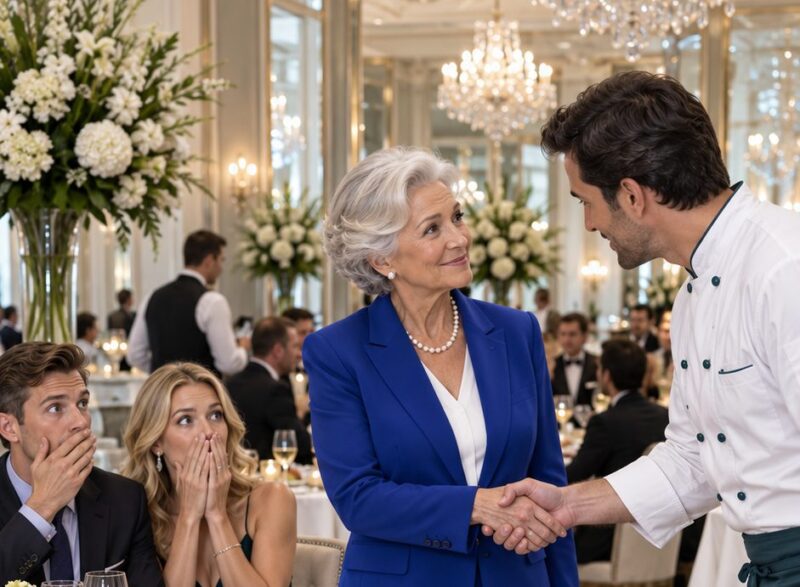
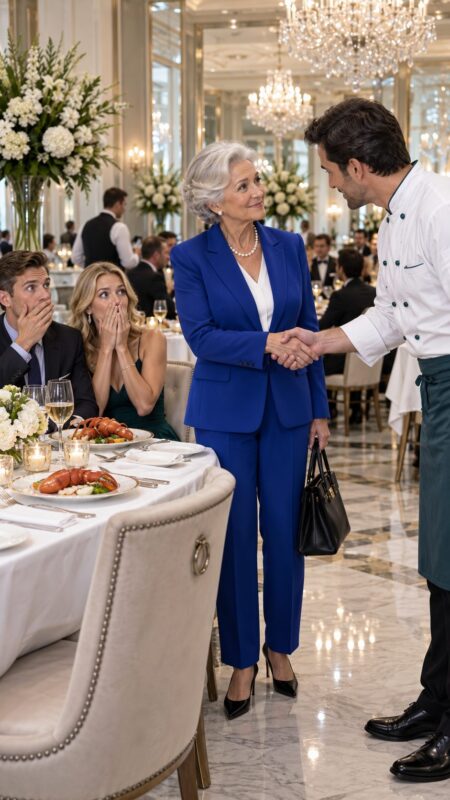
The executive chef stood beside the table.
He removed his hat.
“The partners are assembled upstairs. We can begin whenever you’re ready.”
Vanessa’s fork stopped halfway to her mouth.
“Partners?”
The chef nodded politely to me.
“Yes, ma’am.”
Vanessa stared between us.
“Why is he talking to you like that?”
I pushed my chair back.
“Because we’re working.”
Then I left them sitting there.
Daniel knew I had spent years in restaurants.
What he had never bothered to ask was what happened afterward.
When he left for college, I kept working and saving.
Eventually, I put nearly everything I had into a tiny neighborhood restaurant.
For the first year, I barely paid myself.
Then business improved.
I opened a second location.
Profits went back into expansion rather than luxury.
One restaurant became several.
I never bought designer clothes or moved into a mansion, so Daniel assumed nothing had changed.
But the restaurant where Vanessa had just decided I wasn’t important enough to feed belonged to one of my companies.
When I returned from the meeting, Daniel was waiting.
“Mom, I didn’t realize—”
I stopped him.
“That isn’t an apology.”
“What?”
“You’re sorry because you learned something about me.”
His face reddened.
“I should’ve said something.”
“Yes.”
“I didn’t know what.”
“You could’ve started with, ‘Bring my mother a menu.’”
I picked up my purse and left.
The following morning, Vanessa contacted me.
Her message was short.
*Daniel hasn’t told you everything.*
We met later that day.
She looked considerably less confident than she had at dinner.
Then she told me why.
Daniel had known about my businesses before inviting me.
Months earlier, one of his investments had collapsed. He had borrowed heavily and hidden the losses.
He needed money.
Somehow, he discovered that I owned several restaurants.
“How much?” I asked.
“He thinks you’re worth millions.”
Suddenly, the dinner seemed even uglier.
Daniel hadn’t invited me because he wanted reconciliation.
He wanted information.
According to Vanessa, the plan was to pressure me until I defended myself by revealing my success.
Then Daniel intended to explain his financial problems and ask me to save him.
But there was more.
Vanessa lowered her voice.
“He’s been asking whether you control everything personally.”
“What do you mean?”
“Ownership percentages. Signatory authority. Power of attorney.”
That conversation ended immediately.
I called my financial adviser.
He confirmed that Daniel had made indirect inquiries about my companies and authority over my accounts.
That evening, I asked my son to come over.
I placed the information in front of him.
He became defensive.
“I wasn’t planning to take anything.”
“You investigated ways someone might control my assets.”
“Because I needed to understand how everything was structured.”
“Why?”
He had no convincing answer.
Eventually, the truth came out.
His investment losses had grown.
Debt payments were becoming impossible.
The expensive life he and Vanessa displayed to everyone was largely financed by money they didn’t have.
“I thought you’d help me if you knew how bad things were.”
“You didn’t ask for help.”
Daniel looked away.
“You created a situation designed to manipulate me into offering it.”
He said nothing.
I finally understood something painful.
For years, I had protected Daniel from consequences because I wanted his life to be easier than mine.
Perhaps he had started believing that whenever life became difficult, his mother was supposed to absorb the damage.
Not anymore.
“I won’t pay your debts,” I said.
His head snapped up.
“Mom—”
“I won’t finance your house. I won’t cover your investment losses. And you will never have authority over my companies.”
“You’re really going to watch your own son struggle?”
“No. I’m going to let my adult son solve an adult problem.”
The following day, my attorney and financial adviser reviewed everything.
Corporate protections were reinforced.
My estate plan was revised.
I created a separate education trust for my granddaughter, Chloe, structured so Daniel couldn’t access or manage the money.
Then I stepped back.
Vanessa eventually wrote to apologize for participating in the dinner.
Daniel took additional work, began addressing his debts, and entered counseling.
I hoped he would change.
But I stopped making my peace dependent on whether he did.
Months later, I made a reservation at the same restaurant.
One person.
The hostess offered me the best table in the dining room.
I declined.
“I’d like the table by the window.”
The same one.
I sat beneath the chandeliers and opened the menu.
That evening, nobody ordered for me.
Nobody decided what I deserved.
I chose lobster, dessert, and sparkling water.
When my meal arrived, the server placed the plate in front of me.
For a moment, I remembered the empty space where dinner should have been months earlier.
Then I smiled.
Daniel had once told me to remember my place.
He was right about one thing.
I finally had.
My place wasn’t beneath Vanessa.
It wasn’t behind my son.
And it certainly wasn’t at a table where someone else decided whether I was worthy of being served.
My place was wherever I chose to sit.
And this time, I wasn’t asking anyone for permission.