Three minutes before his boss arrived for dinner, my husband told me to disappear.
Alejandro stood in the kitchen doorway, adjusted his tie, and looked at me as though I were something he needed to apologize for.
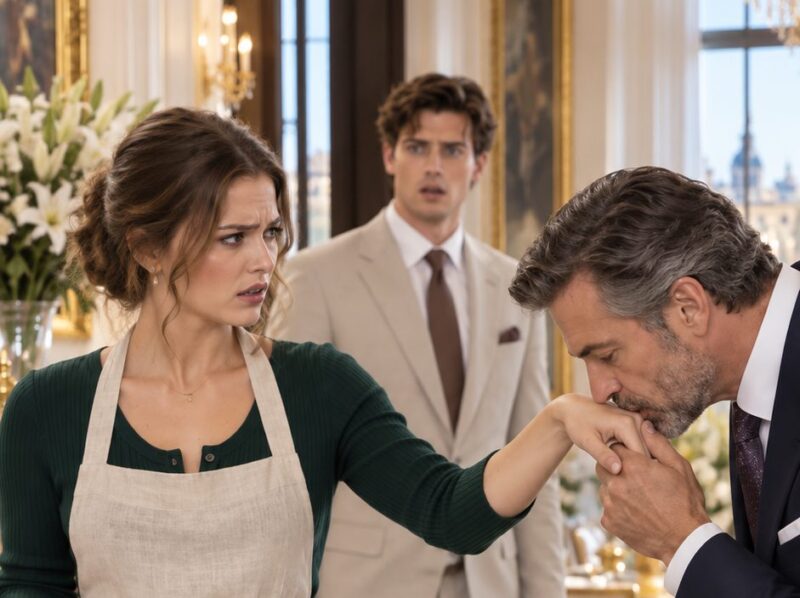
“Go upstairs, Mariana.”
I thought he was joking.
Then he added, “Sergio doesn’t need to see you like this. Tonight could decide my promotion, and I can’t have you making things uncomfortable.”
I looked past him at the dining table.
The crystal glasses were polished. The candles were lit. Every dish had been prepared exactly as Alejandro requested.
I had spent hours making his perfect evening possible.
And now I wasn’t welcome at the table.
I quietly went upstairs.
At forty-eight, I had become accustomed to making myself smaller around my husband.
But I hadn’t always been that woman.
Once, I was Dr. Mariana Torres.
For years, I worked in trauma surgery, where hesitation could cost a life. I had built a career I loved and earned the respect of people whose judgment mattered to me.
Then my twelve-year-old daughter, Lucía, died in a car accident.
That was seven years ago.
After losing her, I couldn’t return to the operating room. Even entering a hospital became unbearable.
Eventually, I resigned.
Alejandro was patient in the beginning. He took care of practical things when I couldn’t and stayed close through months when getting out of bed felt like an accomplishment.
Gradually, however, support became leverage.
“I’ve sacrificed enough for you.”
“You used to be strong.”
“Do you know what I’ve given up because you’re like this?”
Every argument ended the same way.
Alejandro reminded me that he had stayed.
And because part of me still felt guilty for needing him during the worst period of my life, I allowed gratitude to become obedience.
At exactly seven, Sergio Mendoza arrived.
From upstairs, I heard chairs moving and glasses clinking.
Then Sergio complimented the dinner.
“Your wife cooked this?”
“Yes.”
“Why isn’t she joining us?”
Alejandro waited a moment before answering.
“Mariana doesn’t do well around people anymore.”
My body stiffened.
He continued.
“Losing Lucía destroyed her. She has severe episodes. Sometimes I can’t even leave her alone. I’ve missed conferences and canceled business travel because somebody has to take care of her.”
I couldn’t believe what I was hearing.
There had been a time when that description might have contained fragments of truth.
Not anymore.
For nearly two years, I had been steadily reclaiming my independence. I drove, shopped, visited relatives, managed the household, and handled my own appointments.
Recently, I had even started following developments in trauma medicine again.

Alejandro knew all of that.
Yet at work, he was apparently telling another story.
He wasn’t the husband of a woman rebuilding her life.
He was the heroic caretaker sacrificing his ambitions for a wife who couldn’t function without him.
After dinner, Sergio thanked Alejandro and left.
Several minutes later, the doorbell rang again.
He had forgotten his phone.
By coincidence, I was downstairs when Alejandro opened the door.
Sergio saw me.
His expression immediately changed.
“Mariana?”
I hesitated.
Then he said the name I hadn’t heard from a stranger in years.
“Dr. Torres?”
Alejandro looked between us.
“You know my wife?”
Sergio stared at him.
“Your wife saved my son’s life.”
The memory returned instantly.
Daniel Mendoza.
Ten years old.
A terrible accident.
Four exhausting hours in surgery.
I remembered waiting afterward to hear whether he would stabilize.
“He survived?” I asked.
Sergio smiled, his eyes shining.
“He’s twenty-three.”
My throat tightened.
“And he’s in medical school. He wants to become a trauma surgeon.”
Sergio paused.
“Because of you.”
Something shifted inside me.
For years, I had thought of Dr. Torres almost as another person—someone who had existed before Lucía died.
Yet Sergio remembered her.
Daniel remembered her.
Maybe she wasn’t completely gone.
The moment the front door closed, Alejandro turned on me.
“Why couldn’t you stay upstairs?”
I stared at him.
“Why couldn’t you tell your boss the truth?”
“What truth?”
“That I don’t need you supervising me every minute of the day.”
He started to respond, but his phone lit up on the counter.
A message preview appeared.
Chloe: Once the promotion goes through, you’re going to tell her about us, aren’t you?
Alejandro grabbed the phone.
Too late.
The following morning, he insisted I had misunderstood.
Chloe was a colleague.
The message was complicated.
I was overreacting.
For the first time, I didn’t let him explain reality to me.
I called Sergio instead.
Soon afterward, I found myself standing outside the hospital where I had once worked.
My heart pounded as I walked inside.
Sergio was waiting.
So was Daniel.
The child I remembered had become a young man.
When he saw me, he smiled.
“I’ve wanted to meet you again for years.”
Two former colleagues joined us.
Their reaction confused me.
Then one of them said, “Mariana, we tried to see you.”
I frowned.
“When?”
“After Lucía.”
They explained that several people from the hospital had reached out repeatedly.
Alejandro intercepted them.
He claimed conversations about surgery triggered severe episodes and that contact from my former colleagues was damaging my recovery.
He had built a wall around me while convincing me everyone else had simply stopped caring.
Sergio then revealed that Alejandro had been using the same story professionally.
Missed trip?
Mariana was having an episode.
Canceled meeting?
His wife couldn’t be left alone.
Declined conference?
Family emergency.
My pain had become a convenient explanation for whatever benefited him.
That evening, another piece fell into place.
I saw Alejandro arrive home in Chloe’s car.
Before he got out, she reached across the console and took his hand.
The next day, I met her.
She didn’t deny the affair.
It had been going on for eighteen months.
Alejandro had told Chloe that our marriage was effectively finished but that he couldn’t leave because I was emotionally dependent on him.
Then she showed me one of his messages.
Mariana wouldn’t know how to live without me. I’ll deal with the divorce after the promotion.
I stared at those words.
For seven years, Alejandro had encouraged me to believe he was the reason I survived.
Now I understood what he had really been doing.
He needed me to believe I couldn’t survive without him.
When he came home that evening, a suitcase was waiting near the entrance.
He looked at it, then at me.
“What is this?”
“Your luggage.”
He laughed.
“You’re throwing me out?”
“Yes.”
“This is my home too.”
“No. I purchased this place before we were married.”
His expression changed.
Then came the familiar threat.
“You can’t manage your life without me.”
I waited for the old fear.
It never came.
Instead, I said, “You’ve spent years hoping I would believe that.”
I filed for divorce soon afterward.
I also began exploring what it would take to practice medicine again.
Neither process was easy.
Alejandro’s professional life began unraveling as well.
Sergio’s company reviewed the hardship claims Alejandro had submitted over the years and found serious inconsistencies in how he had represented my condition.
His expected promotion was withdrawn.
Chloe ended their relationship.
But I stopped measuring my recovery by what Alejandro lost.
I had something more important to rebuild.
Myself.
Returning to surgery took months of retraining and supervised work.
The first time I scrubbed in again, my heartbeat felt louder than every machine in the room.
Part of me wanted to walk out.
I stayed.
Eventually came the day I completed my first solo surgery since Lucía’s death.
When I emerged afterward, Daniel was standing in the hallway holding flowers.
“You did it,” he said.
Inside the bouquet was a card.
You once gave me another chance at life. I’m glad you gave yourself one too.
I carried that card home.
A year later, I had moved closer to the hospital and was practicing again.
Grief hadn’t disappeared.
I still missed Lucía every day.
But missing my daughter no longer meant disappearing with her.
One morning, before leaving for work, I stopped beside her photograph.
“I’ve got an early case today,” I whispered.
I touched the edge of the frame, picked up my stethoscope, and headed toward the door.
For years, Alejandro had told the world I was a woman who couldn’t be trusted to stand on her own.
Eventually, I had almost believed him.
But that morning, I walked into the hospital as Dr. Mariana Torres.
Not Alejandro’s fragile wife.
Not a woman waiting to be rescued.
Just myself.
And nobody would ever send me upstairs to hide again.