For nearly an hour and a half, everyone aboard the flight had the same explanation for the noise: a miserable baby who simply refused to settle.
Then I heard one particular cry and realized they were wrong.
I was sitting several rows behind first class with my three-year-old daughter, Maya, curled against my chest. She had somehow managed to sleep through most of the commotion.
I hadn’t.
The infant’s cries had been echoing through the cabin for eighty-seven minutes. Flight attendants had brought bottles, blankets, and toys. Passengers had exchanged irritated glances. A few had buried themselves beneath headphones.
Nothing worked.
I tried to ignore it.
I had enough problems of my own.
Four days earlier, I had left my husband after an argument crossed a line involving Maya. I packed what I could carry, took the money I had access to, and bought two tickets to Rome.
My cousin had offered us her couch until I found work and figured out what to do next.
One suitcase.
€274.
A sleeping three-year-old.
That was essentially my entire future.
So when the baby screamed again, I told myself to stay seated.
Then his cry broke into a strained, exhausted sound.
My nursing instincts immediately took over.
Before my personal life fell apart, I had spent six years working in labor and delivery. After thousands of hours around newborns, you learned to notice things other people missed.
Babies had only one language.
Crying.
But hunger didn’t sound exactly like fear, and discomfort didn’t sound exactly like exhaustion.
This baby was searching for something.
I looked down at Maya.
She was still asleep.
I tucked her blanket securely around her and stood.
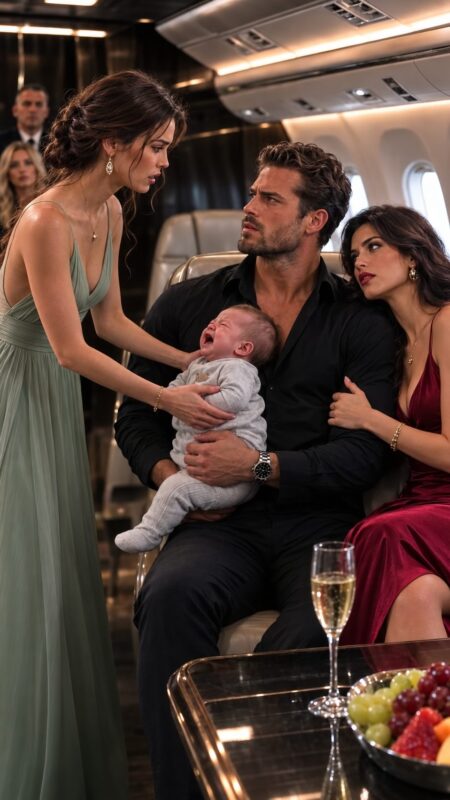
The moment I approached first class, a broad-shouldered man stepped into the aisle.
“Ma’am, return to your seat.”
“I think I can help.”
“We already have people handling it.”
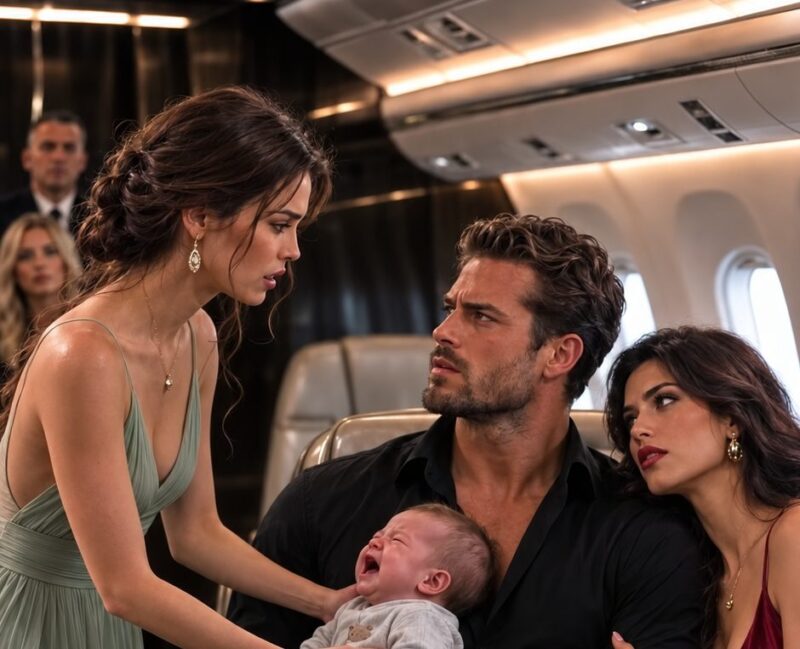
The baby’s next scream answered for me.
A man seated in 2A looked up.
Even exhausted, he had the kind of presence that made everyone around him careful. His dark charcoal suit was perfectly tailored, and the men positioned nearby appeared far more like private security than traveling companions.
But none of that interested me.
I was watching the infant in his arms.
The little boy was flushed from crying, his tiny hands gripping desperately at his father’s shirt.
“What do you want?” the man asked.
“I used to be a labor and delivery nurse.”
His expression remained guarded.
“The flight attendants have tried everything.”
“Have they?”
“Three bottles. Walking him through the cabin. Changing him. Blankets. Nothing works.”
I watched the baby for another moment.
“He isn’t rejecting food because he isn’t hungry.”
The man’s eyebrows drew together.
“What does that mean?”
“He may be looking for the way he was accustomed to being fed.”
The words came out more quietly than I intended.
The baby’s cries had already triggered a physical response in me. I had only recently stopped nursing Maya, and my body apparently hadn’t forgotten as completely as I thought it had.
I felt my face grow warm.
“He may not want another bottle,” I continued. “He may be searching for warmth, closeness, a familiar heartbeat—something his body associates with feeding and feeling safe.”
The father’s expression changed.
Only slightly.
But I saw it.
He looked down at his son as though a possibility he hadn’t considered had suddenly become obvious.
Then his eyes returned to mine.
“Can you help him?”
I glanced back toward Maya.
Getting involved with a powerful-looking stranger in first class was nowhere on my list of sensible decisions.
But the exhausted little boy screamed again.
“I can try to calm him.”
For several seconds, the man didn’t move.
Then he carefully held his son out to me.
I took the baby and settled into the empty seat beside him.
His entire body was tense.
I held him close and gently rocked him, letting him feel the steady rhythm of another person’s breathing and heartbeat.
At first, he continued crying.
Then something changed.
The screams became whimpers.
The whimpers grew quieter.
His clenched fingers relaxed against my blouse.
A few minutes later, the cabin was silent.
People looked up from their screens.
One passenger actually removed his headphones as if he couldn’t believe what had happened.
The little boy was asleep.
I expected his father to look relieved.
Instead, his face seemed to crumble.
“My wife died three weeks ago.”
The sentence was barely above a whisper.
I looked at him.
“She was the only person who could calm him like that,” he continued. “Since she died, he barely sleeps. Sometimes he refuses bottles. I thought he was sick.”
Suddenly, the intimidating men, expensive suit, and carefully controlled manner made no difference.
All I could see was a father who had lost his wife and had no idea how to explain that absence to a baby.
“He probably misses what he associates with her,” I said.
“He’s too young to understand she’s gone.”
“Understanding isn’t the same as feeling.”
He looked at me.
“He may not understand death,” I continued. “But he knows something familiar disappeared. Her smell, her voice, the way she held him—those things were part of how he understood safety.”
The man stared at his sleeping son.
For a while, neither of us spoke.
Eventually, I handed the baby back.
This time, his father pulled him close instead of holding him stiffly.
“What is your name?” he asked.
“Claire.”
“I’m Luca.”
I nodded.
Then he surprised me.
“Why are you going to Rome?”
The safe answer would have been that I was visiting relatives.
Instead, I looked toward the curtain.
“My daughter and I need a new beginning.”
His eyes followed mine.
There must have been something in my voice because he didn’t ask for details.
He simply looked down at his son.
“I suppose we do too.”
For the remainder of the flight, we mostly stayed apart.
I returned to Maya.
Luca remained with his son.
By the time the aircraft touched down in Rome, I assumed our paths would separate forever.
At baggage claim, however, a man approached me and said a car was waiting.
“For whom?”
“You and your daughter.”
I immediately knew who had arranged it.
I found Luca near the exit.
His son was asleep against his shoulder.
“I can’t accept a private car.”
“Then think of it as repayment.”
“I didn’t help you because I wanted anything.”
“I know.”
That answer stopped me.
He handed me a simple card bearing his name and a phone number.
“If you ever find yourself in real trouble, call.”
“I’ll be fine.”
“I hope so.”
I looked down at Maya, who was rubbing sleep from her eyes while holding my hand.
Only four days earlier, I had believed my entire life had collapsed.
I had left behind my home, my marriage, and almost everything familiar because staying no longer felt safe for my daughter.
When I boarded the flight, I wasn’t thinking about building a wonderful new future.
I was thinking about surviving the next week.
Finding somewhere to sleep.
Making €274 last.
Keeping Maya safe.
But somewhere between America and Italy, I had held a grieving stranger’s baby and watched an intimidating man become simply a frightened father.
And in helping his child feel safe, I remembered something about myself.
I was frightened, but I wasn’t helpless.
I had skills.
I had instincts.
I had survived difficult things before.
Most importantly, Maya still trusted me to lead her somewhere better.
I slipped Luca’s card into my bag and took my daughter’s hand.
Perhaps I would never use the number.
Perhaps we would never see him again.
That wasn’t what mattered.
What mattered was the feeling I carried as Maya and I walked toward the airport doors.
For the first time in days, Rome didn’t feel like the place we had escaped to.
It felt like the beginning of somewhere new.
Sometimes a fresh start doesn’t arrive after the fear is gone.
Sometimes it begins while you’re still afraid—when one unexpected moment reminds you that your past may explain how you got here, but it doesn’t get to decide where you go next.