I expected Easter dinner to end with coffee and leftover pie.
Instead, I left my own dining room with blood running down my forehead, spent the evening getting four stitches, and discovered that my son and his wife had quietly begun treating my house as though it already belonged to them.
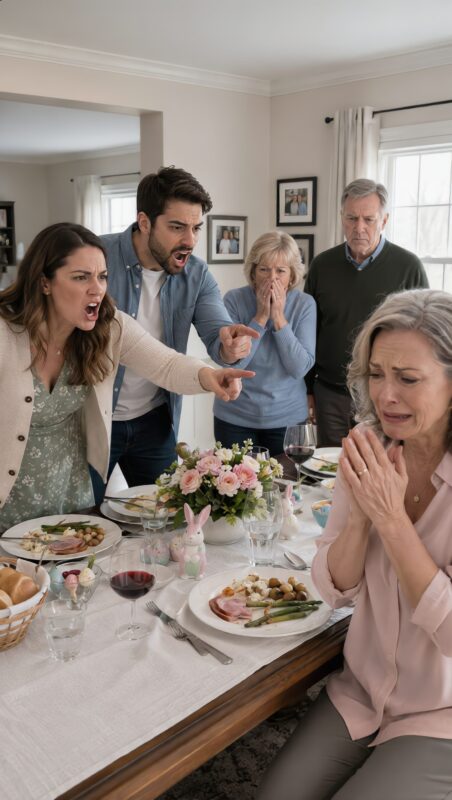
My name is Margaret Lawson. I’m sixty-two years old, a widow, and the legal owner of a four-bedroom house outside Columbus, Ohio.
My husband and I spent decades paying for that home. After his death, it became more than a place to live. It represented stability—the one thing I knew no one could take from me.
Apparently, my son Daniel and his wife, Vanessa, saw it differently.
For several months, they had been pushing me to allow Vanessa’s parents to move in.
The proposal began innocently enough.
“It’ll only be for a little while,” Daniel promised.
Then “a little while” began acquiring permanent features.
Vanessa said her parents needed two bedrooms instead of one. Her father wanted space for his tools, so they suggested converting my garage into a workshop.
Soon they weren’t asking what I thought.
They were telling me how the arrangement could work.
There was only one problem.
I had never agreed to any arrangement.
Every time the subject came up, my answer was no.
Easter Sunday was when their patience finally disappeared.
We were halfway through dinner when Vanessa mentioned her parents again.
“It makes no sense,” she said. “You’re one person living in a four-bedroom house.”
I put down my fork.
“It makes perfect sense to me. It’s my house.”
“You don’t even use those rooms.”
“I don’t have to use them.”
Daniel immediately joined in.
“Mom, do you hear yourself? They need somewhere to live, and you’re protecting empty bedrooms.”
“I’m protecting my right to decide what happens in my own home.”
Vanessa stared at me.
Then she reached for her wine glass.
I thought she was going to take a drink.
Instead, she threw it.
The glass struck me above the eyebrow and broke.
For a moment, I didn’t understand what had happened.
Then I touched my forehead and saw blood on my fingers.
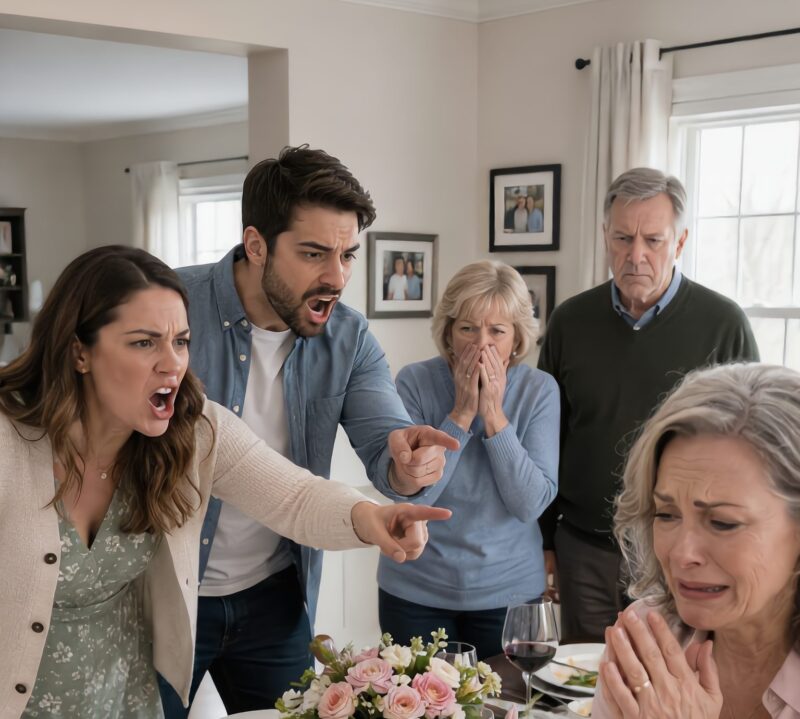
Daniel stood up.
But not to help me.
“Mom, don’t turn this into something huge. She lost her temper.”
I looked at him.
His wife had just thrown a glass at my head, and his first concern was protecting her from the consequences.
That was the moment something inside me became very calm.
I grabbed a clean napkin, pressed it against the cut, collected my purse, and headed for the door.
Before driving to the emergency room, I sent my attorney, Rachel Kim, a short message.
“Phase one is complete.”
Daniel and Vanessa probably would have found that message confusing.
Rachel didn’t.
Six weeks earlier, I had gone to her because the conversations about my house had started feeling less like family disagreements and more like preparation.
Daniel had suddenly become fascinated by my finances.
How much did I have in savings?
Was the house completely paid off?
What investments had his father left behind?
Had I considered putting Daniel on the deed “in case something happened”?
Then Vanessa arrived one afternoon carrying a power-of-attorney form.
She presented it as a convenience.
Rachel saw it differently.
“Don’t fight with them anymore,” she told me. “Secure your documents and keep records of everything.”
So that was exactly what I did.
I saved texts.
I wrote down conversations.
I moved important paperwork somewhere Daniel couldn’t access it.
And I waited.
After I left Easter dinner, a neighbor saw the blood on my face and called the police. At the hospital, the wound required four stitches.
I filed a report.
The next morning, I began separating Daniel from every part of my financial life.
Any access he had was revoked.
I told him to collect the belongings he still stored at my house.
Then Rachel helped me revise my estate plan.
Vanessa made the next mistake herself.
She sent me an angry message explaining that her parents had already surrendered their apartment because Daniel had promised them my answer would eventually change.
I read the message twice.
They hadn’t been hoping I would say yes.
They had been planning around the assumption that my no didn’t matter.
Then Daniel called several days later and made things worse.
“You have no idea what we’ve already set in motion.”
I immediately forwarded those words to Rachel.
She suggested checking my credit.
That was when the argument over bedrooms became something much more serious.
Someone had started a home-equity loan application in my name.
It hadn’t been completed, but enough information had been entered to make one thing obvious: whoever started it had access to financial details I had never willingly provided.
Daniel denied knowing anything at first.
That didn’t last.
Eventually, he admitted that Vanessa had copied information from my tax documents.
Then the rest of the picture emerged.
Vanessa was carrying significant debt.
Her parents had money problems.
Daniel had accumulated debts of his own.
Meanwhile, I owned a mortgage-free house worth close to $600,000.
They hadn’t simply been looking at spare bedrooms.
They had been looking at equity.
During one confrontation, Daniel finally said the sentence that destroyed whatever excuses I had been making for him.
“You’re sitting on all that money, Mom. You don’t even need all of it.”
There it was.
To me, the house represented decades of work with my husband.
To Daniel, it represented money I was selfishly refusing to release.
Investigators eventually connected the unfinished loan application to Daniel and Vanessa’s apartment. There was also evidence that Vanessa had used equipment at work to copy some of my personal documents.
The united front they had presented at Easter quickly collapsed once consequences became real.
Vanessa had to answer for both the incident at dinner and the misuse of my information.
And Daniel had to leave my house.
I thought I would feel victorious when I watched him pack.
I didn’t.
I stood in the hallway while my only child carried boxes out of the bedroom where I had once tucked him into bed.
Before walking out, he looked at me bitterly.
“You’re choosing a house over your son.”
“No,” I said. “I’m refusing to let my son choose my house over me.”
Then I handed him a letter.
I told him I still loved him.
But love was no longer going to mean unlimited access.
If we were ever going to have a healthy relationship again, there would be rules.
My finances were off-limits.
My property was not a family negotiation.
He could visit only when invited.
And if he wanted to rebuild my trust, he needed counseling.
After the front door closed, I went upstairs.
Daniel’s childhood bedroom was nearly empty.
I sat on the edge of the bed and cried until there was nothing left.
Protecting myself felt necessary.
It didn’t feel good.
That was something I had never understood before: sometimes the correct decision still leaves you grieving.
Three months later, Vanessa and Daniel separated.
Then, one Sunday afternoon, Daniel appeared on my porch holding a lemon pie.
There was no speech prepared.
No demand.
No excuse.
He simply said, “I need to tell you the truth.”
He admitted that he had allowed Vanessa to see my financial documents.
He admitted promising her parents that they could eventually live in my house.
And he admitted something even harder.
Somewhere along the way, he had started thinking of my property as his future inheritance rather than my present home.
“I figured it would be mine eventually,” he said.
“Maybe it would have been,” I replied. “But inheritance begins after someone dies, Daniel. I’m still here.”
He looked down.
“I know.”
That conversation didn’t magically fix us.
Apologies don’t rebuild trust by themselves.
Actions do.
Daniel rented an apartment.
He began therapy and started dealing with his debts.
Vanessa moved away, and her parents made other living arrangements.
As for Daniel and me, we started again carefully.
I didn’t return his key.
I didn’t undo the changes to my will.
Those weren’t punishments.
They were consequences.
I could forgive my son without pretending he had never betrayed my trust.
The next Easter, Daniel came over for dinner.
There was no shouting.
No argument over bedrooms.
No one made plans for my property.
After dessert, Daniel lifted his glass.
“To Mom’s house.”
I lifted mine too.
“My house.”
He laughed softly.
“Your house.”
That evening, after he left, I walked upstairs and opened the door to one of the bedrooms Vanessa had once considered hers to assign.
It wasn’t empty anymore.
I had transformed it into a reading room.
Books filled the shelves, and my favorite chair sat beside the window.
Across the hallway, the other bedroom was still unused.
I stood in its doorway for a while.
Once, I might have felt guilty about leaving perfectly good space empty.
Not anymore.
Daniel and Vanessa had looked at those rooms and seen availability.
I saw choice.
They had looked at my home and seen hundreds of thousands of dollars in equity.
I saw every mortgage payment my husband and I had made, every repair we had saved for, and every year of work that had created security for my old age.
They had confused being family with having a claim.
They had assumed a widowed mother would eventually become uncomfortable enough to surrender.
They were mistaken.
Perhaps one day I’ll put a guest bed in that last room.
Maybe I’ll turn it into a sewing room.
Maybe it will become another library.
Or maybe nothing will ever go in there.
That decision doesn’t require anyone else’s approval.
An empty bedroom is not an invitation.
A future inheritance is not present ownership.
And loving someone does not give them the right to decide what you should surrender.
This is my home.
I worked for it.
I protected it.
And as long as it belongs to me, there is only one person who gets to decide what happens inside it.
Me.