The flight delay that threatened the biggest business deal of my career ended up giving me something far more important: the two sons I never knew existed.
I was forty-four when it happened.
For nearly twenty years, I had poured almost everything into building a boutique hotel company. That morning, I was scheduled to fly to Boston, where my executives were waiting to finalize an acquisition worth millions.
Then the departure screen changed.
DELAYED — MECHANICAL ISSUE.
I checked my watch and muttered something under my breath.
At that moment, losing even an hour felt disastrous.
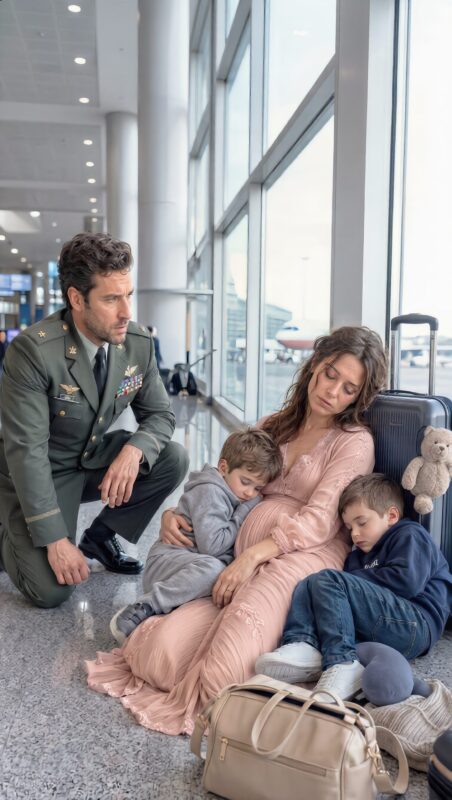
Then I saw Evelyn.
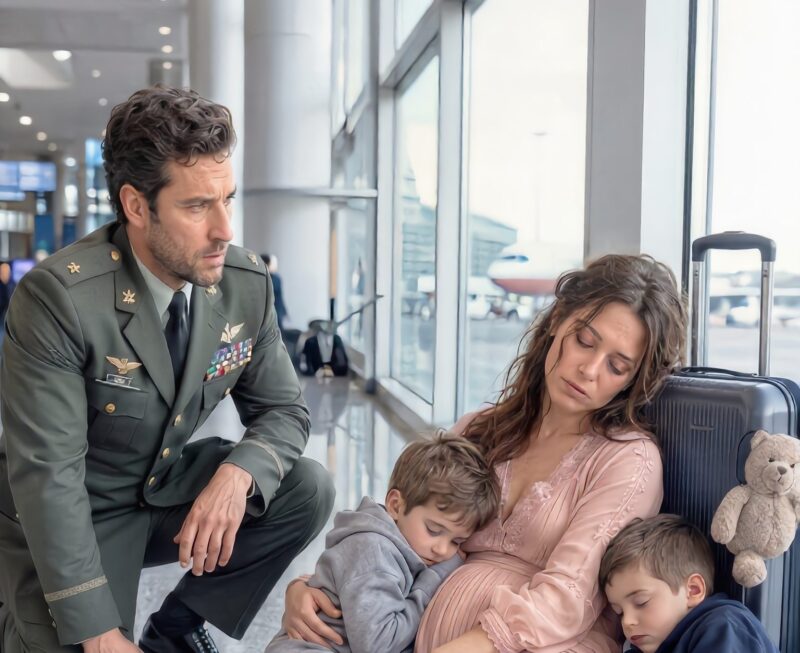
She was sleeping against a wall near the far end of the terminal, her head resting awkwardly against her coat. A battered suitcase stood beside her.
Two small boys were asleep at her feet.
I stopped walking.
Six years.
That was how long it had been since Evelyn had disappeared.
No goodbye.
No explanation.
Nothing.
For years, I had imagined what I would say if I ever saw her again.
Now I couldn’t say a word.
Then one of the boys shifted in his sleep.
His face turned toward me.
My chest tightened.
He had dark hair almost identical to mine.
There was something familiar about the shape of his jaw too—something I remembered from childhood photographs of my father.
Then I noticed his left eyebrow.
A tiny notch interrupted the hair near the edge.
My hand rose instinctively toward my own eyebrow.
Same place.
Same mark.
Coincidence, I told myself.
Then the second boy opened his eyes.
He looked enough like the first to make it obvious they were twins.
And enough like me to make coincidence suddenly feel impossible.
Evelyn stirred.
Her eyes opened.
When she saw me standing there, she pulled the boys toward her so quickly that they both startled awake.
“Marcus?”
Hearing my name in her voice after six years felt unreal.
“Evelyn.”
Neither of us spoke for several seconds.
Then her expression changed from shock to confusion.
“You really don’t know.”
“Know what?”
She looked at the twins.
Then back at me.
“Your mother never told you about them?”
The terminal seemed to go quiet.
“What are you talking about?”
Evelyn swallowed.
“I was pregnant when you came back from Europe.”
I stared at her.
“No.”
“Yes.”
“I came home and you were gone.”
“I know.”
“I searched for you.”
Her eyes filled with tears.
“Marcus, I thought you knew.”
That sentence opened a door I had spent six years trying to keep closed.
Evelyn and I had met through my family’s charitable foundation.
She wasn’t impressed by wealth, expensive restaurants, private events, or the Hale family name.
I was accustomed to people changing the moment they discovered who my family was.
Evelyn never did.
I fell in love with that.
My mother, Eleanor, saw it as a problem.
She believed marriage wasn’t merely personal. In her world, it was another strategic decision—one that should strengthen reputation, influence, and wealth.
Evelyn didn’t fit the future Eleanor had designed for me.
“You can care about someone without building your life around them,” my mother once warned.
I ignored her.
Then I left the country for three weeks to oversee a hotel opening.
When I returned, Evelyn’s apartment was empty.
Her phone had been disconnected.
Letters came back unopened.
I asked everyone I could think of where she had gone.
My mother eventually told me to stop humiliating myself.
“Evelyn left because she understood this relationship had no future.”
I didn’t believe her.
Not at first.
But months became years.
Eventually, I accepted the explanation because I had no other one.
Now Evelyn was sitting in front of me with two five-year-old boys.
“My mother told you I knew?”
“She told me more than that.”
Evelyn opened the old suitcase and searched through a folder.
Then she handed me several pages.
“She said you wanted no involvement with me or the babies.”
I looked at the document.
It appeared formal.
My name was printed throughout it.
Then I reached the final page.
There was my signature.
Except it wasn’t.
Someone had copied the shape well enough to fool a stranger.
They hadn’t fooled me.
“I never signed this.”
Evelyn stared at me.
“What?”
“I have never seen this document in my life.”
Her face went pale.
“She told me your lawyers prepared it.”
“I didn’t even know you were pregnant.”
For six years, Evelyn had believed I had deliberately abandoned her while she was carrying my children.
For six years, I had believed she had decided I wasn’t worth a goodbye.
And between those two lies stood my mother.
I took out my phone.
My CFO answered immediately.
“Marcus? They just announced another twenty-minute delay. We should still be able to—”
“Cancel Boston.”
Silence.
“Cancel the flight?”
“The meeting.”
“Marcus, we have the entire acquisition team waiting. There are millions tied to today.”
“I understand.”
“Then what happened?”
I looked at the boys.
“I found my sons.”
Another silence.
This one lasted longer.
“I’ll handle Boston,” he finally said.
DNA testing later confirmed what my instincts had already told me.
The twins were mine.
But establishing paternity was only the beginning.
My attorneys investigated the document Evelyn had carried for years.
What they found led directly back to Eleanor.
Eventually, my mother stopped denying it.
When I confronted her, she sat behind the desk in her study as calmly as though we were discussing quarterly earnings.
“You forged my signature.”
“I prevented a mistake.”
“They’re my children.”
“They are Hales. That is precisely why I acted.”
I couldn’t believe what I was hearing.
“You threatened their mother.”
“I explained reality to her.”
“You convinced her I had abandoned her.”
“She needed to understand that she wasn’t suitable for the life you were building.”
Then she said the words that ended whatever remained between us.
“She should have known her place.”
I stood there looking at the woman I had trusted since childhood.
“You took six years from me.”
“I protected this family.”
“You protected a surname.”
Her expression hardened.
I shook my head.
“And you nearly cost me my actual family to do it.”
I removed Eleanor from my personal affairs and cut every unnecessary connection she still had to my company.
But anger couldn’t solve the problem that mattered.
My sons were five.
I had missed almost their entire lives.
I hadn’t been there when they learned to walk.
I hadn’t heard their first words.
I had missed five Christmas mornings, five sets of birthday candles, childhood illnesses, scraped knees, bedtime stories, and thousands of completely ordinary days.
There was no amount of money capable of buying those moments back.
And Evelyn had survived all of them without me.
I wanted to apologize until she understood that I would never have abandoned her.
But apologies could only explain the past.
What she and the boys needed was evidence about the future.
So I stopped trying to convince them with words.
I started showing up.
At first, I was simply Marcus.
Not Dad.
Not Daddy.
Marcus.
And I accepted that.
I learned the boys slowly.
One loved pancakes but refused syrup.
The other put ketchup on foods that should never be anywhere near ketchup.
One wanted the bedroom door open at night.
The other insisted it be almost completely closed.
I learned their teachers’ names.
Their favorite cartoons.
Which one hated thunderstorms.
Which one pretended not to be frightened when he actually was.
I went to school events and sat wherever Evelyn told me to sit.
I read stories when they asked.
When they didn’t want me around, I backed away.
I never told them they were supposed to love me because I was their biological father.
Biology explained why we looked alike.
It didn’t create trust.
Only time could do that.
Evelyn remained cautious too.
I couldn’t blame her.
For years, she had believed a document carrying my signature proved I wanted nothing to do with her children.
I never asked her to forget that fear.
I simply tried not to give her new reasons for it.
Months later, on a rainy Saturday afternoon, the boys decided the living room needed a castle.
Soon every chair had a blanket hanging from it, couch cushions covered the floor, and I had somehow been assigned responsibility for defending the entrance.
One of the twins crawled out of the fort and climbed onto my lap.
He studied my face.
“Marcus?”
“Yeah?”
“Are you going home?”
“Later.”
His expression became serious.
“No. I mean are you going away?”
I stopped.
Across the room, Evelyn was watching us.
She said nothing.
She knew this wasn’t her question to answer.
I looked back at my son.
“No.”
“Never?”
I thought carefully before responding.
“I can’t promise that I’ll never have to travel or go somewhere. But if you mean am I disappearing from your life, then no.”
He continued studying me.
“You’ll come back?”
“Every time.”
He seemed satisfied.
Then he leaned against me for a few seconds before scrambling back into the blanket fort.
I stayed still.
That tiny moment meant more to me than any hotel opening, acquisition, or contract I had ever signed.
Six years earlier, someone had copied my name onto a legal document and used that signature to convince Evelyn that I had chosen to disappear.
For a long time after learning the truth, I was consumed by everything I had lost.
But eventually, I understood something.
I couldn’t father my sons backward.
Their first five years were gone.
No lawyer could return them.
No court ruling could restore them.
No amount of money could purchase them.
All I could do was father them forward.
Tomorrow morning.
The next school play.
The next birthday.
The next nightmare.
The next ridiculous blanket fort.
The next question asking whether I was coming back.
My mother had tried to define family through money, status, and a surname.
My sons taught me something far simpler.
Family is the person whose return you learn to trust.
A forged signature had erased me from their beginning.
I couldn’t change that.
But nobody else would decide how the rest of our story was written.
That part wouldn’t be written with ink.
It would be written with ordinary days, promises kept, and doors I kept walking back through.
Again.
And again.
And again.