For Twenty Years, My Mother Fed a Homeless Boy—After Her Funeral, He Arrived With a Secret That Left Me Speechless
I spent most of my life resenting a boy who had nothing.

While my younger brother and I grew up struggling to make ends meet, our mother somehow always found money to feed a homeless teenager named Gabriel.
I believed she loved him more than us.
Years later, after we buried her, a luxury SUV stopped outside our childhood home. A well-dressed stranger stepped out, holding an old metal box.
When I recognized his face, my heart nearly stopped.
“Gabriel? Is that really you?”
He nodded, his eyes glistening.
“Rachel, your mother trusted me with something she never had the courage to give you.”
He placed the box in my hands.
“And once you see what’s inside, you’ll understand why she never wanted you to open it.”
**I had no idea that the greatest secret of my childhood was waiting beneath that rusty lid.**
## PART 1: THE PROMISE THAT CHANGED OUR LIVES
My father died when I was eight, leaving my mother alone with two young children and a mountain of unpaid bills.
We lived in Bluebell Valley, a quiet town where everyone knew everyone else’s business.
After Dad’s death, our lives became a constant struggle.
Mom cleaned offices in the morning and worked at a small diner in the evening. Some nights, she returned home so exhausted that she fell asleep without eating.
There were days when our dinner consisted of watery soup and a few pieces of stale bread.
Yet no matter how little we had, Mom never forgot Gabriel.
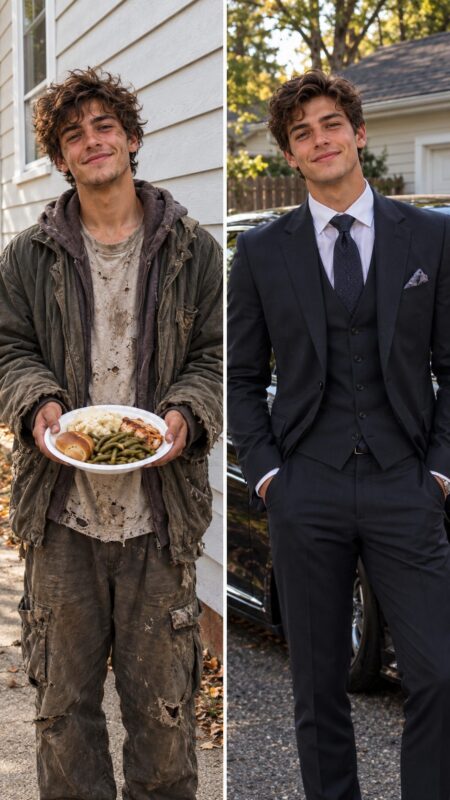
He was seventeen, orphaned and homeless, surviving in an abandoned shed near the town’s dumping ground.
Every afternoon, my mother packed a substantial meal and delivered it to him.
Sometimes it was roasted chicken. Other times, fresh bread, fruit, or homemade pastries.
As a child, I couldn’t understand why a stranger seemed to receive the things we could barely afford.
One afternoon, Mom baked an apple pie.
The smell of cinnamon filled the kitchen, and I ran downstairs, delighted. Apple pie was my favorite, especially when Mom served it warm.
But before I could ask for a slice, she wrapped the entire pie in a clean towel.
“Mom, where are you taking that?”
“To Gabriel, sweetheart.”
I stared at her.
“The whole thing?”
“He hasn’t had a proper meal today.”
My eyes filled with angry tears.
“And what about us? Why do you always give him everything? Don’t you love your own children?”
Mom stopped.
For a moment, something painful crossed her face.
Then she said firmly, “Rachel, you don’t understand what that boy has been through. One day, perhaps you will.”
But I didn’t want to understand.
I wanted my mother to choose me.
From that day forward, Gabriel became the symbol of everything I believed was missing from our family.
Eventually, he left town.
I never asked where he’d gone.
As I grew older, I moved away, started my own family, and allowed the distance between Mom and me to grow.
We spoke occasionally, but our conversations rarely lasted longer than a few minutes.
Neither of us knew how to discuss the resentment that had followed me into adulthood.
Then, eleven years after I left Bluebell Valley, the hospital called.
Mom had suffered a massive stroke.
By the time I reached her bedside, she could barely speak.
I held her hand, suddenly desperate to recover all the years we’d wasted.
“Mom, I’m here,” I whispered. “Please don’t leave yet.”
Her fingers tightened around mine.
“Rachel… promise me…”
“Anything.”
“Don’t abandon Gabriel. Whatever happens, please remember him.”
I felt as though she’d opened an old wound.
Even now, with so little time left, she was worried about Gabriel.
But I couldn’t refuse her final request.
“I promise, Mom.”
She smiled faintly and closed her eyes.
She died that evening.
For days afterward, I struggled with grief, guilt, and the familiar bitterness I’d carried since childhood.
After the funeral, I returned to our old house to sort through her belongings.
I had barely reached the front porch when a sleek black SUV pulled up beside the gate.
A tall man stepped out.
His suit was perfectly tailored, and an expensive watch gleamed on his wrist.
But beneath his polished appearance, I recognized the same gentle eyes I’d seen decades earlier.
“Gabriel?”
He gave a small, emotional smile.
“Hello, Rachel.”
I could hardly believe it.
The hungry teenager who once slept near the town dump now looked like a successful businessman.
Gabriel explained that he’d founded a recycling company after completing his education. Over the years, it had grown into a thriving business with operations across several cities.
“Your mother helped me get started,” he said. “She paid for my school supplies, encouraged me to continue studying, and never let me believe that being homeless determined my future.”
I listened in stunned silence.
“She never told me any of that.”
“She didn’t want recognition,” he replied. “She just wanted me to have a chance.”
Then he opened the back of his vehicle and removed a battered metal box.
“There is something else you need to know.”
We sat on the porch while he explained.
Long before my father died, Gabriel’s mother had become seriously ill. With no relatives willing to help, Gabriel had been forced to survive on the streets.
My father had discovered his situation and quietly begun bringing him food.
“He treated me like a human being when everyone else looked away,” Gabriel said.
“When your father became ill, he asked your mother to continue helping me. She promised she would.”
I looked down at my hands.
All those years, I’d assumed my mother was neglecting us for a stranger.
But she had been fulfilling a promise to my father.
Still, that wasn’t the secret Gabriel had come to reveal.
He placed the metal box between us and carefully lifted its lid.
Inside lay a collection of old cassette tapes, neatly arranged in rows.
Each bore a handwritten message.
Rachel’s Eighteenth Birthday.
The Day Rachel Graduates.
For My Daughter on Her Wedding Day.
When Rachel Needs Courage.
My breath caught.
I recognized the handwriting immediately.
It was Dad’s.
“Where did you get these?” I whispered.
Gabriel looked at me sadly.
“Your father recorded them during the final months of his illness. He knew he might never see you grow up, so he prepared messages for the important moments of your life.”
My hands began to shake.
“All these years… these were here?”
He nodded.
“Your mother listened to one shortly after he died. It brought back so much pain that she couldn’t bear to hear another.”
“Then why didn’t she give them to me?”
“She was afraid hearing his voice would hurt you the way it hurt her. At first, she planned to wait until you were older. But every year, she found another reason to postpone it.”
I stared at him.
“And you knew?”
“Not when I was young. Years later, after I returned to visit her, she asked me to keep the tapes somewhere safe. She said she would give them to you when the time was right.”
“But that time never came.”
Gabriel lowered his eyes.
“No. And I regret not convincing her otherwise.”
A wave of conflicting emotions swept over me.
I understood that Mom had been grieving.
But she’d denied me something I could never replace.
My father’s voice.
His advice.
His presence on the days when I’d needed him most.
We carried the box into the house and searched until we found an old cassette player in the hallway cupboard.
I wiped the dust from its surface, plugged it in, and inserted the tape marked with my eighteenth birthday.
For a moment, there was only a faint hiss.
Then I heard him.
“Hello, my beautiful Rachel. If you’re listening to this, then you’ve turned eighteen.”
I pressed a hand over my mouth.
The voice was unmistakable.
It was my father, speaking as though he’d never left us.
He laughed softly, remembering how I used to insist on wearing mismatched shoes and how I always asked him to tell the same bedtime story.
He told me how proud he was and how much he hoped I would build a life filled with courage, honesty, and compassion.
Then his voice grew gentle.
“My sweetheart, I want you to remember something important. Kindness isn’t something we give away and lose. Every time we help another person, we make the world a little less lonely.”
Tears streamed down my cheeks.
“And if you ever wonder why your mother spends time helping someone outside our family, please don’t mistake that kindness for a lack of love. Her heart is big enough for all of you.”
I closed my eyes.
Suddenly, the memories I’d carried for decades began to change.
I saw Mom standing in our tiny kitchen, packing food after a long day at work.
I remembered the exhaustion in her face and the determination in her movements.
She hadn’t been trying to hurt us.
She’d been carrying her grief, raising two children, and keeping a promise to the husband she’d lost.
But understanding her motives didn’t mean I could ignore her mistakes.
She should have shared Dad’s recordings with us.
She should have explained why Gabriel mattered so much.
Perhaps if she’d trusted us with the truth, our family might never have grown so distant.
Over the following months, Gabriel and I met often.
He shared memories of my father that I’d never known. I told him about the childhood resentment that had shaped my feelings toward him.
He didn’t judge me.
“I always knew you were upset,” he admitted. “Sometimes I wished your mother would stop bringing food because I hated seeing you unhappy.”
That confession broke my heart.
I’d spent years imagining Gabriel as someone who had taken from us.
In reality, he’d been a lonely boy trying to survive.
Together, we listened to the remaining recordings.
I made digital copies for my younger brother and carefully preserved the originals.
Then I began recording messages for my own children.
I wanted them to know our family history, including the mistakes we’d made and the lessons we’d learned.
I never wanted secrets or unspoken resentment to separate us the way they had separated my mother and me.
A year after her death, I invited Gabriel to our childhood home for dinner.
We prepared a simple meal and sat at the old wooden table.
For dessert, I baked Mom’s apple pie.
When Gabriel saw it, his expression softened.
“She used to bring me this whenever she knew I’d had a difficult week.”
I smiled sadly.
“I remember being furious every time she made one for you.”
He looked down.
“I never knew it upset you that much.”
“I know. We were both children in different ways.”
That evening, we decided to listen to the final cassette.
Dad’s voice filled the kitchen one last time.
“If Gabriel is listening, I hope you’ve finally learned to stop worrying about everyone else and accept a little kindness yourself.”
Gabriel laughed through his tears.
“And Rachel,” Dad continued warmly, “if your mother has baked an apple pie, make sure you save Gabriel a generous slice. That boy could eat enough for three people!”
We both burst into laughter.
For a moment, it felt as though Dad were sitting at the table with us.
I picked up the knife and divided the pie into generous portions.
Then I placed a plate in front of Gabriel.
“This time,” I said softly, “there’s enough for both of us.”
He smiled and reached for my hand.
There, in the kitchen where my childhood jealousy had begun, something finally changed.
I no longer saw the boy who’d supposedly taken my mother’s affection.
I saw a man whose life had been transformed by my parents’ compassion.
And I realized that although Mom had made painful mistakes, the love behind her actions had been genuine.
She had raised us, cared for Gabriel, and tried to preserve the memory of the husband she had lost.
For years, I had believed that love was something limited—that giving more to someone else meant having less for me.
But sitting beside Gabriel, listening to my father’s voice and tasting the apple pie that had once caused so much resentment, I finally understood.
Love isn’t measured by how much we keep for ourselves. Its true strength lies in what we’re willing to share. And sometimes, the person we resent most becomes the one who helps us find our way back to the family we thought we’d lost forever.