My Fiancée Publicly Shamed Me for Being in a Wheelchair—Until I Rose Before Everyone and Changed Everything
“You used to be a man everyone feared and respected. Now look at you! You can’t even stand on your own!”

My fiancée’s voice rang across the crowded ballroom, cutting through the music and conversation.
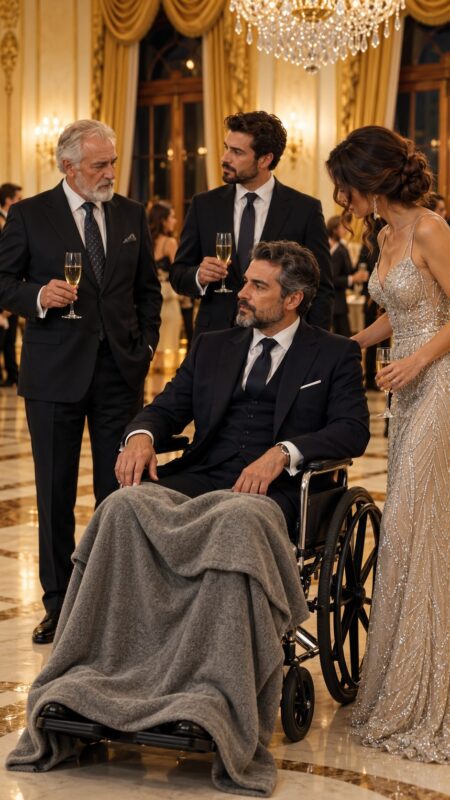
Vanessa stood beside my wheelchair, her expensive evening gown shimmering beneath the chandeliers. She wore the confident smile of someone who believed she could say anything without consequences.
Nearly a hundred guests watched the humiliation unfold.
A few chuckled awkwardly. Others turned their faces away, unwilling to become involved.
I remained seated, my hands resting on the armrests, a dark-gray blanket covering my legs.
My uncle Martin stood near the fireplace, avoiding my gaze. Daniel, my closest business associate for fifteen years, suddenly found his phone fascinating.
Neither said a word.
Then Clara, my longtime housekeeper, stepped forward.
She gently adjusted my blanket and placed a reassuring hand on the back of my wheelchair.
“Please don’t let her words hurt you, sir,” she said softly. “Nothing about your circumstances makes you less deserving of respect.”
Vanessa burst into mocking laughter.
“How touching! Even the cleaning lady thinks she needs to defend you!”
Clara didn’t retreat.
And in that moment, I knew the evening had reached its turning point.
**Because there was one thing nobody in that ballroom knew: I wasn’t actually unable to walk.**
In fact, I had been capable of standing the entire time.
Three weeks earlier, my car had been involved in a serious collision on a rain-soaked highway.
The vehicle was almost completely destroyed, and the emergency responders initially feared the worst.
Fortunately, my injuries were not life-changing. I suffered a broken wrist, bruising, and a mild concussion, but my spine and legs were unharmed.
My doctors expected a full recovery.
However, while I was recuperating, I discovered something far more painful than any physical injury.
The people who claimed to love me seemed considerably more interested in my money than in my health.
Before the accident, I had spent twenty years building a successful investment company.
I owned a beautiful estate, held substantial shares in several businesses, and enjoyed a lifestyle most people could only imagine.
Vanessa adored that lifestyle.
She loved exclusive restaurants, expensive jewelry, luxury vacations, and the attention that came with being engaged to a wealthy businessman.
Martin, my uncle, had benefited from my generosity for years.
And Daniel, whom I considered almost a brother, had helped manage my business affairs.
I believed these three people would stand beside me through anything.
Then, during my recovery, I overheard conversations I was never meant to hear.
Martin wanted authority over my investment accounts.
Daniel was already discussing the possibility of replacing me as chief executive.
And Vanessa?
She was worried about whether marrying someone with a disability would interfere with the glamorous future she had imagined.
One evening, I heard her speaking on the phone.
“I didn’t agree to become somebody’s permanent caregiver,” she complained. “I wanted a husband who could take me around the world, not someone I’d have to push around.”
Her words left me stunned.
For the first time, I questioned whether the relationships I had trusted were genuine.
That was when I made a deeply flawed decision.
Although my doctors knew I could walk, I allowed my relatives and associates to believe the accident had left me with a permanent mobility impairment.
My attorney knew the truth and warned me that such deception could damage innocent relationships.
I ignored his warning.
I wanted to discover who would remain loyal if they believed I could no longer offer the same power, prestige, and lifestyle.
At first, Vanessa performed her role beautifully.
Whenever guests visited, she sat beside me, held my hand, and spoke about the strength of our relationship.
She even told friends that nothing could separate us.
But the moment we were alone, her warmth disappeared.
She stopped discussing our wedding with excitement.
She began sleeping in a separate bedroom.
And whenever I needed assistance, she reacted as though I had personally inconvenienced her.
Meanwhile, Martin pressured me to sign documents granting him greater control over my finances.
Daniel gradually excluded me from company meetings.
Neither seemed interested in what I actually wanted.
They treated my supposed inability to walk as though it had somehow erased my intelligence and judgment.
Clara was different.
She had worked in my home for nearly eight years, and her kindness never depended on my circumstances.
She offered help without making assumptions about what I could or couldn’t do.
She listened when I wanted to talk and gave me privacy when I needed silence.
Most importantly, she never treated me as a burden.
Once, when I thanked her for her patience, she smiled.
“You’ve always treated the people in this house with consideration, sir. You deserve the same.”
I had no idea how much those words would eventually mean to me.
Then Vanessa announced an enormous reception at my estate.
She claimed it would be a celebration of my recovery.
I suspected she had another reason.
Still, I agreed.
On the evening of the event, the mansion glittered with crystal chandeliers, fresh flowers, and elegant decorations.
Business partners mingled with wealthy acquaintances while waiters carried trays of refreshments through the ballroom.
Vanessa appeared radiant in a fitted emerald gown.
For the first hour, she behaved like the perfect hostess.
Then, after several drinks, her carefully maintained image began to collapse.
She approached my wheelchair in front of everyone.
“Ladies and gentlemen,” she announced, raising her glass, “I think it’s time we stopped pretending.”
Conversations faded.
I looked up at her.
“Pretending what, Vanessa?”
She gave me a contemptuous smile.
“That everything is perfectly fine!”
She pointed toward me.
“Look at the man I agreed to marry. He used to be confident, successful, and powerful. Now he spends his days sitting there while everyone else takes care of him!”
An uncomfortable silence filled the room.
“Vanessa, that’s enough,” I said quietly.
But she wasn’t finished.
“I’ve sacrificed enough already! Do you understand what it’s like to be engaged to someone who can’t even walk into a room without assistance?”
I glanced toward Martin.
He stared at the floor.
Daniel turned away.
Not one person intervened.
Vanessa continued, growing increasingly bold.
“Perhaps you should finally accept reality and let someone capable run your company!”
Then she reached down and yanked the blanket from my knees.
“I wanted a partner, not a responsibility!”
A shocked murmur passed through the crowd.
Before I could respond, Clara hurried forward.
She retrieved the blanket and carefully placed it back over my legs.
“Miss Vanessa, please stop,” she said firmly. “You have no right to speak to him like that.”
Vanessa glared at her.
“And who asked for your opinion? You’re just the housekeeper!”
Clara straightened.
“That doesn’t mean I should stand here and watch someone be humiliated.”
For several seconds, nobody spoke.
I looked at Vanessa and asked one final question.
“If I could walk again tomorrow, would you still want to marry me?”
She rolled her eyes.
“What a ridiculous question!”
“Answer it.”
“Of course things would be different if you could walk!”
I studied her expression.
“So the man I am matters less than what my body can do?”
“Stop trying to make me look terrible!”
I nodded slowly.
There was nothing more to discuss.
I took the blanket from my knees and folded it carefully.
Then I placed my hands on the armrests and shifted forward.
My feet touched the marble floor.
I straightened my back.
And stood.
For an instant, the entire ballroom seemed to stop breathing.
Someone gasped.
A guest’s glass slipped from their hand and shattered against the floor.
Vanessa’s eyes widened.
Martin stared at me as though he were seeing a ghost.
Daniel looked completely stunned.
I stepped away from the wheelchair.
Then I took another step.
And another.
Vanessa stumbled backward.
“How are you doing that?”
I stopped directly in front of her.
“Because I never lost the ability to walk.”
Her face drained of color.
“You’ve been lying to us?”
“Yes,” I replied. “And I was wrong to do it.”
She stared at me in disbelief.
“Do you realize what you’ve put everyone through?”
“I do. And I’ll take responsibility for my deception.”
I paused.
“But I didn’t force you to insult me. I didn’t make Martin try to gain control of my assets. And I certainly didn’t make Daniel exclude me from decisions about my own company.”
Martin opened his mouth, but I raised my hand.
“Not now.”
Daniel lowered his head.
Vanessa suddenly changed her expression.
Her anger disappeared, replaced by an eager smile.
“Oh, darling! This is incredible!”
She hurried toward me.
“You’re better! Everything can go back to the way it was!”
She reached for my arm.
I stepped away.
“No, Vanessa.”
She blinked.
“What do you mean?”
“There’s no wedding.”
Her smile vanished.
“You can’t be serious!”
“I’ve never been more certain.”
“But I love you!”
I looked at her for a long moment.
“You loved the life you expected me to provide. The moment you thought that life might change, your respect disappeared.”
“I was upset! People say things they don’t mean!”
“Perhaps. But you chose to humiliate me in front of everyone.”
She began crying.
“Please don’t throw away everything we’ve planned!”
“Our relationship ended the moment you decided my supposed disability made me unworthy of basic kindness.”
I turned toward the guests.
“I’m sorry this evening has become so unpleasant. The reception is over.”
Nobody argued.
Within minutes, the ballroom began to empty.
Vanessa stormed upstairs to collect her belongings.
Martin attempted to explain himself, but I refused to discuss anything until my attorney could review the financial documents he had prepared.
Daniel received notice that his recent executive decisions would be independently examined.
By midnight, the mansion was quiet.
For the first time in weeks, I felt I could think clearly.
But the following morning brought a realization I couldn’t ignore.
I had exposed other people’s dishonesty by deliberately deceiving someone who had always treated me well.
Clara.
I found her in the breakfast room, arranging fresh flowers.
When she saw me walk through the doorway, she set down the vase.
“Good morning, sir.”
“Clara, may we talk?”
She nodded.
I sat across from her.
“I owe you an apology. You believed I couldn’t walk, and I allowed you to keep believing it. You offered genuine compassion, and I repaid you with a lie.”
She was quiet for a moment.
“Why did you do it?”
“Because I was afraid the people around me only valued what I could give them.”
She considered my answer.
Then she said something I would never forget.
“You shouldn’t need to pretend to be vulnerable to discover whether someone respects you. Everyone deserves dignity, regardless of what they can or cannot do.”
I lowered my eyes.
“You’re right.”
“And you shouldn’t have to prove your worth to people who refuse to recognize it.”
Her words affected me more deeply than Vanessa’s public insults ever had.
I had spent weeks trying to expose the flaws in other people’s character without fully considering my own behavior.
Clara helped me understand that trust cannot be rebuilt through manipulation.
It requires honesty, accountability, and respect.
In the months that followed, I made significant changes.
I permanently ended my engagement to Vanessa.
After reviewing the financial records, I established clear boundaries with Martin and reduced his involvement in my personal affairs.
Daniel’s professional responsibilities were reassessed, and I introduced stronger oversight within the company.
I also apologized to those who had been affected by my deception.
Clara remained an important part of my household, and I made sure her dedication and professionalism were properly appreciated.
Life gradually settled into a new rhythm.
One afternoon, while searching through a cupboard, I discovered the same gray blanket I had used during those difficult weeks.
It had been washed, folded, and placed neatly on a shelf.
I picked it up and remembered two moments from that unforgettable evening.
First, Vanessa ripping it from my legs as though my supposed disability were something shameful.
Then Clara quietly replacing it, determined to protect my dignity.
Those two actions revealed more about their characters than any speech could have.
Vanessa wasn’t wrong because she insulted someone who could secretly walk. She was wrong because she believed I couldn’t walk and decided that made me less valuable.
The guests at that party will probably remember the moment I rose from the wheelchair for the rest of their lives.
But that isn’t the memory I treasure.
I remember Clara standing beside me when she believed I needed the chair.
I remember her defending me when everyone else remained silent.
And I remember finally understanding a truth I should have known all along.
My worth had never depended on whether I could stand, how much money I possessed, or what I could offer someone else.
It existed long before my accident.
It remained unchanged while I sat in that wheelchair.
And it would have been exactly the same even if I had never stood up again.
That night didn’t teach me how to stand on my own two feet. It taught me to recognize the people who would respect me whether I stood or sat.