He Thought It Was a Routine Dispatch—Until He Saw a Child Carrying a Child
The call came in just after sunrise: possible loitering near the dumpsters by the park. Officer Michael Reyes had handled hundreds like it in his twelve years on the force. Most ended with a warning, a report, and a quiet drive back to patrol.
This one did not.
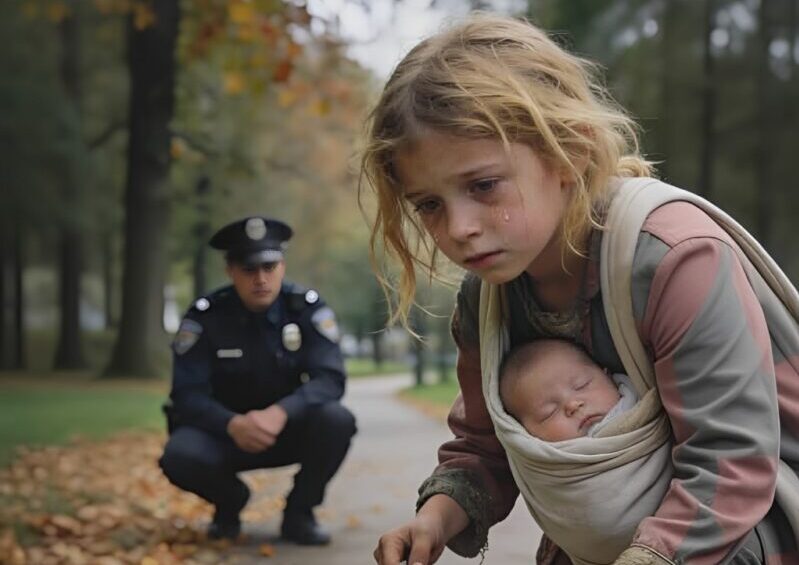
Autumn wind skimmed along the deserted street, pushing brittle leaves across fractured pavement. The neighborhood felt worn down, the brick buildings faded by time and neglect. Michael stepped from his cruiser expecting to find an adult digging for scrap.
Instead, he saw a little girl.
She was barefoot on the cold concrete, moving carefully as if each step required thought. She couldn’t have been older than five. A torn plastic bag scraped behind her, half-filled with crushed cans. Her hair was tangled, her cheeks marked with old tear tracks.
Then he noticed what she carried.
A faded blue T-shirt had been tied across her small body, forming a makeshift sling. Inside it lay a baby boy, nestled against her chest. His face was pale, his lips dry. Even asleep, he looked tired beyond his months.
Michael stopped in his tracks.
He had seen hardship before. He had witnessed hunger, addiction, neglect. But he had never seen a child shoulder the weight of another life like this—tiny hands trying to hold together a world that had already fallen apart.
The girl crouched to retrieve a dented soda can and placed it into her bag with quiet efficiency. This was not a desperate act done once. It was a practiced routine.
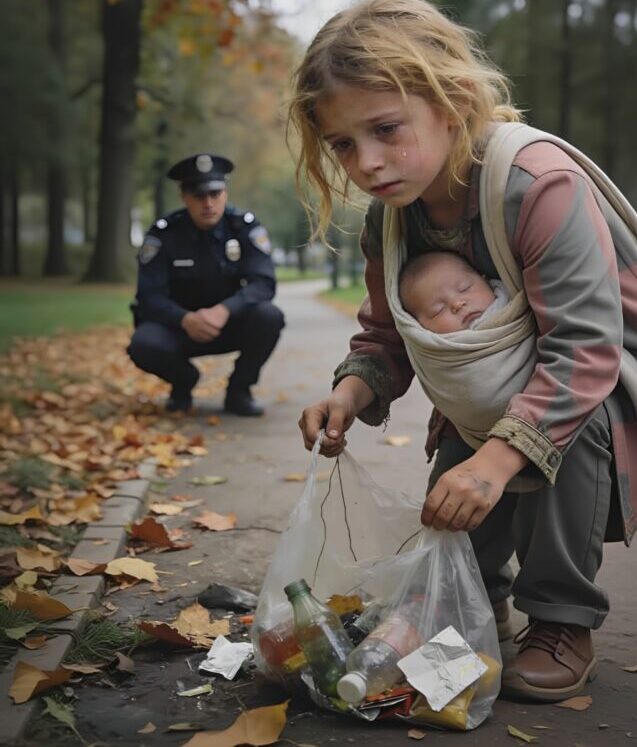
The baby shifted, letting out a faint sound. She immediately leaned forward, shielding him from the wind with her own thin frame.
That was when Michael understood: this wasn’t temporary misfortune.
This was abandonment.
She didn’t see him until he was only a few yards away. The moment her eyes locked onto his uniform, her body stiffened. Fear swept across her face—sharp and immediate.
Her gaze flickered over his badge and holster. Her hand tightened around the bag.
It wasn’t fear of a stranger.
It was fear of being taken.
Michael lowered himself slightly, making sure he didn’t tower over her. He kept his hands visible and his voice gentle.
“What’s your name?” he asked softly.
Her answer barely rose above a whisper.
She told him she and her baby brother had been staying behind the old laundromat. Their mother had gone out to find food.
She hadn’t returned.
Three nights had passed.
The girl explained in simple, careful words how she had wrapped her brother in spare cloth to keep him warm. How she tried to feed him whatever scraps she could find. Someone once told her bottles could be exchanged for coins, so she started collecting them.
Michael felt something tighten in his chest.
He thought of his own daughter—safe, warm, waiting for breakfast cartoons. The contrast felt unbearable.
The baby’s breathing was shallow. The girl’s hands trembled from cold and exhaustion. They both needed help—immediately. But Michael knew if he rushed toward them with authority, she would bolt. And if she ran, she might disappear into the city for good.
So he set the badge aside, at least in spirit.
He reached into his pocket and pulled out a granola bar he kept for long shifts. Slowly, he unwrapped it and held it out.
She hesitated, watching him carefully.
Then, after a long pause, she stepped closer and took it.
The first bite seemed to steady her. A quiet exhale slipped from her lips—almost relief.
And then she whispered the words that would echo in Michael’s mind long after that morning ended.
“Please don’t take my brother.”
Not a request for food.
Not a plea to avoid punishment.
Just that.
In that fragile sentence, he heard everything: the nights alone, the fear of sirens, the instinct to protect the only family she had left.
What happened next involved more than kindness. It required paramedics, social workers, paperwork, and long conversations. It required careful reassurance and steady patience.
But it began with something simple.
He stayed.
He didn’t treat it as another report to close or another file to archive. He knelt on cold pavement and chose compassion over procedure.
That decision changed more than one life that morning.
Because sometimes the turning point isn’t dramatic. It isn’t loud. It doesn’t come with applause.
Sometimes it is just one person refusing to walk past suffering.
Sometimes it is choosing to see.
And sometimes, that is enough to begin rewriting the future.