For hours, investigators tried to understand how Emily Parker’s car could simply vanish from Route 16.
The answer was hidden below the highway.
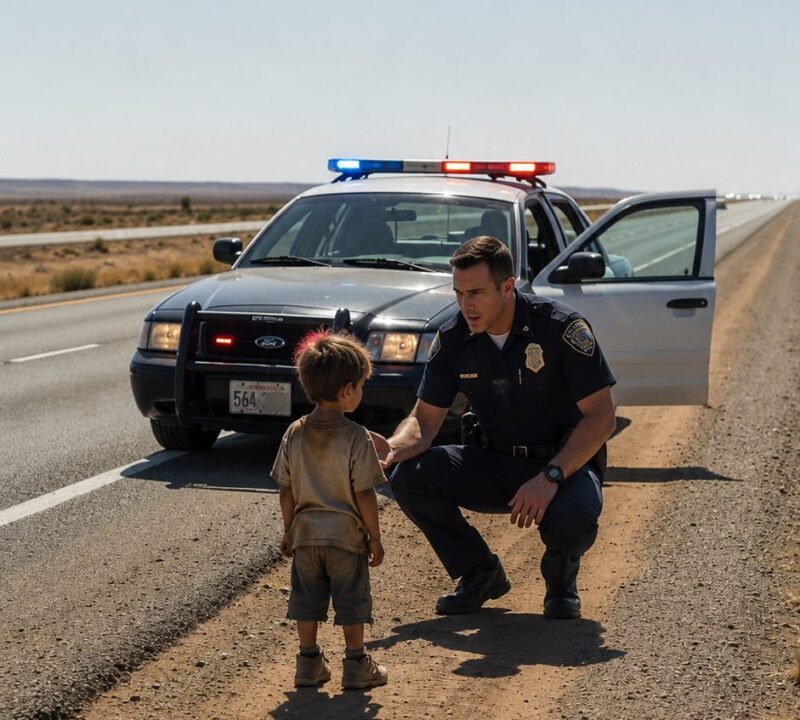
During a heavy afternoon rainstorm, Emily had entered a sharp bend, lost control, and crashed through the roadside barrier. Her vehicle tumbled down a steep ravine and came to rest beneath thick vegetation, completely invisible from the road above.
The driver’s side had taken the hardest impact.
Emily was gravely injured.
Her three-year-old son, Ethan, was still alive.
His safety seat had protected him from the worst of the crash. He was frightened and bruised, but conscious.
Emily knew she had to get him out.
Despite her condition, she pulled herself toward the back seat and managed to release Ethan from his harness. One of the windows had shattered, leaving an opening large enough for a small child.
Emily pushed her son through it.
She tried to escape after him, but her strength was fading. She made it only as far as a nearby tree before collapsing.
Ethan remained beside her.
Days passed.
The little boy survived on whatever he could find inside the damaged vehicle: crackers, candy, and a small bottle of water.
What investigators discovered around Emily told an even more painful story.
Some of the food had been placed beside her.
Ethan had been trying to share it with his mother.
Leaves covered part of her legs.
He apparently believed she was cold and had tried to keep her warm.
Eventually, their water was gone.
That was when Ethan began searching for help.
The tracks around the ravine showed what he had been doing. His footprints repeatedly traveled away from the tree before circling back toward Emily.
Each time he ventured farther, he returned.
Leaving her alone frightened him more than staying in the ravine.
But one memory remained in his mind.
His mother had told him what to do.
“Go up. Look for the lights.”
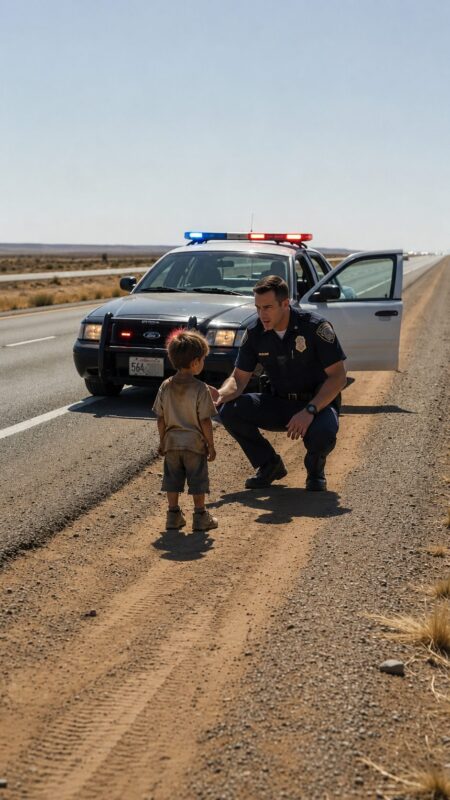
So Ethan began climbing.
The hillside was so steep that rescuers later struggled to cross it while wearing proper equipment. For a three-year-old child, the climb was enormous.
He crawled across rocks, pushed through brush, and grabbed roots and branches whenever the ground became too steep. He slipped more than once. Somewhere below the highway, one shoe came off. Then he lost a sock.
Still, he continued upward.
Eventually, the trees opened.
Ethan saw the road.
He had reached Route 16.
Vehicles rushed past the tiny barefoot boy standing near the highway.
Then one vehicle slowed.
Officer Daniel Miller had noticed him.
He stopped.
The next afternoon, Daniel went to the hospital to see the child he had found.
Ethan was sitting in bed holding a cookie.
He refused to eat it.
It belonged to his mother.
“When is Mama coming?” he asked.
Rebecca, Emily’s sister, struggled to find an answer.
A social worker sat near Ethan and carefully began asking him about the accident.
“The car went down,” Ethan said.
Then he added something that changed everything.
“Mama got me out.”
Investigators had suspected that Emily had rescued him, but Ethan’s words confirmed it.
The social worker asked what happened afterward.
Ethan lifted one small hand and pointed toward the ceiling.
“Mama said go up and find the lights.”
“So you climbed?”
“Yes.”
“Did you stay at the road?”
Ethan shook his head.
“I went back.”
“Why?”
His answer was immediate.
“Because Mama needed me.”
He looked down at the cookie.
“I told her I’d come back.”
Rebecca eventually had to explain that Emily was not going to wake up.
Ethan could not understand.
He insisted they return to the ravine and bring his mother home.
Daniel left the room quietly, unable to remain without becoming emotional in front of him.
Ethan’s bruises gradually disappeared.
Other wounds took much longer.
Rebecca noticed that food began disappearing from the kitchen. She eventually discovered crackers hidden beneath Ethan’s pillow.
He also refused to sleep without water nearby.
Closed doors frightened him.
And whenever Rebecca walked away, even briefly, Ethan asked the same question.
“You’re coming back, right?”
Every time, Rebecca answered him.
“I’m coming back.”
As part of his recovery, therapists encouraged Ethan to draw.
The pictures were remarkably similar.
There was usually a car at the bottom of a hill.
Two figures stood beside it.
Far above them was something bright.
One day, a therapist pointed toward the bright shape.
“What is that?”
Ethan answered without hesitation.
“The lights.”
Daniel remained part of his life.
During one visit, Ethan gave him a picture. It showed a tiny boy standing beside a much taller figure in uniform.
Daniel smiled.
“Who are these two?”
“That’s me and you.”
“And what’s happening?”
Ethan studied the drawing before answering.
“You found me.”
At Emily’s funeral, Ethan arrived carrying two things.
The first was the cookie he had refused to eat.
He placed it near his mother’s photograph.
“That’s for Mama.”
Then he set down his small toy car.
Rebecca asked why he wanted to leave it there.
Ethan’s answer was simple.
“In case she needs to drive home.”
Afterward, Rebecca found Daniel and thanked him.
“If you hadn’t stopped, I don’t know what would have happened.”
Daniel looked toward Ethan.
“Emily is the reason he reached that road,” he replied. “She saved him before I ever saw him.”
Rebecca and her husband later became Ethan’s guardians.
They gave him a new home without asking him to forget his first one.
Pictures of Emily remained on the walls. They spoke about her openly. As Ethan grew older, he gradually came to understand the magnitude of what she had done.
His mother had been badly injured, yet her final concern had been getting her son to safety.
Five years after the accident, Ethan encountered Daniel again during a community road-safety program.
Eight-year-old Ethan approached him carrying something made in his school workshop.
It was a small wooden plaque.
Four words had been carefully painted across it:
THANK YOU FOR STOPPING.
Daniel read it and smiled.
“You know, most officers would have done exactly what I did.”
Ethan looked directly at him.
“Maybe. But you’re the one who stopped for me.”
Daniel remembered that sentence for the rest of his career.
Ethan remembered something else.
He remembered being the child everyone else had driven past.
That memory eventually helped shape his future.
As an adult, Ethan trained to become a paramedic.
Friends sometimes asked what had drawn him to emergency medicine.
He could have told them about the ravine.
About his mother.
About climbing toward a highway with one shoe missing.
About the officer who finally noticed him.
Usually, he gave them only one sentence.
“Someone once stopped when I needed help.”
Early in his career, Ethan responded to a call involving a frightened young child who had been found alone.
When Ethan arrived, he did not rush toward the child.
He walked over slowly, lowered himself to the child’s level, and spoke gently.
“Hey. My name is Ethan. I’m here to help.”
The child stared at him for several seconds before reaching out.
Ethan lifted the child into his arms.
Suddenly, a memory returned.
A wet road.
Cold air.
Cars disappearing into the distance.
And then one person finally stopping.
Ethan held the frightened child securely.
“You’re safe with me,” he whispered.
Long ago, three people had made three choices.
Emily chose to spend what strength she had left saving her son.
Ethan chose to obey his mother and climb.
Daniel chose to notice a child beside the highway instead of simply driving past.
None of them could have known where those choices would lead.
Years later, the frightened little boy from the ravine was wearing an emergency responder’s uniform of his own.
Emily’s final instruction had once guided Ethan toward safety.
Go up.
Find the lights.
He followed them.
And when he grew older, he became the person waiting at the top for someone else.