My wife spent almost forty-eight hours turning our kitchen into a one-woman catering operation for our granddaughter’s eighteenth birthday.
Thirty-eight different dishes.
Seventy-five guests.

By the end, Gloria could barely keep her eyes open. Two of her fingers were wrapped in gauze after she burned them against the oven rack, but she still checked every platter before carrying it outside.
Then our daughter-in-law took one look at everything Gloria had prepared and said something I will never forget.
“It doesn’t really feel special enough. I booked a restaurant instead.”
Within twenty minutes, seventy-five people were gone.
They left behind thirty-eight untouched dishes—and the woman who had sacrificed two days making them.
I didn’t confront anyone.
I took a picture of the empty chairs.
Then I made a phone call.
What happened afterward changed our family permanently.
It had begun the previous morning when Tiffany arrived carrying a sheet of paper.
She handed it to Gloria.
“We’re counting on you for Kayla’s food.”
My wife scanned the page.
“How much food are we talking about?”
“Enough for seventy-five.”
I leaned over her shoulder.
The list seemed endless.
Garlic-free roast chicken. Slow-cooked beef stew. Gluten-free cornbread. Dairy-free macaroni. Vegan stuffed peppers. Croissants made from scratch. Macarons. Red velvet cake. Peach cobbler. Homemade lemonade.
And that was only part of it.
Each item came with its own request or restriction.
Gloria looked up.
“You need all of this tomorrow?”
Tiffany smiled.
“You run a restaurant, Mom. You do this every day.”
Kevin, our son, was standing beside her.
His eyes never left his phone.
He could have said, “That’s too much.”
He could have offered to pay.
He could have volunteered to help.
Instead, he stayed silent.
Gloria folded the list.
“All right.”
I knew that response well.
For forty years, I had watched my wife say yes whenever someone in our family needed something.
She cooked.
She babysat.
She remembered birthdays nobody else remembered.
She showed up when people were sick.
She helped without keeping score.
And because Gloria rarely complained, people gradually stopped noticing how much they were asking of her.
When Kevin and Tiffany drove away, I took the list from her.
“This is ridiculous.”
“It’s Kayla’s eighteenth,” she said.
“That doesn’t mean you have to exhaust yourself.”
“I want her birthday to be beautiful.”
There was no changing her mind.
We drove from store to store looking for everything Tiffany had requested.
By the time we finished, the receipt totaled $587.
When Gloria reached for her wallet, my stomach tightened.
I knew exactly where the money was coming from.
At Gloria’s Corner, the small restaurant we had built together, the main oven had become unreliable. Gloria had been putting her tips into an old coffee can for months so we could replace it.
Most of that money disappeared at the grocery store that afternoon.
By midnight, our kitchen smelled like a bakery, a diner, and a holiday dinner all at once.
Flour covered the counter.
Pots crowded the stove.
Cooling racks filled every available surface.
Gloria moved from one dish to another without stopping.
I chopped vegetables, washed bowls, carried trays, and tried to convince her to rest.
She refused.
At 1:07 a.m., her phone buzzed.
Tiffany.
More requests.
Another guest couldn’t eat dairy. Someone else needed a different side dish. A third person had changed their dietary preferences.
The final message read:
“Nothing complicated.”
I saw Gloria close her eyes for a second.
Then she tied her apron tighter.
Hours later, a gasp pulled me from the chair where I had accidentally fallen asleep.
Gloria stood beside the oven with one hand pressed against her chest.
“What happened?”
“I touched the rack.”
Two fingers were already turning red.
I grabbed a clean towel, ran it under cool water, and wrapped it gently around her hand.
“You’re finished.”
She shook her head.
“The croissants still need another batch.”
“Forget the croissants.”
“Hank.”
“Gloria, it’s four in the morning.”
She looked toward the trays.
“They’re expecting them.”
That sentence told me everything.
Not “I want to make them.”
Not “I enjoy doing this.”
They were expecting them.
I asked why she hadn’t woken me sooner.
Her answer almost made me angry—not at her, but at everyone who had learned to take her kindness for granted.
“You were sleeping so peacefully.”
There she stood, exhausted and injured, worrying about disturbing me.
When the sun came up, the food was finally ready.
Every requested dish was there.
But Gloria had added two more.
The first was tomato soup.
Kevin had loved it as a child. Whenever he came home sick from school, Gloria made him a bowl and served it with toast.
The second was peach cobbler.
When Kevin was fourteen, Gloria had taught him how to make one. He had burned the crust, spilled sugar everywhere, and declared it the greatest dessert ever created.
She remembered.
Of course she remembered.
That afternoon, we transformed the backyard.
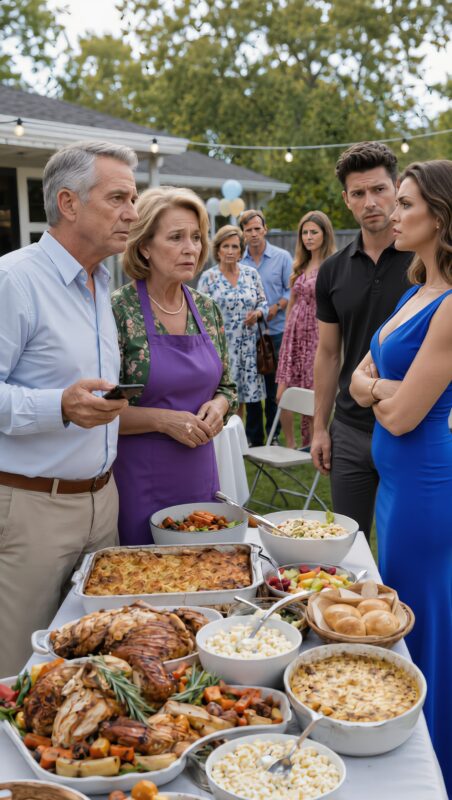
Six long tables stood beneath strings of lights and balloons. Platters covered almost every inch.
Guests began arriving until all seventy-five seats were occupied.
Gloria changed clothes and covered her injured fingers with fresh bandages.
Despite everything, she looked happy.
Then Tiffany stood.
She tapped her spoon against a glass until the conversations stopped.
“Everyone, I have a surprise!”
She announced that she had reserved a private dining room at Rosewood.
“It’s more upscale,” she explained. “Kayla only turns eighteen once, and I want tonight to feel special.”
My eyes went straight to Gloria.
Tiffany followed my gaze.
Then she gestured casually toward the food.
“You two can keep all this. Maybe freeze it or something.”
Nobody laughed.
Nobody challenged her either.
Within seconds, people started standing.
Coats were collected.
Cars were unlocked.
The backyard slowly emptied.
I watched Kevin approach the gate.
He passed the tomato soup.
Then the peach cobbler.
Two pieces of his childhood sitting on a table his mother had spent all night preparing.
He walked right by.
Not even a thank-you.
Soon, only Gloria and I remained.
Seventy-five chairs sat empty beneath the lights.
Thirty-eight dishes had barely been touched.
Gloria stood in the doorway holding a towel against her apron.
After a long silence, she said quietly, “We’ll need a lot of containers.”
Something inside me hardened.
“No, we won’t.”
She looked confused.
I pulled out my phone and took a photograph.
Empty chairs.
Full tables.
Untouched food.
Then I called a family shelter a few miles away.
“My wife prepared dinner for seventy-five people,” I said. “Would you have anyone who could use it?”
The woman on the other end went silent.
Then she said, “Yes. Absolutely.”
Volunteers arrived about an hour later.
Nothing went into the freezer.
Nothing went into the trash.
Every dish left our house.
Later that evening, the shelter sent us a photograph.
Gloria and I sat together at the kitchen table and opened it.
Families filled the shelter’s dining room.
Children were choosing macarons from a tray. A mother was cutting red velvet cake into smaller pieces for her kids. An older woman held a steaming bowl of beef stew between her hands.
Everyone was eating.
Everyone looked grateful.
There was a message beneath the photograph.
“Please thank Gloria. Tonight, seventy-five people felt as though someone had remembered them.”
Gloria covered her mouth.
Then she cried.
Not because the food was gone.
Because someone finally understood what she had actually given.
Those thirty-eight dishes weren’t ingredients arranged on plates.
They were two sleepless nights.
They were burned fingers.
They were $587 saved one tip at a time.
They were childhood memories.
They were decades of motherhood.
They were love made visible.
And our family had walked away from all of it.
That was when I knew what I needed to do.
For years, our plan had been simple.
One day, Gloria’s Corner would become Kevin’s.
We had never seriously questioned it.
He was our son.
The restaurant was our legacy.
That night, however, I realized those two things did not automatically belong together.
The following morning, I called our attorney.
We changed our estate plans.
When the time came, Gloria’s Corner would be transferred to a charitable foundation. The restaurant would continue serving paying customers, but part of its mission would be providing meals and culinary training to families facing hardship.
Gloria’s work would still become a legacy.
Just not the inheritance Kevin expected.
News traveled quickly.
Before ten that morning, my phone started ringing.
Tiffany called.
I ignored it.
Kevin called.
I ignored that one too.
He tried again.
Eventually, I answered.
“Dad, what are you doing?”
“You already know.”
“You’re changing everything because of yesterday?”
“No.”
“That was one misunderstanding!”
I glanced across the kitchen.
Gloria was holding the old coffee can she had emptied to pay for groceries. The lid had cracked, and she was repairing it with tape.
“Dad, please. You’re taking away my inheritance.”
I watched my wife smooth the tape over the dented metal.
“I’m not taking anything away from you.”
“Then what do you call this?”
“I call it choosing where our life’s work will do the most good.”
Silence.
Then I added, “Your mother spent decades feeding people because she believed food could make them feel cared for. I want this restaurant to belong to people who understand that.”
Kevin didn’t respond.
Several months later, Gloria finally replaced the old oven.
Business continued.
Life became quieter.
Then, one Saturday afternoon, the bell above the restaurant door rang.
Kayla walked in.
Alone.
She approached Gloria slowly.
“I’m sorry, Grandma.”
There was no speech.
No excuse.
Just those three words.
Then Kayla reached for one of the spare aprons hanging near the kitchen.
“Would you teach me something?”
Gloria raised an eyebrow.
“What?”
“Peach cobbler.”
For the next hour, grandmother and granddaughter stood side by side.
Kayla measured the ingredients incorrectly twice. Her crust came out uneven, and one corner browned much faster than the rest.
She looked devastated when Gloria pulled it from the oven.
But Gloria laughed.
“Don’t worry.”
Kayla stared at her.
“Your dad’s first one looked almost exactly like this.”
Kayla started laughing too.
Then the tears came.
Gloria put an arm around her.
I watched from the doorway without interrupting.
For years, I had believed love meant giving endlessly and asking for nothing in return.
Gloria had lived that way.
But I learned something from those thirty-eight abandoned dishes.
Love offered freely is a gift.
Love treated as an entitlement becomes invisible.
You cannot force people to value what you do for them.
Sometimes, words will never make them understand.
Sometimes, they only recognize the worth of something when they discover that they are no longer automatically entitled to it.
And perhaps that was the real legacy Gloria would leave behind.
Not a restaurant.
Not an oven.
Not even a recipe.
But the lesson that love deserves to be received with gratitude, not expectation.