“His own children disgraced him in front of everyone to seize his fortune… never suspecting that a cook’s little girl would rewrite his legacy forever.”
PART 1
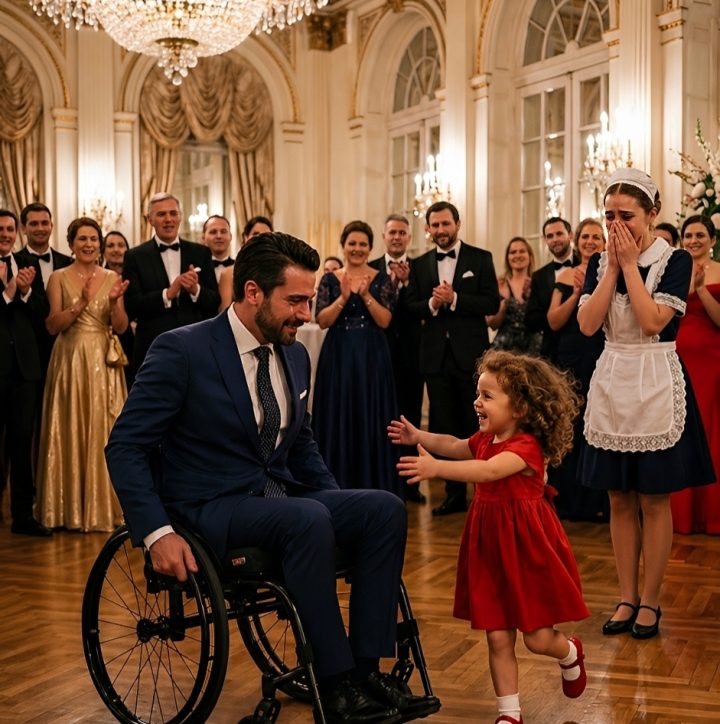
Luxury hung in the air like a heavy curtain. Deep within Jardines del Pedregal—one of Mexico City’s most prestigious enclaves—the Garza estate radiated a kind of grandeur reserved for generations of wealth. Crystal chandeliers cast shimmering light over tables dressed with white orchids, servers in white gloves moved gracefully with trays of champagne and aged family tequila, and a string quartet filled the garden with soft music. The evening marked forty years of Grupo Garza, the nation’s most powerful logistics empire. Everything appeared flawless—everything except the man who had made it all possible.
Don Arturo Garza, seventy-two, sat quietly in his wheelchair, tucked into a dim corner of the enormous hall.
Only six months earlier, a stroke had robbed him of mobility and weakened his voice, yet his mind remained razor-sharp, just as it had been when he opened his very first warehouse. Still, to the more than two hundred influential guests filling his home, he was no longer a force to be reckoned with. He had become background—an object, almost invisible, and deeply inconvenient.
The coldness of passing politicians and businessmen barely registered. What truly cut deep was the behavior of his own children, Mauricio and Fernanda. They had arranged the celebration not out of respect, but to put his frailty on display. From his shadowed corner, Don Arturo watched as Mauricio mingled with major investors, leaning in with a smug expression, occasionally glancing back at him with rehearsed sympathy.
“It’s heartbreaking,” Don Arturo overheard his son telling a banker nearby. “My father has lost touch with reality. Next week, we’ll finalize the legal declaration of incapacity. It’s for his own good—he’ll be placed in a private clinic in Cuernavaca. I’ll step in as president immediately.”
Rage surged through the old man’s chest, though his expression did not change. They weren’t just sidelining him—they were erasing him, preparing to take everything he had built. Around him stood people waiting, like scavengers, for his final breath.
Mauricio moved to the center of the room and lightly struck his glass. Conversations faded into silence.
“Friends, partners, family,” he began, his tone carefully controlled. “Tonight, we celebrate forty years of success. Sadly, as you can see, the mighty oak has fallen. My father is no longer truly with us—his mind drifts, his body fails him. And so, this evening marks a transition of leadership…”
Don Arturo tightened his fists against his lifeless legs. The humiliation was unbearable. Not a single voice rose in his defense.
Then, unexpectedly, the polished order of the evening shattered.
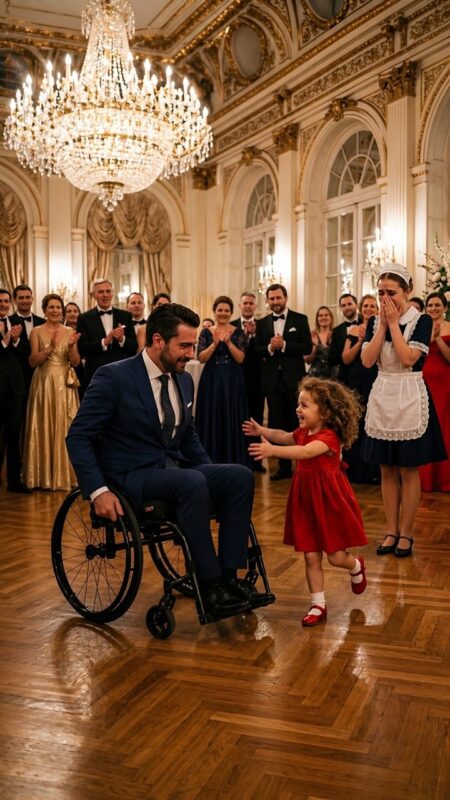
A small girl stepped forward.
It was Sofía, seven years old, the daughter of Carmela—the head cook. She wore a plain cotton dress and scuffed shoes. Ignoring both the guards and the scandalized stares of the wealthy guests, she walked straight across the floor, passing directly in front of Mauricio without hesitation. She stopped only when she reached Don Arturo.
She looked into his eyes—not seeing a fallen magnate or a useless old man, but simply a lonely grandfather.
“Excuse me, Mr. Arturo,” she said, her clear voice echoing across the silent room. “Why do your children say you’re not here if I can see you crying? Why are you all alone?”
The entire hall froze. Somewhere in the back, Carmela dropped a tray in shock and rushed forward in panic.
But before anyone could intervene, Sofía did something that stunned everyone. She gently held out her hand toward the man they claimed could no longer move.
“Don’t listen to them,” she said with a warm smile. “If you’d like… I can dance with you.”
Every gaze locked onto her small outstretched hand. Mauricio’s face flushed with anger as he stepped toward her. The room held its breath. The air turned thick, tense, charged with something about to erupt. No one anticipated how intense the next moment would be.
PART 2
The silence felt suffocating. Mauricio reached the girl, his jaw tight and his eyes burning with fury at the disruption.
“Get this child out of here immediately!” he snapped at a security guard, pointing at Sofía. “And dismiss her mother—right now!”
Carmela rushed in, trembling, her face streaked with tears.
“I’m so sorry, Don Mauricio, please forgive us!” she begged, taking Sofía by the shoulders in an attempt to pull her away. “She didn’t understand—she’s just a little girl. Please… don’t take my job…”
Before Carmela could usher her daughter toward the kitchen, a rough, guttural voice cut through the air and seemed to halt everything.
“Let her go.”
It wasn’t soft or uncertain—it carried the weight of command, an authority so strong it felt as though the mansion itself trembled.
Every guest, including Mauricio and Fernanda, slowly turned, their faces drained of color.
Don Arturo Garza—the man believed to be brain-dead, the one they had planned to send away to a care facility—had lifted his right hand. With visible effort, yet undeniable dignity, he reached for Sofía’s small hand. His fingers trembled for a moment before gripping hers with surprising strength.
“Let her go, Mauricio,” he repeated. His voice was rough from months of silence, but each word was clear and deliberate.
Mauricio staggered backward, nearly losing his balance. Fernanda gasped, her hands flying to her mouth as her champagne glass slipped from her grasp and shattered across the marble floor.
“D-dad…” Mauricio stuttered, a cold sweat breaking over him. “We thought… the doctors said you were…”
“That I was finished. That I had become a burden,” Don Arturo interrupted, pushing the wheels of his chair forward with one hand while still holding Sofía’s. “You believed you could steal from me under my own roof. You mistook my silence for weakness. In truth, it was a test.”
The music had fallen completely silent. Around two hundred members of Mexico’s elite stood frozen, like statues carved from salt.
“Music,” Don Arturo ordered the quartet, who stared at him in shock. “A bolero. Now.”
The cellist hesitated, then began to play the opening notes of “Sabor a Mí.”
Don Arturo met Sofía’s gaze. She smiled at him, calm and fearless. Slowly, keeping time with the melody, he began to move his chair, following the gentle steps of the girl beside him. Together, they turned in quiet circles at the center of the hall, under the stunned eyes of the country’s most powerful figures.
This was no celebration—it was judgment. Each turn, each faint smile he gave the child, struck like a blow against his children and every opportunist who had already dismissed him as gone. In that moment, Sofía—wearing a simple, worn dress and her unshaken innocence—seemed more regal than any of the jewel-adorned women watching in disbelief.
When the music faded, Don Arturo released her hand with care and brushed her cheek softly.
“Thank you, my dear. You’re the only genuine soul in this room full of shadows,” he murmured.
Then he turned to face his family. The sorrow that had once defined his expression was gone, replaced by something far more powerful—the fierce anger of a wounded lion.
“Mauricio. Fernanda,” he said, each name edged with cold intensity. “For six months, I have listened as you plotted against me. I heard you bribe doctors to falsify reports. I watched as every so-called friend in this room played along, waiting for their share of what you thought would be left behind.”
“Dad, you’re mistaken—it’s for your own good!” Fernanda cried, stepping forward, tears streaming down her face. “We love you. We only wanted to protect you!”
“Enough!” Don Arturo thundered, striking the armrest of his chair. “Do not insult my intelligence!”
He signaled toward the entrance. A silver-haired man in a flawless suit—barely noticed all evening—stepped forward carrying a black leather briefcase. It was Licenciado Valdés, Don Arturo’s most trusted attorney, whom the children had believed they had already turned to their side.
“Counselor, explain their situation,” Don Arturo said firmly.
The lawyer opened the briefcase, removed a set of documents, and adjusted his glasses.
“Two weeks ago, Don Arturo Garza underwent three independent neurological evaluations in the United States, conducted in strict confidence,” he announced calmly. “He was found to be fully competent. Earlier today, in the presence of a notary, he activated an emergency provision within the bylaws of Grupo Garza.”
Mauricio’s face went ashen, his breath faltering.
“W-what provision?” he asked, his voice shaking.
“The disinheritance clause for attempted fraud and breach of trust,” the lawyer replied, handing him the document. “You and your sister Fernanda have been removed from the board of directors, effective immediately. Your corporate accounts were frozen forty-five minutes ago. Additionally, Don Arturo has transferred eighty percent of his shares, along with full ownership of this residence, into an irrevocable blind trust. You will receive nothing. You are no longer part of the company. Nor are you part of this family.”
Fernanda’s scream tore through the silence. Mauricio collapsed to his knees, sobbing, reaching desperately for his father.
“You can’t do this to us! We’re your own blood!” Mauricio pleaded, his arrogance gone, reduced to a frightened child.
“Blood makes you relatives. Loyalty makes you family,” Don Arturo replied coldly. “And the only person who showed loyalty and humanity tonight does not carry my last name.”
Don Arturo lifted his gaze toward the guests, who watched the heirs’ empire collapse in pale terror.
“The party is over,” the patriarch declared. “Get out of my house. All of you.”
No one needed to be told twice. Like rats fleeing a sinking ship, politicians, businessmen, and the disowned heirs rushed toward the exits. There were no farewells, no excuses—only the sharp echo of hurried heels on marble and the roar of luxury cars vanishing into the night.
In less than twenty minutes, the vast mansion stood empty.
The echoes of music and forced laughter had vanished. Only the scent of expensive flowers remained, along with a deep, clean silence.
Don Arturo turned his wheelchair toward the back of the hall, where Carmela held Sofía close, trembling. He moved toward them.
“Carmela,” he said softly, no longer the tyrant who had just destroyed his children, “could you make me a pot of coffee? I miss the taste of cinnamon and raw cane sugar from my homeland.”
The woman nodded, unsure what to say, and walked into the large industrial kitchen. Don Arturo followed her. Away from the dazzling main hall, the kitchen felt warm and real.
As the aroma of coffee and spices filled the air, Don Arturo watched Sofía, who sat on a small stool, swinging her legs.
“I spent forty years building a glass empire,” he told Carmela as she handed him the steaming cup. “I accumulated money, houses, companies… and raised two monsters who only waited for me to fall. I surrounded myself with important people who were worth nothing. I had to end up trapped in this chair to realize I had been completely blind.”
Carmela wiped away a tear with her apron.
“Sometimes, Don Arturo, God pulls the handbrake so we can finally see the view,” she replied with simple, homespun wisdom.
He nodded, taking a sip. The taste carried him back to his childhood—before money, before greed.
“This house is too big for one man,” the millionaire said, glancing at the vast kitchen walls. “And my companies are now in the hands of a management board. I don’t want to do business anymore, Carmela. I want to do something meaningful before I die.”
He looked at her intently.
“I’m going to turn this mansion and its gardens into a boarding school and arts academy for underprivileged children—children who, like Sofía, have more light and courage in a single finger than the entire upper class of this city. But I can’t do it alone.”
Carmela’s eyes widened in shock.
“Do you want me to cook for the children, sir?” she asked humbly.
Don Arturo smiled and shook his head.
“No, Carmela. I want you to be the operations director of the foundation. You know what it means to raise a child with values and kindness. You understand what they need. I’ll provide the millions—you’ll provide the heart. We’ll be partners.”
The woman burst into tears, covering her face, unable to grasp that her life had just changed forever. Sofía stepped closer and hugged Don Arturo, and he returned the embrace, closing his eyes and feeling a peace no fortune had ever given him.
One year later.
The mansion in Jardines del Pedregal no longer appeared in business magazines, nor did it host corrupt politicians. Now its walls were filled with colorful drawings. The vast rooms had become bright classrooms, and the enormous garden had turned into a playground where more than 150 children ran and laughed every day.
Don Arturo Garza no longer wore tailored suits. He dressed in a comfortable sweater and sat in his wheelchair beneath the shade of a jacaranda tree, watching the children play.
His health had improved remarkably. He was no longer the frail old man from that night of terror. His eyes shone with renewed purpose.
Sofía, now eight years old and the star student of the music program, ran toward him with a small guitar in her hands.
“Ready for our music and dance lesson, Grandpa Arturo?” the girl asked with a wide smile.
He nodded, extending his hand to her—the same hand that, a year earlier, had broken his chains.
As the girl strummed the strings and he kept the rhythm, Don Arturo understood the greatest lesson of his life: true luxury is not having the money to buy people, but having the humility to be saved by those who have no price. Sometimes, when you lose everything in front of the world, that is when you finally find your true family.