I Became a Mother at 56 Overnight—But the Secret My Son Kept for 23 Years Changed Everything
When I reached my late fifties, I believed my life had already taken its final shape. I expected quiet years ahead—no major changes, no sudden surprises. But one freezing winter morning proved how wrong I was. A newborn was left on my doorstep, and at fifty-six, I became a mother.
Today I am seventy-nine, and my husband Harold is eighty-one. Yet what happened twenty-three years later still echoes in my memory—the moment another knock on our door revealed a truth our son had been carrying alone for years.
When Harold and I were young, life was a constant struggle. Paying rent alone was difficult, and raising children seemed impossible. We lived simply—canned soup, cheap coffee, and endless promises that someday things would improve.
But life had other plans.
A minor health issue turned into years of treatments and hospital visits. Eventually, a doctor quietly told me that I would never be able to have children. Harold and I sat in the car afterward in silence. There were no dramatic tears—only the quiet understanding that our future would look different than we once imagined.
We built a peaceful routine instead. We bought a small house in a quiet town, worked steadily, paid our bills, and took slow weekend drives through the countryside. People assumed we simply chose not to have children. It was easier to let them believe that.
Then came the winter I turned fifty-six.
One early morning I woke to a faint sound. At first I thought it was the wind outside, but the noise became clearer—a weak, trembling cry.
A baby.
“Harold, call 911!” I shouted as I rushed to the front door.
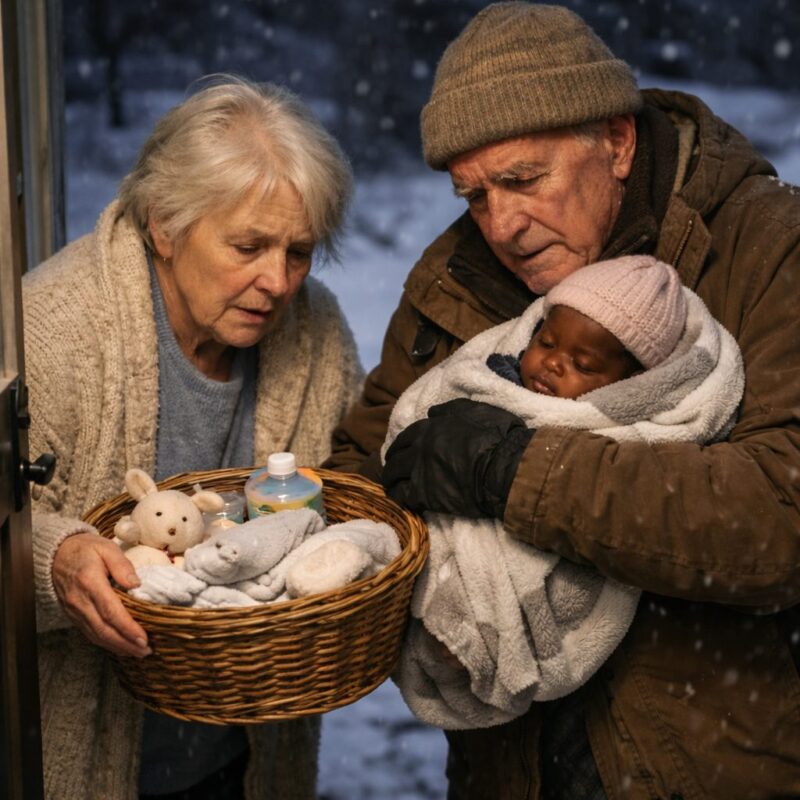
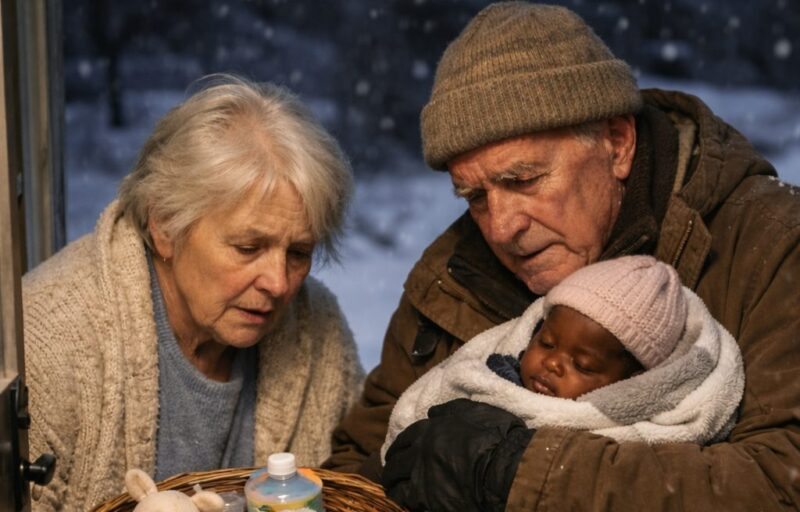
Cold air hit my face as I opened it. On the doormat sat a small basket. Inside was a newborn boy, his cheeks red from the freezing air, wrapped in a blanket so thin it barely kept him warm.
Harold quickly wrapped him in towels while I called for help. Soon the quiet street filled with flashing lights and concerned voices. The responders asked if we had seen anyone—any car, any note—but there was nothing.
They took the baby away.
It should have ended there. Just a strange and sad story we would remember occasionally. But I couldn’t stop thinking about him.
The social worker had given me a phone number “if you’d like updates.” I called that same afternoon. Then again the next day. And the day after.
Eventually she told me that if no relatives were found, the baby would enter foster care.
I looked across the kitchen table at Harold.
“We could take him,” I said quietly.
He looked surprised. “We’re almost sixty.”
“I know,” I replied. “But he needs someone.”
Harold’s eyes filled with tears. That was enough.
After months of interviews, paperwork, and home visits, we were finally approved to adopt him. We named him **Julian**.
Raising a baby in our late fifties wasn’t easy. There were sleepless nights, aching backs, and plenty of exhaustion. But every time Julian curled his tiny fingers around mine, it felt like a miracle.
We always told him the truth: he had been left at our door, and we chose him.
Julian grew into a thoughtful, kind young man—curious about the world and fiercely loyal. Sometimes he asked about the woman who had left him there.
“I hope she remembers you,” I would say. “But I know I think about you every day.”
When Julian turned twenty-three, another knock came at our door.
A woman stood outside holding a box.
“My name is Marianne,” she said calmly. “I’m Julian’s attorney. There’s something you should see.”
Inside the box were legal documents—and a photograph of a well-dressed couple standing in front of a grand estate.
“They are Julian’s biological parents,” she explained.
They had been wealthy and well-known. Doctors warned them their child might have serious health complications, and in fear they abandoned him. Years later they died in a car accident, leaving their entire fortune to their only child.
Julian.
The most surprising part was that Julian had already known about this—for years.
That evening he came over for dinner like he always did. When I mentioned the box, he sighed.
“I asked her not to come,” he said quietly. “I didn’t want that story brought into our home.”
Harold asked gently, “And the inheritance?”
Julian laughed softly. “It’s enormous. More money than I ever imagined. But every time I think about accepting it, it feels like I’m saying they were my real parents.”
Harold shook his head. “Nothing could change who we are to you.”
Julian looked at us with shining eyes.
“You pulled me inside when I was freezing,” he said. “They left me outside. That tells me everything.”
In the end, Julian decided he would rather walk away from the fortune—or donate it quietly if possible.
“I already got the best thing,” he said. “Parents who wanted me.”
That night, as he hugged us goodbye, he said something I will always carry with me:
“Family isn’t defined by blood. It’s defined by who opens the door when you’re standing in the cold.”
For years I believed I had failed at motherhood because my body couldn’t give me a child.
But the truth is, I became a mother the moment I refused to close that door.
And twenty-three years later, my son chose us just as surely as we once chose him.