“I come with four children and nothing else,” Magdalena said. “No husband. No savings. Not even a home of our own.”
Rafael glanced at the children gathered behind her, then back at Magdalena.
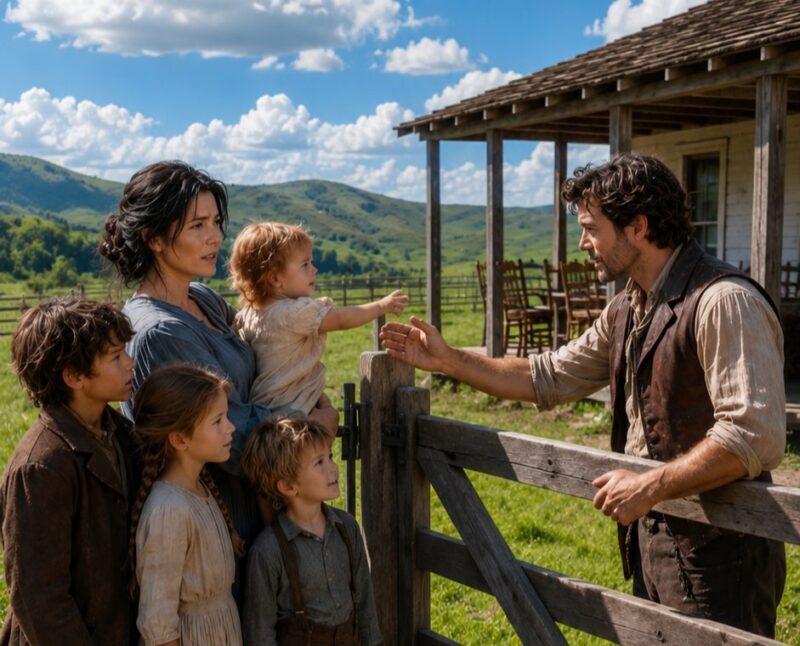
“That doesn’t sound like nothing to me.”
She tightened her arms around little Rosa.
“You don’t understand. There are five of us.”
“I understand perfectly,” he replied. “That means I need five more places at the table.”
Magdalena Duarte had arrived at Los Álamos Ranch carrying the youngest of her children against her chest. Behind her stood Daniel with a weathered bag containing their few possessions, Catalina with her drawings pressed protectively beneath one arm, and nine-year-old Tomás watching Rafael with the wary eyes of someone much older.
“I’m not asking anyone to rescue us,” Magdalena said firmly. “I can work.”
“That’s fortunate,” Rafael replied. “Because I need someone to run the household and prepare meals. The position comes with wages and rooms in the house.”
Magdalena stared at him.
“For all of us?”
Rafael opened the gate.
“I have more empty rooms than I know what to do with.”
Magdalena didn’t move immediately.
Experience had taught her to be suspicious of kindness.
Two years earlier, a mining accident had taken her husband, Miguel. Since then, she had done whatever honest work she could find—laundry, mending, cooking, cleaning—while raising four children alone.
A few men had entered her life promising security.
Every promise ended the same way.
They would look at Magdalena.
Then they would count her children.
One.
Two.
Three.
Four.
And eventually, they would leave.
To them, four children represented four problems.
Rafael saw something entirely different.
Long before Magdalena appeared at his gate, Rafael had built the ranch house with his beloved wife, Elena. They imagined children running through the hallways and filling every room with noise.
That dream ended during a terrible storm.
Elena went into labor, but the weather prevented medical help from arriving in time. Neither she nor their baby survived.
Afterward, Rafael remained alone.
For ten years, he sat at a dining table built for six.
One chair was his.
The other five remained empty.
Until Magdalena arrived.
Within weeks, the house began to change.
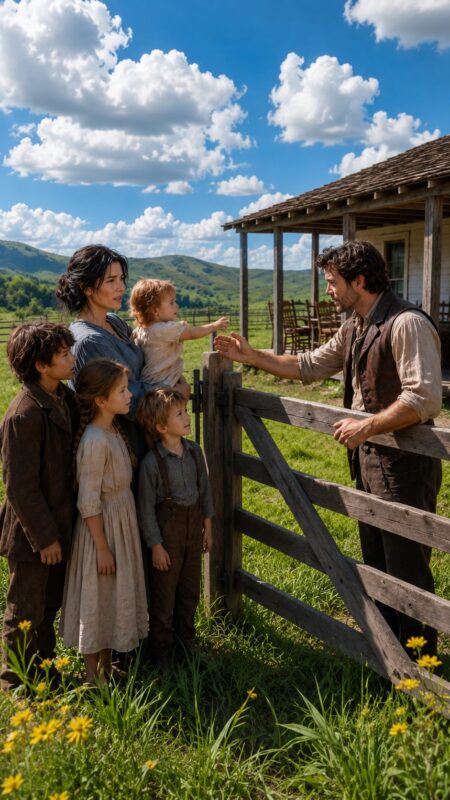
Rosa quickly decided that the seat beside Rafael belonged to her. Catalina covered the kitchen walls with pictures drawn using the colored pencils Rafael had brought her from town. Daniel became his constant shadow, following him through the barns and fields while asking more questions than Rafael could possibly answer.
The ranch was no longer quiet.
There were muddy shoes by the door.
Laughter in the kitchen.
Arguments in the hallway.
Crumbs on the table.
Toys under chairs.
Rafael loved every bit of it.
But Tomás remained cautious.
The boy had been only seven when his father died. From that day forward, he had quietly appointed himself the protector of his mother and siblings.
He watched Rafael carefully.
Tomás knew adults could make promises.
He also knew they could disappear.
Magdalena understood her son’s fear because she carried the same one.
Beneath her bed was a packed suitcase.
She never told Rafael about it.
Every night, it waited there as insurance against the day he finally decided that his peaceful life had become too crowded.
Then came the harshest winter the ranch had seen in years.
A sudden frost damaged the crops. Several animals fell ill. Repair bills mounted, and money became tight.
One afternoon, Tomás passed the barn and overheard the foreman speaking to Rafael.
“We have to cut expenses,” the man said. “There are too many people here now.”
Tomás stopped.
He didn’t stay long enough to hear Rafael’s answer.
That evening, while everyone slept, the boy packed a small bundle.
A shirt.
Some bread.
And the only photograph he had of his father.
Then he slipped out of the house.
In Tomás’s mind, the solution was simple.
Five people cost more than four.
If he left, his mother and siblings would be safer.
By the time Magdalena discovered the empty bed, snow was already covering the ground.
“My son!”
Her scream brought Rafael running.
Tomás’s belongings were gone.
So was Miguel’s photograph.
Rafael immediately reached for his coat.
“I’m going after him.”
Magdalena grabbed his arm.
“You don’t have to do this.”
Rafael turned toward her.
“Yes, I do.”
“He isn’t your son.”
Something changed in Rafael’s expression.
“He is a child who lives under my roof and sits at my table,” he said. “That makes him mine to protect.”
Rafael rode into the storm.
The snow grew heavier.
He searched roads, fields, and trails until, hours later, he spotted a small figure curled against a fence.
“Tomás!”
The boy lifted his head.
His lips trembled from the cold.
“I’m not coming back.”
Rafael climbed down and wrapped his coat around him.
“Why did you leave?”
Tomás looked away.
“I heard what the foreman said. There are too many people.”
Understanding struck Rafael.
“I can work in town,” Tomás continued. “I’ll send money to Mama. Then there will be less food to buy.”
Rafael crouched until they were eye to eye.
“You thought the best way to help your family was to remove yourself from it.”
Tomás began to cry.
“My father took care of everyone,” he whispered. “Now I have to.”
Rafael’s heart broke.
“No, Tomás.”
He placed both hands on the boy’s shoulders.
“You are nine years old. Your job is not to replace your father. Your job is to grow up, make mistakes, play with your brother and sisters, and drive the adults around you crazy from time to time.”
Despite his tears, Tomás almost smiled.
“And listen carefully,” Rafael continued. “You are not an expense that needs to be eliminated. You are not an extra mouth at my table.”
He pulled the boy closer.
“For ten years, I prayed for this house to feel alive again. You and your family gave that back to me.”
Tomás looked up at him.
“You really want us there?”
Rafael nodded.
“Every single one of you.”
Something inside the boy finally gave way.
For the first time since Miguel’s death, Tomás stopped trying to be the man of the family.
For one night, he allowed himself simply to be a child.
When they reached the ranch, Magdalena rushed through the snow and pulled her son into her arms.
She held him until neither of them could speak.
Hours later, after the children were asleep, Magdalena found Rafael sitting near the fireplace.
“I don’t know how to repay you,” she said.
Rafael looked at her.
“There is nothing to repay.”
“You risked your life looking for him.”
“Of course I did.”
“Why?”
Rafael seemed surprised by the question.
“Because you don’t leave family alone in a storm.”
Magdalena’s breath caught.
“Family?”
Rafael stood and walked toward the dining room.
His hand rested on the back of one of the chairs.
“Elena and I chose this table together,” he said. “We bought six chairs because we dreamed of having a house full of children.”
He smiled sadly.
“For ten years, I sat in one chair while five remained empty.”
Then Magdalena came closer.
“You arrived at my gate believing you were bringing me four burdens,” Rafael continued. “But that’s because you’ve been counting the wrong thing.”
Magdalena looked at him.
“Tomás. Catalina. Daniel. Rosa.”
He paused.
“And you.”
Five.
Rafael pulled out the sixth chair.
“Then there’s me.”
Magdalena’s eyes filled with tears.
“Six chairs,” she whispered.
“Six people.”
She looked around the table.
“For years, I’ve been terrified that someone would decide my children took up too much space.”
Rafael shook his head.
“They didn’t take up space, Magdalena.”
He looked toward the hallway where the children slept.
“They filled it.”
Magdalena smiled through her tears.
The suitcase beneath her bed was unpacked the following morning.
The next spring, she and Rafael were married.
Trust came slowly for Tomás.
Rafael never demanded that the boy call him anything special. He simply stayed.
Through good harvests.
Through bad winters.
Through scraped knees, broken fences, school troubles, birthdays, and ordinary Tuesday dinners.
Then, one evening, Tomás reached across the table with the breadbasket.
“Here, Dad.”
He froze the instant the word escaped.
So did Rafael.
For a moment, neither spoke.
Then Rafael accepted the bread.
“Thank you, son.”
Nothing more needed to be said.
Years passed.
The children grew.
The ranch prospered.
And the house that had once been painfully silent became so crowded that one evening Magdalena stood in the dining room, laughing.
“We have a problem.”
Rafael looked up.
“What kind of problem?”
“There aren’t enough chairs anymore.”
Rafael glanced around at the family gathered before him.
Then he smiled, walked toward his workshop, and picked up his tools.
Magdalena laughed.
“What are you doing?”
“What I should have done years ago.”
He turned back toward her.
“Building a bigger table.”
And he did.
Because family isn’t measured by how much food someone eats, how much space they occupy, or how many chairs they require.
No child should ever believe the people they love would be better off without them.
And genuine love doesn’t count the people at the table and wonder who should leave.
It looks around, realizes there isn’t enough room—
and builds a bigger table.