I had survived twenty-one exhausting hours of labor and could barely lift my head when Ethan finally stepped into my hospital room.
He carried a bouquet in one hand and wore the relieved smile of a man who had spent the night terrified of losing everything.
He kissed my forehead.
Then he went to meet our daughter.
The moment he leaned over Lily’s bassinet, his expression changed.
His smile vanished.
His fingers loosened around the flowers, and the bouquet landed beside his shoes.
I tried to sit up.
“Ethan? What’s wrong?”
He didn’t seem to hear me.
He was staring at a tiny spot just below Lily’s ear.
Finally, he whispered, “How did you know?”
“Know what?”
His eyes met mine.
“You didn’t know?”
I shook my head.
That was when fear gave way to confusion.
Whatever Ethan saw in our newborn wasn’t something he disliked.
It was something he recognized.
And somehow, it terrified him.
For four years, becoming parents had been the one dream we never stopped sharing.
At first, we assumed pregnancy would happen naturally.
It didn’t.
Each negative test made the next one harder to take. Eventually, I stopped buying baby magazines and stopped discussing names because imagining a child we might never have had become unbearable.
Then one ordinary morning, two lines appeared.
I sat on the bathroom floor staring at them until Ethan came looking for me.
He saw my tears and immediately knelt down.
“What happened?”
I couldn’t speak.
I simply handed him the test.
He looked at it three times before understanding.
“Are we…?”
I nodded.
Ethan covered his mouth.
Then he pulled me against him and cried.
During the months that followed, he became completely absorbed in preparing for fatherhood.
He attended appointments, assembled the crib twice because the first attempt wasn’t perfect, and read parenting books late into the night.
His favorite ritual happened before bed.
He would place his hand against my stomach and wait.
Sometimes Lily wouldn’t move for several minutes.
Ethan never became impatient.
Eventually, there would be a kick.
“There you are,” he’d whisper.
Then he’d smile at me.
“My whole family in one room.”
I believed that sentence.
I simply didn’t realize there was another family Ethan had erased from the story.
Labor began late one evening.
By the following afternoon, I had been struggling for twenty-one hours.
Then everything changed.
A monitor began sounding.
The medical staff moved quickly.
Ethan was told to step back.
He grabbed my hand until someone separated us.
“I’m right here,” he kept saying.
Then his voice shifted toward the doctors.
“Please. Whatever you have to do, protect them both.”
The ceiling lights blurred.
Voices became distant.
Then the room disappeared.
Lily was born at 3:17 p.m.
Healthy.
I wasn’t able to properly see Ethan again until the next morning.
That’s when he brought the flowers.
And that’s when he saw the mark.
After the bouquet fell, he sank into a chair.
“I owe you an explanation.”
The seriousness in his voice frightened me.
“About what?”
“Something I told you years ago.”
He looked toward the door.
“I told you my father was dead.”
“Yes.”
“He isn’t.”
I stared at him.
Before I could respond, someone knocked.
An older man stood outside the room.
He looked to be in his sixties, with silver hair and an expression that carried equal parts hope and fear.
Ethan couldn’t look at him.
The stranger couldn’t stop looking at Ethan.
“Who is this?” I asked.
Ethan’s answer came quietly.
“His name is William.”
A pause.
“He’s my father.”
My mind struggled to catch up.
“You told me your father died when you were young.”
“I know.”
“So you’ve been lying to me our entire marriage?”
Ethan lowered his eyes.
“Yes.”
William remained near the doorway.
“I’m sorry,” he said. “I never wanted you to discover my existence this way.”
I wanted to be angry at both of them, but there was something else I needed to understand first.
“Why?”
Ethan took a long breath.
His parents had separated when he was eleven.
The breakup had been ugly, and Ethan had grown up believing William had willingly abandoned his family.
For years, he hated him.
Only as an adult did Ethan discover there had been another side to the story. William had tried to stay connected, but by then Ethan had already built his identity around believing he didn’t need a father.
After Ethan’s mother died, William tried again.
He sent letters.
Birthday cards.
Messages.
Ethan returned some and ignored the rest.
Eventually, silence became easier than reconciliation.
Twenty years passed.
When Ethan met me, telling me his father was dead seemed simpler than explaining that he’d chosen to treat him as though he were.
I looked at Lily.
“Why tell me now?”
Ethan approached the bassinet.
He gently moved the blanket away from the side of her face.
“Because of this.”
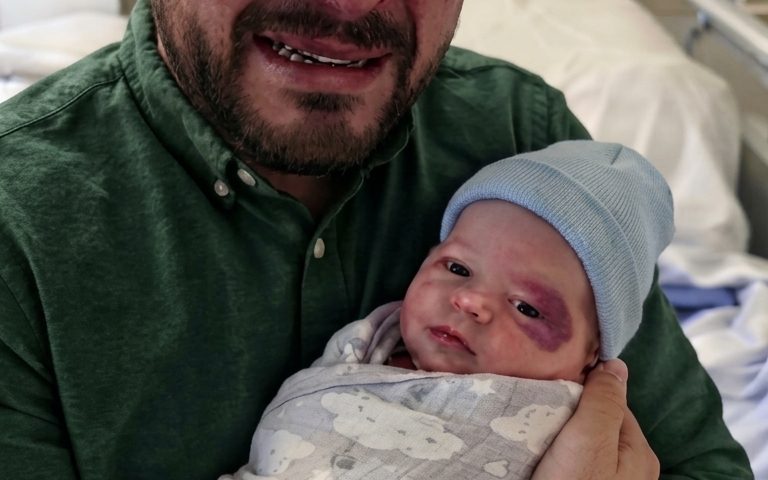
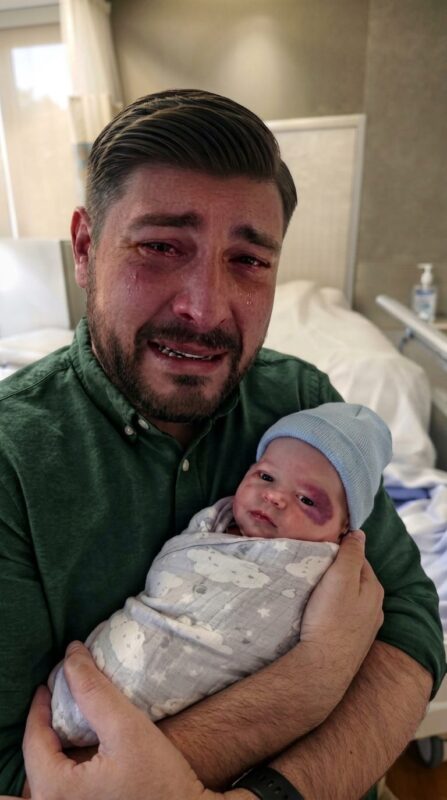
Just beneath Lily’s ear was a soft reddish mark.
I’d noticed it when the nurse first placed her beside me.
To me, it was simply another detail of my newborn daughter.
To Ethan, it meant something entirely different.
“My grandmother had that mark,” he said.
Then William turned his head.
I saw it immediately.
A faded version of the same shape rested beneath his ear.
Ethan pulled his shirt collar aside.
He had one too.
Four generations.
One tiny mark.
“When I saw Lily,” Ethan whispered, “I suddenly remembered being little and asking Grandma why we matched.”
His eyes filled again.
“I spent years convincing myself that part of my family didn’t matter.”
He looked at our daughter.
“Then she arrived carrying it with her.”
I turned toward William.
“But why are you here this morning?”
William looked at Ethan.
“Because my son called me last night.”
I couldn’t hide my surprise.
Ethan sat beside me.
“When they took you away and nobody would tell me what was happening, I thought you might die.”
He stared at our joined hands.
“I kept thinking about everything I would regret if you didn’t come back.”
Then another thought had struck him.
What if Lily someday became angry with him?
What if years passed?
What if pride became silence?
What if he repeated exactly what had happened between him and William?
So while I was still unconscious, Ethan opened his phone.
William’s number had been saved there for twelve years.
He pressed call.
“I didn’t even know whether the number still worked,” Ethan said.
William gave a faint smile.
“It worked.”
“How quickly did you answer?” I asked.
“Immediately.”
William had driven through the night.
Now he stood only a few feet from the son he hadn’t held in two decades.
Lily made a small sound from the bassinet.
William looked toward her but didn’t move.
He clearly wanted to.
He was simply waiting for permission.
“She has your family’s mark,” I said.
William nodded.
“My mother’s.”
For the first time, he smiled fully.
“She would have adored this little girl.”
I looked at Ethan.
I was still hurt.
“You should have told me about him years ago.”
“I should have.”
“You don’t get to decide which parts of your life I’m allowed to know.”
“I understand.”
“No more pretending people don’t exist because remembering them hurts.”
Ethan nodded.
“No more.”
Then I glanced toward William.
“Well?”
Ethan frowned.
“Well what?”
“He drove all night.”
Neither man moved.
So I said what both of them apparently needed someone else to say.
“Start somewhere.”
Ethan slowly stood.
He faced his father.
“I don’t know what I’m supposed to say after twenty years.”
William’s eyes filled with tears.
“You don’t need twenty years’ worth of words.”
He paused.
“One will do.”
Ethan looked at him.
“Dad.”
William broke.
He crossed the room and embraced his son.
Ethan held him back.
I watched two grown men cry over years neither of them could recover.
Nothing was magically repaired.
No letter, apology, or hug could return two decades.
But something had finally changed.
Neither of them was running anymore.
Later that morning, Lily woke.
I lifted her carefully and looked toward William.
“Would you like to hold your granddaughter?”
He stared at me as if I’d offered him something he had stopped believing he’d ever receive.
“May I?”
I placed Lily in his arms.
William’s hands trembled.
He looked down at her face, then at the small mark beneath her ear.
“Hello,” he whispered. “We’ve apparently already got something in common.”
Lily wrapped her fingers around one of his.
William laughed softly.
Ethan stood beside his father and placed a hand on his shoulder.
That was when the flowers on the floor finally made sense to me.
Ethan hadn’t recoiled because there was something wrong with our daughter.
He had frozen because Lily carried visible proof of everything he’d tried to bury.
His childhood.
His grandmother.
His father.
His own history.
His family.
For twenty years, Ethan had treated the past like a room whose door could remain permanently locked.
Then our daughter arrived carrying the key beneath her ear.
Lily couldn’t repair what had happened between her father and grandfather.
That work would belong to them.
But before she was even a day old, she gave them a reason to begin.
Twenty lost years remained lost.
The next twenty didn’t have to be.
And as I watched William hold his granddaughter while Ethan stood beside him, I realized something else.
Sometimes a family doesn’t find its way back through a grand apology.
Sometimes it begins with something much smaller.
A phone call.
A single word.
A newborn’s tiny hand.
And one little mark that nobody could erase.